Audiovisual Companion
to my Spring 2021 seminar on
Nietzsche and Modern Literature

Roderick T. Long


Nietzsche (center); Mann (upper left); Gide (upper right); Lawrence (lower left); Rand (lower right)


WEEK TEN:


Blondie! You Know What You Are?

Last week in class I mentioned the film The Good, the Bad, and the Ugly as an illustration of Nietzsche’s distinction between the good/bad opposition within master morality and the good/evil opposition within slave morality – taking “bad” in the film title to mean Nietzsche’s “evil,” and “ugly” to mean Nietzsche’s “bad.” Blondie, the “good” character, could represent the masters as seen by themselves, while Angel-Eyes, the “bad” character, could represent the masters as seen by the slaves – a lamb’s-eye-view of a bird of prey. Blondie is not “good” according to the standards of conventional morality – all three of the characters are involved in various criminal schemes and are relatively careless of other people’s lives – though he does come closer than the other two: he shows some compassion for Tuco, the “ugly” character (not overmuch, but some, whereas Angel-Eyes is devoid of compassion), and he has more of a sense of honour than either Tuco or Angel-Eyes.

Both Blondie and Angel-Eyes are “cool” – competent, confident, self-assured, gracefully minimalist in their movements, at ease with themselves, at home in their skin. Tuco, by contrast – although he does get some “cool” moments (his line “when you have to shoot, shoot; don’t talk” is cool enough in context that Blondie could have said it), and he is nearly as skilled a gunfighter as the other two – is twitchy, nervous, vindictive, constantly fidgeting, filled with bluster and resentment.

Blondie and Tuco each have a scene where he abandons the other one in the desert; but Blondie does it to Tuco in a spirit of playful mockery, leaving open a fair chance for (though not a guarantee of) Tuco’s survival, whereas Tuco does it to Blondie out of seething, vengeful, sadistic hostility – though as soon as Blondie’s survival becomes useful to him he is quick to simulate eager, fawning, dog-like affection.

Later on, when Tuco tries to hang Blondie he is deadly serious; when Blondie does the same to Tuco it is a game whose payoff is actually a final act of generosity to Tuco that Angel-Eyes would never have committed – but the game is a light-heartedly cruel one that does risk Tuco’s life. Each takes pleasure in the other’s suffering, but Tuco is thoroughly invested in and suffused with the pleasure of tormenting Blondie, whereas Blondie’s tormenting Tuco is an idle diversion, a kind of teasing, and he’s willing to slip him a lordly tip at the end of it if Tuco survives – and ultimately he’s just not obsessed with Tuco the way Tuco is obsessed with him.

Here’s the original trailer that, as I mentioned in class, mistakenly identifies Tuco as the bad and Angel-Eyes as the ugly (it also makes it seem as though the Civil War is more central to the story than it actually is; it only occupies part of the movie, and none of the three main characters has any investment in either side):


And here’s a modern trailer that gets right which characters are which:


That Cyrano Passage

A Yes, a No, a straight line, a goal.
     — Nietzsche, Twilight of the Idols I.44

A Yes, a No; to fight, or write.
     — Edmond Rostand, Cyrano de Bergerac


Last week in class I also mentioned a passage in Edmond Rostand’s Cyrano de Bergerac – incidentally Rand’s favourite play – that offers a conception of heroic independence that resonates in important ways with much that Nietzsche has to say, but which explicitly rejects the Sipo Matador model that Nietzsche embraces at BGE § 258 (BW, p. 392; and see once again the image here). Where Nietzsche compares the role of “higher men” in his favoured type of society to “those sun-seeking vines of Java – they are called Sipo Matador – that so long and so often enclasp an oak tree with their tendrils until eventually, high above it but supported by it, they can unfold their crowns in the open light and display their happiness,” Cyrano by contrast disdains to “like a creeping vine on a tall tree / crawl up where I cannot stand alone”:

My soul, be satisfied with flowers
with weeds, with thorns even; but gather them
in the one garden you may call your own. ...
In a word, I am too proud to be a parasite;
and if my intellect lacks the germ that grows
towering to heaven like the mountain pine ...
I stand – not high, it may be – but alone.


Here’s the whole speech, from the excellent 1950 movie version (well, not quite the whole speech, since the movie abbreviates it, but whole enough to convey the general idea) – Cyrano is explaining why he refuses to seek patronage, curry favour with the elite, or compromise his artistic integrity in order to gain popularity or financial support:


(Of course, there’s a further complication introduced by Le Bret’s suggestion that Cyrano’s angry declaration of solitary independence is motivated by his discovery that Roxane, the woman he loves, is in love with someone else. But I don’t think we’re meant to conclude that that’s all there is to Cyrano’s speech, even if Le Bret is right that that’s part of it.). (Incidentally, Rostand died in the flu pandemic of 1918 – an unhappy link between his time and our own.)

I mentioned last week that both Lawrence and Rand likewise find the Sipo Matador model unappealing and are looking for an approach to heroic individualism that, while capturing much of Nietzsche’s conception of heroic individualism, dispenses with the strand in Nietzsche that celebrates subjugation, in favour of something more like Cyrano’s vision of being “too proud to be a parasite.” (And I think there are strands in Nietzsche that favour the Cyranoesque approach too; he is complicated, as always.)

That’s not to say that either Lawrence or Rand frees themselves completely from the glorification of subjugation we find in the Sipo Matador strand in Nietzsche’s thought. We’ve seen in Lawrence’s 1915 political correspondence that he favoured a kind of dictatorship; and pro-subjugation and anti-subjugation strands can be found in Rand too, as the Nietzschean influence competed with the influence of Schiller, Hugo, and Rostand.

Rand herself says that her own early embrace of the pro-subjugation strand in Nietzsche was always merely metaphorical:

“[Nietzsche was] equivocal about the nature of power. I assumed he really meant spiritual power, the conquest of nature, not power over others. He is very much like the Bible, he writes poetically, and you can take it as a metaphor or not; I took it metaphorically. I believed that the superior man could not be bothered enslaving others, that slavery is immoral, that to enslave his inferiors is an unworthy occupation for the heroic man.”
— Quoted in Barbara Branden, The Passion of Ayn Rand, p. 45.


And certainly Rand would eventually declare “[r]efraining mutually from injury” to be the “fundamental principle of society” – the very move that Nietzsche condemned as “a principle of disintegration and decay.” (BGE § 259; BW, p. 393)

But the pro-subjugation theme pops up so often in Rand’s early writing that there’s room to wonder whether it really is purely metaphorical or whether Rand is engaging in retroactive self-editing when she says so. Recall Kira’s line in the 1936 edition of We the Living, excised from the 1957 edition: “If one believes one’s right, one shouldn’t wait to convince millions of fools, one might just as well force them” (although, admittedly, she does add: “Except that I don’t know, however, whether I’d include blood in my methods” – what alternative method of “forcing” does she have in mind?). Or again Kira’s 1936 line “I know no worse injustice than justice for all” – a line revised in 1957 to the more ethically palatable, if less poetically striking, “I know no worse injustice than the giving of the undeserved” – a line that would sound natural coming from Dagny, the heroine of Atlas Shriugged, but sounds a bit off coming from Kira.

As we’ll see, it’s in The Fountainhead that Rand finally places the Sipo Matador conception of individualism and the Cyranoesque (and Socratic) conception of individualism in clear opposition to each other, and declares for the latter and against the former; but even in The Fountainhead the romance of subjugation is not completely abandoned (for example, in the infamous rape scene). And in her nonfiction writings and speeches from the 1960s and 70s, her defense of Europeans’ right, as bringers of a superior culture, to displace the “savage” American Indians (or, later, the Palestinians) suggests that she may never have completely disentangled herself from it. (Many critics would also argue – in fact, I have – that the vision of heroic entrepreneurs and captains of industry in Rand’s later work unduly downplays the contributions of rank-and-file workers to a firm’s success and so in effect legitimises an inappropriate stratification of status within a capitalist economy.)


Nietzsche: Genealogy of Morals, Book II

BW, p. 502: “Don Quixote at the court of the Duchess”: In Cervantes’s novel, a Duke and Duchess offer Don Quixote and Sancho the hospitality of their court, only to subject them to a series of cruel practical jokes.

BW, p. 513: Nietzsche’s distinction here between origin and present purpose is important.

BW, p. 515: In his article “Administrative Nihilism,” Huxley charged Spencer with inconsistency: Spencer liked to compare human society with a biological organism, but Spencer was also a near-anarchist, favouring a maximum of individual liberty and a minimum of governmental direction – yet, objected Huxley:

Suppose that, in accordance with [Spencer’s] view, each muscle were to maintain that the nervous system had no right to interfere with its contraction, except to prevent it from hindering the contraction of another muscle; or each gland, that it had a right to secrete, so long as its secretion interfered with no other; suppose every separate cell left free to follow its own “interest,” and laissez-faire lord of all, what would become of the body physiological?

The fact is that the sovereign power of the body thinks for the physiological organism, acts for it, and rules the individual components with a rod of iron.


Spencer replied, in “Specialized Administration,” that Huxley had greatly underestimated the degree of spontaneous self-maintenance within the biological organism.

BW, p. 522: Nietzsche’s suggestion that the founders of the state conquered a nomadic populace runs contrary to the usual 19th-century theory of state formation (as found, e.g., in Franz Oppenheimer), according to which it is precisely because farmers are settled that they are unable to escape from the roving bands of bandits and so become the state’s first subjects.


Rand: We the Living, I. 15-17

I.15: The ABC of Communism by Nikolai Bukharin and Yevgeny Preobrazhensky appeared in 1922. I discuss it in this YouTube video:


The operettas of Kálmán Imre (a.k.a. Emmerich Kálmán – the Hungarian version of his name has the family name [Kálmán] first while the German version has the family name last) and Franz Lehár were major sources of emotional life support for Rand during her Soviet days. Here’s a sample of Kálmán’s Die Bajadere (“The Dancing Girl”) – not to be confused with Johann Strauss’s polka or Marius Pepita’s ballet of the same name:


And here’s the “Shimmy” song that was one of the inspirations for the “Song of Broken Glass”; notice a ghostly similarity between it and the previous song, despite the difference in tone:


There are a bunch of performances of this number online, but in none of them are they dancing an actual Shimmy, which looks like this:


The whole Bajadere is online, with the Shimmy song starting at 1:39:10.

Lehár’s music doesn’t make an appearance in We the Living, but here are two representative selections from his Merry Widow.


People often (reasonably enough) link Kálmán’s Bajadere, Lehár’s Merry Widow, and Strauss’s Fledermaus together as three representative samples of sparkling, effervescent Austro-Hungarian operetta; but Rand wouldn’t have, as she didn’t care for Strauss. (Her loss!)


(Nietzsche was also a fan of operetta, but he lived before the era of Kálmán and Lehár; operetta for him meant Offenbach, and such less remembered names as Audran and Massager. He shared Rand’s distaste for Strauss.)

I.16: If you have an older edition of We the Living, the words “THE PURGE” at the beginning of this chapter appear in ordinary font. If you have the newest edition, they appear in handwritten form:


There’s no editorial note announcing or explaining the change, but then the Rand estate is notoriously lax about such things. My guess is that it’s Rand’s handwriting (it looks like hers) from the original typescript, indicating her intention that the words appear as handwriting in the text, but that the publisher originally either didn’t realise this was what she wanted or else didn’t care – but that more recently, someone from the Rand estate recognised or remembered that this was what Rand wanted and so got the publisher to change it.

Irina on the star of La Traviata: “In the last act she ....” – what she does in the last act, of course, is to die of tuberculosis, the same disease from which Marussia has just died, and which is also about to menace Leo (and possibly Irina herself):


Tuberculosis was of course the disease that menaced Michel and killed Marceline in Gide’s Immoralist; and Mann set an entire novel (The Magic Mountain) in a tuberculosis sanatorium. As for Lawrence, he died of tuberculosis in real life, writing of his illness: “Piecemeal the body dies, and the timid soul / has her footing washed away, as the dark flood rises.” (Complete Poems, p. 718)

I.17: In writing about We the Living, Rand compares the Leo-Kira-Andrei triangle to the situation in Puccini’s opera Tosca, in which the heroine has to decide whether to have sex with a government official in order to save the life of the man she loves. Rand points out the crucial difference that unlike the official in Tosca, Andrei is innocent of extortion and mistakenly believes Kira loves him; by making the antagonist more admirable, Rand makes her version of the situation more “Hugoesque.”


Rand: “No”

This is a “deleted scene” from the manuscript. It’s not clear precisely where it would have gone, since the date quoted at the end does not fit the chronology of the novel as published.

To clarify: unlike the “I admire your methods” passage quoted last week, this is not a passage from the first edition that got deleted in the second; rather, like the likewise-previously-quoted “Professor Leskov” passage, it’s a passage from the draft that Rand deleted prior to the publication of the first edition.

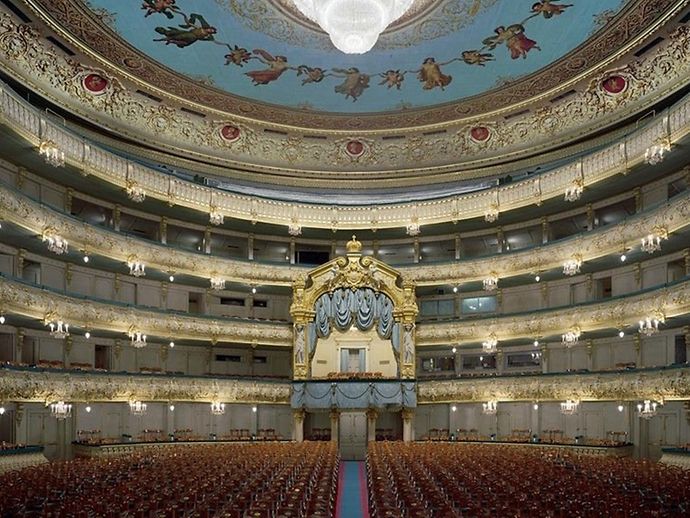
Rand describes the appearance of three St. Petersburg theatres; here they are. The Alexandrinsky, with its “chariot” and “five balconies”:


The “blue and silver” Marinsky:


And the less pretentious Mikhailovsky (you’ve already seen the interior last week, but here it is again, along with the exterior):


I found several Red Guard songs but none seemed to be the one quoted here.

I also found several songs about Vanka and Mashka, but they were all too recent. I did find a 1920s-era song, “Streetcar Number Nine,” that lacks Vanka and Mashka but has the “lamtsa-dritsa-tsa-tsa” chorus:


Nietzsche: Genealogy of Morals, Book III

BW, p. 540: On Nietzsche’s critique of the Kantian conception of aesthetic contemplation as being devoid of interest, see also the section on “immaculate perception” in Zarathustra II.15 (PN, pp. 233-266).

BW, p. 541: For more on the notion of beauty as a “promise of happiness,” see Alexander Nehamas’s book Only a Promise of Happiness: The Place of Beauty in a World of Art.

BW, p. 543: “What great philosopher hitherto has been married?” – Well, Aristotle, for one.

BW, p. 545: Venice’s Piazza di San Marco as a modern temple:


BW, p. 551: The figure of Vishvamitra in Hindu mythology can be seen as a satire, on the part of the Brahmins (the priestly class) against their chief rivals, the Kshatriyas (the royal and aristocratic warrior class). Vishvamitra is a Kshatriya ruler who devotes his life to an envious rivalry with the Brahmin holy man Vashista, beginning when he tries to steal Vashista’s magic cow; at one point Vishvamitra attempts to use the spiritual power he has accumulated through the practice of austerities, to get an “untouchable” (the lowest possible status in the caste system) person into heaven, but is unsuccessful, so he creates his own upside-down heaven. The story of Vishvamitra encapsulates the Brahmins’ vision of their upstart Kshatriya rivals: aggressive interlopers claiming authority they weren’t entitled to, and turning society upside-down with their opposition to caste privilege. It’s notable that while Hinduism exalts the Brahmin class, Hinduism’s two chief religious rivals – Buddhism and Jainism – emerged from the Kshatriya class.

BW, p. 560, n. 3: Goethe’s line encapsulates precisely Nietzsche’s reading of Spencer.


Magee: “The Turn”

p. 194: for a similar point, see my “Peeling the Self.”

p. 197: Magee really likes the “Magic Fire Music”:


Michael Berliner: “The Music of We the Living”:

Most of this I’ve already talked about (including his mistake re “John Gray”), but two more notes:

Berliner mentions Robert Stolz’s “Mucki aus Amerika” as another possible inspiration for the Song of Broken Glass. I can’t find a recording online, but you can at least see the first page (only, alas) of the sheet music here.

As Berliner notes, Herbert Küster’s “Will o’ the Wisp” (a.k.a. “Irrlicht”) came out too late to have been an inspiration, but Rand retroactively identified it as the kind of thing she was thinking of:


Rand: We the Living, II.1-17

II.1: The “implacable emperor” is Tsar Peter the Great, who had St. Petersburg built by conscript labour in the early 18th century. Rand’s description of him is rather Nietzschean. Here’s his statue:


Here’s another view of the Aleksandr III statue on Nevsky Prospekt:


I’ve shown you the Admiralty tower already.

Here’s the Anichovsky Palace:


And I’ve already shown you the Alexandrinsky Theatre.

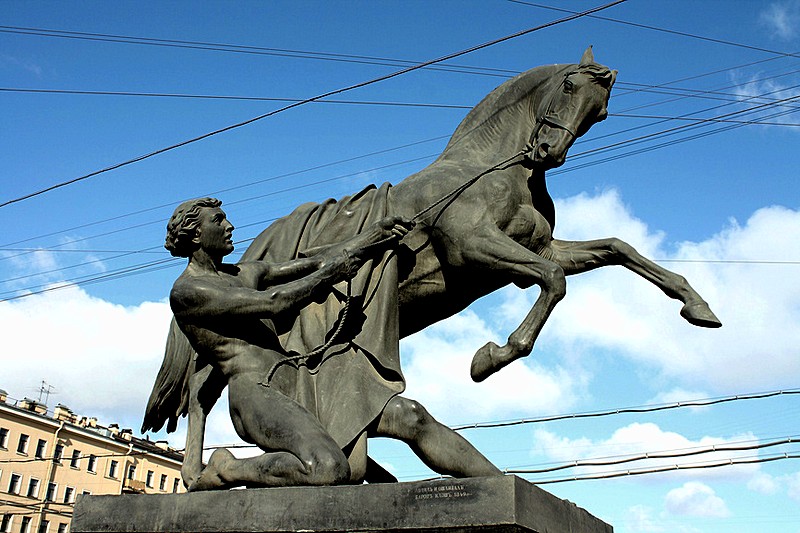
The four statues to which Rand refers are the “Horse Tamer” statues on the Anichkov Bridge over the Fotanka branch of the Neva river, designed in 1851 by Peter Clodt von Jürgensburg (1805-1867). Here they are:


Here’s a different angle on the fourth one:


And here’s the whole bridge:


Here’s the Winter Palace (which nowadays houses the Hermitage Museum):


And here’s the Peter-Paul Fortress:


The German actor with the “tense face, enormous eyes and long, thin hands” seems likely to be Conrad Veidt, one of Rand’s favourite actors:


Rand was especially fond of the 1921 film The Indian Tomb, in which Veidt played a character named Ayan, which some have suggested as an inspiration for “Ayn”:


Rand herself, however, told friends that she’d adapted the name “Ayn” from the Finnish writer Aino Kallas:


A third possible source has been suggested in the fact that the last three letters of Rand’s last name, “Rosenbaum,” in Cyrillic script look a bit like “ayn,” though I suspect the similarity would be less striking to someone familiar from childhood with both the Russian and Western alphabets, as Rand was, who would likely be attending from rather than to the shapes of the letters (in Michael Polanyi’s phrase).


“Ayn” or “Ayin” is also a letter of the Hebrew alphabet, and this too has been suggested as a source; but Rand’s identification with Jewish culture was so close to nonexistent as to render this hypothesis dubious.

As for the last name “Rand,” Barbara Branden reports that she took the name from her Remington-Rand typewriter; but this is chronologically impossible, as the Remington-Rand company was not formed until 1927, and Rand was already sporadically using the name before that.


The “American Resident” was a real 1920s toy:


II.2: Sasha Chernov was based on an unnamed friend of the Rosenbaum family who ended up being sent to a Siberian labour camp.

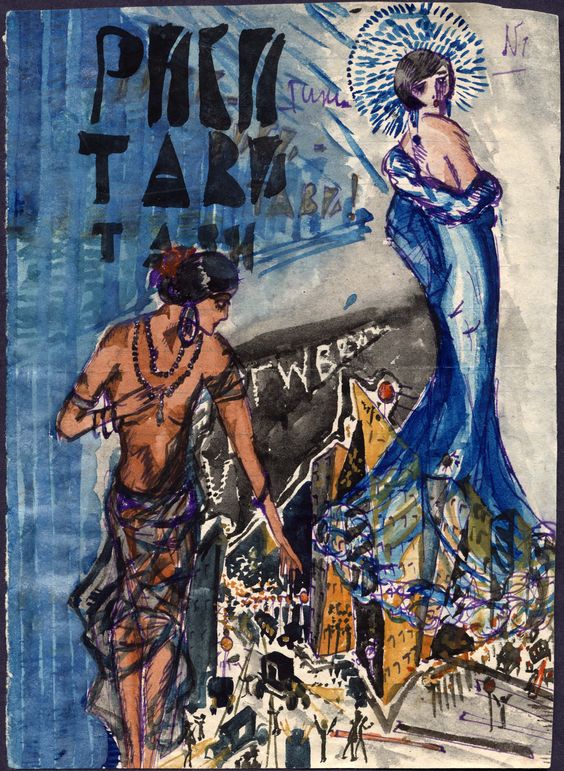
The description of Irina’s art reflects the art produced by Rand’s real-life sister Nora; here’s a sample:


Kira’s job as a museum guide mirrors Rand’s own.

II.3: Antonina Platoshkina, the woman Leo meets in the sanatorium, was based on a woman Rand had met in Crimea and whom she later got help from in Paris.

Here’s the European Hotel (Hotel Evropeiskaya; today, the Belmond Grand Hotel Europe) and its rooftop restaurant:


The orchestra plays a foxtrot from Die Bajadere:


II.5: Here’s an example of a Sèvres vase:


II.11: Here’s the Parisiana Theatre on Nevsky Prospekt, where Kira and Andrei watch the film Red Warriors:


Pudovkin’s End of St. Petersburg (1927) was released the year after Rand left Russia and so is probably not her model for Red Warriors, but it is very much the sort of movie she describes. Here’s a clip:


The whole movie’s on YouTube if you’ve got a spare ninety minutes.

Andrei and Leo have a similarly Nietzschean, homicidal look to them. Back in I.4 we were told that Leo’s mouth “was that of an ancient chieftain who could order men to die” and his eyes “were such as could watch it.” Now we’re told that Andrei has the kind of face “that could have watched secret executions in dark, secret cellars.” Once again, the influence of Lantenac and Cimourdain, the icy political rivals in Hugo’s Ninety-Three, seems likely; Cimourdain orders the execution of his dearest friend, while Lantenac gives one of his sailors an award for saving the ship from a literal loose cannon, and then has him executed for his carelessness in letting the cannon loose in the first palce.

II.13: Between 1936 and 1940, Rand wrote several versions of a play based on We the Living. (The final version, under the title The Unconquered, was staged on Broadway in 1940, though less successfully than her previous Broadway outing, Night of January 16th. The first and last versions of the We the Living play, plus excerpts from the intermediate ones, were only recently published, likewise under the title The Unconquered.) In one of them, Andrei’s final speech references Hitler:

Comrades! Look at the world we’re facing! Do you see the seeds we planted sprouting abroad in new forms? In another country, close to us, there is a man, an obscure man who is rising. He is rising upon a principle he learned from us: Man is nothing, the State is all. What if he proclaims it under another color and another name? We were the first to say it! God forgive us, we were the first to say it! We brought a gift.

The affinity between Communism and Nazism will be revisited in The Fountainhead.

II.14: “Do you suppose Lazarus was grateful when Christ brought him back from the grave ...?”: Here Rand may be inspired by the short story “Lazarus” by Leonid Andreyev (1871-1919), in which Lazarus post-resurrection leads a bleak and meaningless existence, having never truly recovered from his death experience.

In the unauthorised Italian movie version of We the Living, Andrei is killed by Pavel Syerov – which makes little sense. When she re-edited the movie, Rand cut that scene to make it look as though Andrei had commited suicide.

II.15: Here’s the official Soviet funeral song, “You Fell As a Victim”:


Here’s the Field of the Victims of the Revolution (known as the Field of Mars before the Revolution, and again after World War II):


II.16: Kira asks Leo two questions: would if he stay if he learned she’d always been loyal to him, and would he stay if he learned something that obligated him to stay. The wording suggests that these are two different items. It’s not clear what the second item she has in mind is. One obvious possibility is the revelation that she’d slept with Andrei only to get the money to save Leo, so that he owes her his life. The problem is that this item doesn’t seem sufficiently different from the first item of information, since this is precisely what would prove she’d always been loyal. Another possibility is that Kira is hinting that she’s pregnant. The idea seems obvious in context, but I have never seen anyone suggest this interpretation, perhaps because pregnancy seems so alien to Rand’s female protagonists. In any case, nothing else that Kira thinks or does suggests she is pregnant.

Lydia plays the Red Cavalry song:


“Acia is a bright child. She’ll go far.”: This seems likely to be another of Vasili’s self-delusions; Acia never shows any sign of being particularly exceptional.

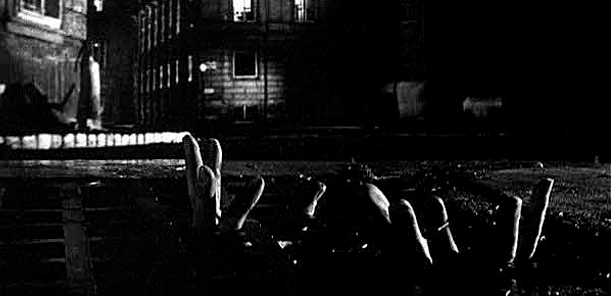
II.17: In her aforementioned stage adaptation(s) of We the Living, Rand wrote multiple versions of Kira’s death scene before finally dropping it altogether. These versions generally have Kira captured by border guards rather than simply being shot in the snow. (The idea, presumably, was to enable dialogue to replace the narrative description of Kira’s final thoughts, which works in the book but wouldn’t in a play. Probably for the same reason, when Rand edited the We the Living movie she eliminated the death scene also – though it can be viewed as a DVD extra, and is indeed rather weak.) In one poignant scene, Kira asks a guard: “Those lights ... over there ... it’s the border? ... The border of the U.S.S.R.? ... The end of it? ... And that’s abroad – there – beyond the lights? ... So close ... I ... I could touch it with my hands ....” I was reminded of Harry Lime’s tantalising taste of freedom in The Third Man, when he presses his fingers through the grate he cannot open.

Friends in low places ....


In another version, Kira gives a delirious speech before succumbing to her gunshot wound and falling lifeless to the floor:

Let me go! – I’m still alive – You’ve taken most of it already. Once, when I was very young, I wanted to be an engineer, to work and to build. You’ve taken that. I had a friend and you made me betray him. You’ve taken that. I loved someone, someone who could have lived if he’d been born there, across the border. You’ve taken that. I have nothing left. Nothing but that I know I’m still alive and I can’t give up ....

Do you see what’s around us? Do you see them closing in on us? Do you see them staring, pointing, laughing at me? All the weak, the hopeless, the useless ones of the world! All the blind eyes, the shaking hands, the still-born souls! All the botched, icy-blooded ones who huddle their skins and their sweat together to keep warm enough to stay alive! You think you’ve won? You think you’ve broken me? But I’m laughing at you! I’m alive! Come on! Who’ll fight me first! Why do you shrink? There are so many of you and I’m alone! Or is that what’s frightening you? Alone! The only title, the only crown of glory one can wear today! Stand back, you poor, unborn ghosts! You can’t stop me! ....

I can walk. I’ll walk as long as I’m alive. I’ll fight you all as long as I’m alive! .... In the name of every living thing of every living world!


The speech doesn’t quite work, and Rand was wise to excise it. But it’s interesting for a couple of reasons. First, the reference to the “botched” and “useless” shows how strong the influence of Nietzsche still was at this point in Rand’s life, before she’d freed herself from Nietzsche’s psychological determinism and his medical model of virtue and vice, and moved fully to the view that virtue and vice are chosen rather than innate.

Second, the speech is clearly modeled rather directly on Cyrano de Bergerac’s death scene in Rostand’s play (not coincidentally, Rand’s favourite play – and as I’ve hinted before, the similarity of the names “Cyrano” and “Kira” is probably not a coincidence either):


When Cyrano says “All my laurels you have riven away, and my roses,” the “laurels” are honours for his literary accomplishments, while the “roses” represent his love for Roxanne.

(Incidentally, André Gide did not share Rand’s admiration for Rostand: “The enthusiasm with which the plays of M. Rostand are received by the public makes it very plain that success and literary quality have nothing to do with each other as far as the theatre is concerned.” (quoted in Klaus Mann, p. 65) But then Gide and Rand also disagreed over the value of Hugo, and Cyrano is an especially Hugoesque play.)

The fact that Kira’s speech was so closely imitative of Cyrano’s was probably part of the reason Rand dropped it. (Kira’s line “Do you see them staring, pointing, laughing at me?“ also fits Cyrano far better than it fits Kira; Kira’s enemies don’t laugh at her especially, and if they did she would mind it less than Cyrano does.)

Rand herself did not attempt a secret escape across the border. Instead, with great difficulty (and via economic sacrifices on the part of her family, who realised that she would be unlikely to survive if she stayed in Russia), Rand managed to obtain a temporary travel visa to the U.S. This was permitted only because she convinced the Soviet authorities that she had a fiancé in Russia and so could be counted on to return. In fact she had no fiancé and no plans to return; once in the U.S., she appears to have overstayed her visa, becoming an illegal immigrant, until marriage to an American citizen finally made her safe from deportation. (In later years she would strongly oppose immigration controls.)


Rand: “Kira’s Viking”

Two more deleted scenes, one from I.3 and one (just the final paragraph) from II.17. The story of Kira’s Viking was originally told in more detail. This version suggests still more strongly that Lang’s Siegfried film was an important inspiration; the Viking’s setting out to conquer the priestess’s citadel, described as “[f]ar away in the polar seas, where the bridges of northern lights connected the waves and the clouds,” echoes Lang’s visual depiction of Brünnhilde’s Icelandic fortress, which Siegfried likewise sets out to conquer:


Rand: “The Inexplicable Personal Alchemy”

I assigned this 1969 piece because it’s one of the few nonfiction pieces in which Rand discusses Soviet Russia in personal terms (making it a nice coda to We the Living). And I assigned only the first half of it because the second half goes off on an ayn-rant about other stuff.


Nietzschean Tune of the Week

“Aus der Czarda” (“From the Czarda”). The Czarda or Csárdás is a type of Hungarian folk tune:


Back to the main page