


Audiovisual Companion
to my Spring 2021 seminar on
Nietzsche and Modern Literature

Roderick T. Long


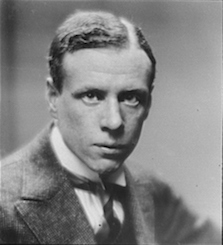
Nietzsche (center); Mann (upper left); Gide (upper right); Lawrence (lower left); Rand (lower right)


WEEK ELEVEN:


Schopenhauer’s Will and Pictorial Representation

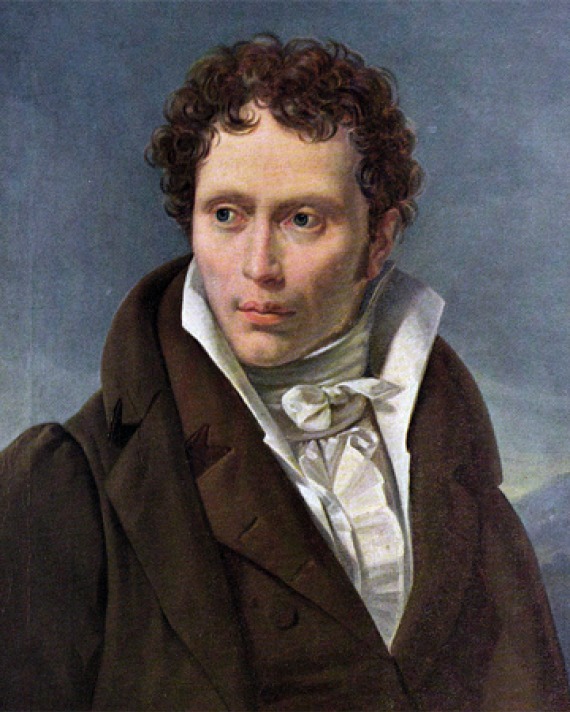
Last week we saw Nietzsche reminding us that “In all things concerning Schopenhauer’s philosophy ... one should never forget that it was the conception of a young man of twenty-six” (Genealogy III.6; BW, p. 541). He would thus think I’d ill-served you by thus far showing you only an image of Schopenhauer old:


So let me correct that now by adding an image of Schopenhauer young:


I can’t vouch for the accuracy of the painting, of course.

By the way, I’ve mentioned before the difficulty of separating the intellectual and artistic achievements of our six authors (Nietzsche, Wagner, Mann, Gide, Lawrence, Rand) from some of their particularly problematic ideas, actions, and character traits – a problem that Nietzsche himself wrestles with in relation to Wagner at Genealogy III.4 (p. 536). Schopenhauer likewise raises this problem; despite preaching an ethic of compassion, his writings are filled with a vitriolic misanthropy – including an especially vitriolic misogyny that makes Nietzsche sound like a feminist in comparison. When he saw protesters in the streets, he invited the police up to his apartment so that they could have a better shot at them from the window, He once kicked his landlady downstairs, in consequence whereof he had to pay her compensation for her lasting injuries every month for the rest of her life; when she finally died, he wrote in his diary “Obit anus, abit onus” – meaning “The old woman has died, the burden is lifted.”


Schopenhauer, Wagner, Nietzsche, Rand: A Matter of Life and Death

As I mentioned at the beginning of class on Friday, here’s a comment I should have made last week (meaning week 10 – which is actually this week as I write this, since it’s still Friday, but I’m speaking from the standpoint of the webpage ....):

By a kind of serendipity – because I didn’t plan it, it was just how reading sequentially through our various authors worked out – the readings from Nietzsche, Magee, and Rand for Friday all end up resonating with and against one another.

Wagner’s Tristan und Isolde and Rand’s We the Living both end “tragically,” with the death of the main character(s) in the very last scene – the titular Tristan and Isolde in one case, Kira in the other – and in both cases the characters nevertheless meet their deaths serenely, even joyously, perhaps even ecstatically. Yet the meanings behind their joyous deaths are very different. As Magee explains, for Wagner – channeling Schopenhauer – happiness is impossible in this life, and so Tristan and Isolde find joy only by slipping into nonexistence or undifferentiated existence in the noumenal morass (as into Hindu brahman or Buddhist nirvana, or like Mann’s Aschenbach unclenching his hands before the sea). Kira, on the other hand, in her dying moments takes comfort in precisely the opposite idea, that happiness is possible in this life.

In Nietzsche’s notes from 1888, contrasting the Christian meaning of suffering with the Dionysian-tragic meaning of suffering (PN, p. 459; also from Friday’s readings), Nietzsche maintains that “the Christian negates even the happiest life on earth .... The God on the cross is a curse on life, a pointer to seek redemption from it.” It can of course be debated whether this is the right understanding of Christianity, or of all Christianity; but it does seem to capture the Schopenhauerian-Wagnerian meaning of the Liebestod (the “love-death” – the final aria in which the dying lovers express their longing for self-annihilation). By contrast, the Dionysian meaning of suffering is that “existence is considered sacred enough to justify even a tremendous amount of suffering.” The contrast that Nietzsche is talking about seems both to illuminate and to be illuminated by the difference between Tristan and Isolde’s final moments, seeking redemption from life, and Kira’s final moments, triumphantly asserting the value of life and the possibility of happiness even in the face of death.

Rand is surely influenced by Nietzsche here – but, as I’ve argued, also by Cyrano, who as he dies, his “laurels” and “roses” having been riven away, still triumphantly maintains his “white plume” – in French, his “panache,” which has the double meaning of its original sense, an ornamental feather in one’s hat or helmet, and its modern sense of verve, flamboyance, bravura, an air of heroic grandeur (though for Cyrano also the sense of uncompromised integrity) – all of which can be related once again to Nietzsche’s idea of “giving style to one’s character.”

According to Nietzsche, “Dionysus versus ‘the Crucified One‘’ is “the main contrast.” One might equally say: We the Living versus the Liebestod. This contrast between Kira’s attitude toward life, death, and suffering and the Wagnerian-Schopenhauerian one is one of the many reasons I think it’s a mistake to think of We the Living as merely a book “about the Soviet Union” or “about Communism” or “about dictatorship” or even (its “official” theme) “about the individual versus the state” – although it is certainly about those things, just as Doktor Faustus is about music, and The Counterfeiters is about writing, and The Fountainhead is about architecture, and Atlas Shrugged is about the railroad industry, and Moby-Dick is about the whaling industry, and War and Peace is about the Napoleonic invasion of Russia, and Gone with the Wind is about the American Civil War, and Jane Austen’s novels are about women trying to find husbands – all correct characterisations, but also all inadequate. The contrast between Kira’s triumph even in the face of death with the defeat (whether resulting in literal or only spiritual death) of both Leo and Andrei engages issues of fundamental attitudes about life and suffering that transcend political concerns about state power.

Note, by the way, that in this Dionysus-versus-the-Crucified passage, the meaning of the Dionysian for Nietzsche has been somewhat reconceived. Tristan and Isolde’s flight into nirvana (or Aschenbach’s Adriatic) is precisely what Nietzsche would have called “Dionysian” during his Birth of Tragedy days, but to which he now treats the Dionysian as a foil. The Apollonian-Dionysian contrast in Birth of Tragedy was aligned with a Schopenhauerian phenomenal/noumenal contrast in which Nietzsche no longer believes, and so a reconceiving was inevitable (which is presumably why Apollo makes so few appearances in the later writings).

Incidentally, during his final mental collapse in 1889 Nietzsche sent off bizarre notes to various acquaintances, signing some of them “Dionysus” and others “The Crucified.” (See PN, pp. 684-687.) Make what you will of that.


Slip-Slidin’ Away

A play on words in last week’s readings that I neglected to point out: in Genealogy III.25 (sec. 591), Nietzsche writes: “Since Copernicus, man seems to have got himself on a inclined plane – now he is slipping faster and faster away from the center ....” The “inclined plane” is a reference to the device that early modern scientists like Galileo employed to overthrow the previously accepted laws of motion and establish the new ones (for example, Galileo’s experiments showed that, once friction is minimised, balls roll down an inclined plane at the same rate regardless of differences in their weight, contrary to what Aristotelean physics predicts).


Incidentally, although the idea that mediæval geocentric cosmology also placed humanity at the center of things metaphysically is a common view – recall for example the Cardinal’s (fictional) lines from Brecht’s play Galileo: “I am informed that Mr. Galilei transfers mankind from the center of the universe to somewhere on the outskirts. Mr. Galilei is therefore an enemy of mankind and must be dealt with as such. Is it conceivable that God would trust this most precious fruit of His labor to a minor frolicking star?” – and while that may indeed be true for some mediæval thinkers (Saadya Gaon, for example, says that in this universe that God has created, the more important stuff is toward the center), nevertheless C. S. Lewis argues, in his book The Discarded Image, that for most mediæval thinkers the intelligible universe is the inverse of the physical one.

As Lewis notes, in the mediæval model of the physical universe, the earth is at the center, and so small in comparison with everything else that it’s almost like a dimensionless point. Then come a series of concentric spheres – the atmosphere, the heavenly bodies, etc. The outermost physical layer is the first mover-that-that-is-moved. And beyond that lies God, non-physical, the first mover-that-that-is-NOT-moved.

But in the intelligible universe, of which the physical universe is merely an imperfect reflection, everything’s the other way around – a fact that Lewis sees as most clearly expressed, in literary terms, in Dante’s Divine Comedy (Inferno, Purgatorio, Paradiso), and in visual terms in such works as Raphael’s Chigi cupola. There, God, the first mover-that-is-NOT-moved, is at the center, metaphysically speaking; and being non-physical he has no magnitude and so is like a dimensionless point. (Though of course the Chigi cupola portrays him as a bit larger than that, in order to make him look like God.) Then the various heavenly bodies are concentric spheres around God; and beyond that, we poor terrestrial beings are at the outermost limit – the outskirts! So from the mediæval viewpoint, as interpreted by Lewis, it's the least important, most peripheral stuff, spiritually speaking, that’s at the (physical) center, while while what’s at the spiritual center is at the physical periphery.

If Lewis is right, that might pose a problem for Nietzsche’s “Since Copernicus” remark. (And indeed I haven’t come across any real-life condemnation of Galileo that takes the Brechtian form – although that doesn’t prove there wasn’t one.)

Here’s the Chigi cupola Lewis refers to, with its inverted cosmos – God at the center, then the celestial bodies orbiting around him, and then terrestrial matters at the outmost circumference:


Nietzsche: Twilight of the Idols 2-7

In a pun that’s even clearer in German, the title Twilight of the Idols (Götzendämmerung) is a play on Wagner’s Twilight of the Gods (Götterämmerung). The subtitle “How One Philosophises With a Hammer” conjures up bombastic images of indiscriminate destruction –


– but Nietzsche makes clear in the preface that the kind of hammer he has in mind is a tuning fork, light taps with which can determine whether an idol is hollow.

PN, p. 473: The last words of Socrates, according to Plato’s Phædo, were a request to have a rooster sacrificed to Asclepius, god of healing. Since this was typically done in gratitude for having been healed of an illness, a natural implication (though not the only possible one – for alternative [though to my mind not especially convincing] interpretations, see here and here) is that Socrates regards life as an illness for which death is the cure. Note, though, that this sentiment fits better the view of life and death in the Phædo than it does that in the Apology; and since the Apology is thought to be truer to the historical Socrates than the Phædo, these “last words” may be Plato’s invention.

PN, p. 475: “monstrum in fronte, monstrum in animo” is Latin for “monster in face, monster in mind,” meaning “if one has a monstrous face, it may be inferred that he has a monstrous mind.”

The anecdote about Socrates and the physiognomist comes from Cicero, but Nietzsche’s description of Socrates’ response is misleading (though he corrects it two pages later). According to Cicero:

Zopyrus, who claimed to discern every man’s nature from his appearance, accused Socrates in company of a number of vices which he enumerated, and when he was ridiculed by the rest who said they failed to recognize such vices in Socrates, Socrates himself came to his rescue by saying that he was naturally inclined to the vices named, but had cast them out of him by the help of reason. (Tusculan Disputations 4.80)

Again, do we not read how Socrates was stigmatized by the physiognomist Zopyrus, who professed to discover men’s entire characters and natures from their body, eyes, face and brow? He said that Socrates was stupid and thick-witted, because he had not got hollows in the neck above the collar-bone – he used to say that these portions of his anatomy were blocked and topped up: he also added that he was addicted to women – at which Alcibiades is said to have given a loud guffaw! But it is possible that these defects may be due to natural causes; but their eradication and entire removal, recalling the man himself from the serious vices to which he was inclined, does not rest with natural causes, but with will, effort, training .... (On Fate 10-11)


PN, p. 479: The suggestion here that resentment against becoming, or the desire to immortalise, makes one hostile to the study of history, is precisely the opposite of Mann’s suggestion in“Disorder and Early Sorrow.”

PN, pp. 485-486: This account of the transformation of realism into idealism and then into realism again seems to prefigure the following remarks of Wittgenstein’s:

This is the way I have travelled: Idealism singles men out from the world as unique, solipsism singles me alone out, and at last I see that I too belong with the rest of the world, and so on the one side nothing is left over, and on the other side, as unique, the world. In this way idealism leads to realism if it is strictly thought out. (Notebooks 1914-1916, p. 85)


I also see a parallel with the following saying by the 9th-century Zen Buddhist master Qingyuan Weixin:

Before I had studied Zen for thirty years, I saw mountains as mountains, and waters as waters. When I arrived at a more intimate knowledge, I came to the point where I saw that mountains are not mountains, and waters are not waters. But now that I have got its very substance I am at rest. For it’s just that I see mountains once again as mountains, and waters once again as waters.


For a similar move in a very different Buddhist tradition, see Georges Dreyfus’s book Recognizing Reality: Dharmakirti’s Philosophy and Its Tibetan Interpretations.

PN, p. 491: This passage is particularly important for the thought (expressed even more clearly here than in the Genealogy) that ressentiment involves hatred not just of strength and health but, ultimately, of reality as such. (Rand, despite disagreeing with Nietzsche about free will, would use this idea of cosmic ressentiment for the character of James Taggart in Atlas Shrugged.)

PN, pp. 492-493: One person trying to live the lifestyle appropriate to another will only destroy himself: one thinks of Michel in The Immoralist.

PN, p. 493: Virtue as an expression of, rather than as a means to producing, a healthy psychological state: this is one of the ways in which Nietzsche seems to belong to the virtue-ethical tradtion.

PN, p. 500: “perhaps by Plato already”: Nietzsche is presumably thinking of the Myth of Er in the last book of the Republic, in which disembodied souls between incarnations choose the bodies they will next inhabit.

PN, pp. 503-505: The Manu-smṛti, or “Laws of Manu,” is a Hindu legal code dating from somewhere between the 2nd century BCE and the 3rd century CE; it contains inter alia regulations for the maintenance of the caste system. Some commentators find it clear and obvious that Nietzsche is here endorsing Manu’s approach; other commentators find it clear and obvious that Nietzsche is here attacking Manu’s approach.


Rand: Red Pawn (excerpt)

In 1931 Rand took a break from writing We the Living to pen Red Pawn, a shorter tale on a similar theme (a variation on the Andrei-Kira-Leo love triangle, likewise set against the background of Soviet Russia). She successfully sold it as a screenplay to Universal, but it was never produced; the screenplay version has likewise never been published, but the long-short-story or short-novella version has been, and that’s what I’ve given you an excerpt from. (It’s intended as a treatment for the screenplay, but it’s filled – as in this excerpt – with Hugoesque descriptive detail that could hardly have been conveyed in the screenplay version.)

Red Pawn takes place on the imaginary Strastnoy (“Passion,” in the Christian theological sense) Island, in “the Arctic waters off the Siberian coast,” where a Christian monastery has been converted into a Soviet prison camp.

In real life there actually was, during the 1920s and 30s, a Christian monastery that had been converted into a Soviet prison camp, on a remote island in Arctic waters – though on the western side of Russia, not the eastern, Siberian side – namely Solovki Prison on Solovetzky Island, which was actually the nucleus of the entire Gulag system. (Appropriately enough, the Gulag Archipelago began on a literal archipelago.)


Solovki Prison is not as forbidding-looking as the one described in Rand’s story (Rand’s version has a bit more the flavour of the Château d’If), but I still suspect it influenced the tale. (During World War II, Solovki became a military base. Today it is a monastery again.) (There was also a Strastnoy monastery in Moscow that was demolished by the Soviets, and might have influenced Rand’s choice of name.)

Would Rand have been aware of Solovki Prison? I think likely yes, since two books had been published on it in the west during the 1920s, by former inmates – S. A. Malsagoff’s An Island Hell: A Soviet Prison in the Far North, and Youri Bezsonov’s Mes vingt-six prisons et mon évasion de Solovki (“My 26 Prisons and My Escape from Solovki”).

The excerpt describes the prison library, where Soviet posters have been plastered over the old Christian murals. The editor, Leonard Peikoff, takes the moral of this passage to be “the philosophic identity of Communism and religion.” To me the passage suggests contrast more than identity; though neither represents Rand’s own ideal, the Christian iconography is portrayed as beautiful, tragic, and enduring – misguided but noble – while the Soviet iconography is portrayed as crass and ephemeral. Or so I read it; but you can decide for yourself.

While the movie of Red Pawn was never made, there is a very recent motion comic version (or just-barely-motion comic version). I’m not crazy about the look of the art – both Kareyev and Fedossitch look like they shambled out of one of Universal’s 1930s monster movies – and the acting is uneven – but lo, it exists.


Rand: Ideal

Ideal – the story of a movie star who seeks to discover the degree of sincerity in her fans’ expressed admiration – was written first as the draft of a novel in 1934, immediately after We the Living (which was finished in 1934, though not published until 1936), and then (greatly improved) as a play in 1936. As a play about the movie industry, Ideal draws on Rand’s long involvement with both types of drama. While Rand is best known today for her novels and her nonfiction essays, her early career focused more heavily on work for the stage and screen.

In Russia, after graduating from college, Rand studied at the State Institute of Cinematography; her first two publications, in Russia, dealt with the world of movies (one was about the Polish movie star Pola Negri, and the other was about Hollywood; they’re both collected in her Russian Writings on Hollywood, translated by the late Dina Garmong, a former philosophy instructor here at Auburn).

Who remembers Pola Negri? Quentin Tarantino, apparently.


After coming to America, Rand held various jobs in the Hollywood film industry, working inter alia as a movie extra on the set of The King of Kings, a script editor for Cecil B. DeMille, and head of the RKO wardrobe department. Rand wrote four plays (Ideal, Think Twice, Night of January 16th, and The Unconquered), the latter two of which were produced on Broadway; and she successfully sold five screenplays (Red Pawn, Top Secret, Love Letters, You Came Along, and her own adaptation of The Fountainhead), the latter three of which were filmed – and at the time of her death she had started work on a script for a tv miniseries adaptation of Atlas Shrugged. In addition, her fiction writing often has a cinematic quality (as in this line from Fountainhead I.8: “His shadow rose from under his heels, when he passed a light, and brushed a wall in a long black arc, like the sweep of a windshield wiper”).

While Ideal does not stress the four themes (innatism, immoralism, political elitism, and subjectivism) that I identified as the early Rand’s Nietzschean inheritance, it is still one of her most Nietzschean works. Take the heroine’s lament:

“If all of you who look at me on the screen hear the things I say and worship me for them – where do I hear them? ... I want to see, real, living, and in the hours of my own days, that glory I create as an illusion! I want it real! I want to know that there is someone, somewhere, who wants it, too! Or else what is the use of seeing it, and working, and burning oneself for an impossible vision? A spirit, too, needs fuel. It can run dry.”


This sentiment seems to echo the lines that Nietzsche penned in Zarathustra II.9, in his “Night Song” (inspired by the fountain in Rome’s Piazza Barberini):

I live in my own light; I drink back into myself the flames that break out of me. I do not know the happiness of those who receive .... [T]his is my envy, that I see waiting eyes and the lit-up nights of longing. Oh, wretchedness of all givers! ... Oh, craving to crave! ... They receive from me, but do I touch their souls?


As for Gonda’s fans, who pretend – to Gonda and to themselves – to long for a greatness they are really afraid to seek, they seem to echo Nietzsche’s discussion, in Assorted Opinions and Maxims § 169 (handout, p. 251), of the “artistic need” of such people as the “half-noble who are too weak to correct the one fundamental mistake of their life,” or the “scholar, physician, merchant, official ... whose nature has as a whole never been given free rein, and who pays for this by perfoming his duties efficiently but with a worm in his heart.” And “what is it that they really desire of art? That it shall scare away their discontent, boredom and uneasy conscience for moments or hours at a time ....”

The chief inspiration for Kay Gonda herself is clearly Rand’s favourite actress, Greta Garbo, though arguably with touches of two of Rand’s other favourites, Pola Negri and Marlene Dietrich. (As noted above, Rand’s first publication, back in Russia, was a eulogy of Negri; and she campaigned (unsuccessfully) for Garbo and Dietrich to star in the film versions of, respectively, her Fountainhead and Red Pawn.)

Pola NegriGreta GarboMarlene Dietrich


In 1997, an abbreviated film version of Ideal, starring Janne Peters, was released as a DVD extra on the documentary Ayn Rand: A Sense of Life. The filmmakers drastically abridged the play, but made up for it by filming the remainder at a glacial pace. Here’s a clip:


In We the Living, the west generally, and America in particular, had been seen as an ideal to escape to, an almost-utopia free from the forces that had prevailed in Russia. The impression created was that if Kira and Leo, for example, had only managed to get to the west, Leo’s slide into depression and self-destruction would have been averted, and Kira would have been able to achieve her career goals. But in both Ideal and The Fountainhead, set in what for Rand were America’s two most iconic cities (Los Angeles and New York, respectively), the west is presented as far less idyllic; here too, malevolent forces turn out to hold sway – manifesting now mainly through social conformity and cultural malaise rather than governmental oppression – and the threats of stifled dreams, depression, and self-destruction remain. Rand’s identification of the main threat is here shifting from the political to the ethical, psychological, cultural, and aesthetic. (In her final novel, Atlas Shrugged – which, I’ve argued elsewhere, in many ways represents Rand’s attempt at Randian counterpart to Plato’s Republic – Rand will attempt to integrate it all: ethical, political, economic, psychological, cultural, aesthetic, epistemological, and metaphysical.)


Prologue: Ideal was never published or performed during Rand’s lifetime, and I don’t know whether she regarded it as finished. It strikes me as not fully polished in parts, particularly the parts where Kay Gonda is not on stage, and lesser mortals are bickering with each other. This makes the Prologue – during which Gonda is entirely absent throughout, and lesser mortals bickering with each other is the whole deal – the weakest part of the play, for me. (But the original novel version is even weaker in this regard, IMHO.)

Rand did not identify closely with her Jewish heritage, and Jewish characters are rare in her fiction; character names tend to be Celtic or Scandinavian. It’s unfortunate that her most clearly identifiable Jewish character, Sol Salzer, is an utterly generic stereotype of a Jewish Hollywood producer.

Act I, Scene 1: Another of Rand’s favourite novelists was Sinclair Lewis; many of her minor characters (though never her main heroes) seem modeled on Lewis’s. In Act I, the repressed businessman George S. Perkins is likely based on George F. Babbitt, the main character in Lewis’s 1922 Babbitt and a minor character in his 1926 Elmer Gantry. (Babbitt is also a likely inspiration for Guy Francon in The Fountainhead – while Lewis’s It Can’t Happen Here, a novel about the rise of folksy fascism in a future America, was an influence on Atlas Shrugged.)

Act I, Scene 3: Dwight Langley represents the idea (which Rand identifies as Platonic) that ideals are proper objects of ecstatic contemplation but are pragmatically unachievable on earth.

Act II, Scene 1: This condemnation of Christianity mirrors the condemnation of Communism in Act I, scene 2; both are presented as requiring the sacrifice of the higher for the sake of the lower.

The character of Essie Twomey seems based on another Sinclair Lewis character, the evangelist Sharon Falconer in Elmer Gantry. Rand must have liked the name “Essie Twomey,” since she effectively recycles it for the chief villain of The Fountainhead, Ellsworth Toohey (who is even nicknamed “Elsie”).

Here’s Lewis’s Sharon Falconer in the 1960 movie version of Elmer Gantry:

A real-life model for both Lewis’s Falconer and Rand’s Twomey was real-life Los Angeles evangelist Aimee Semple McPherson:


The character of “Sister Alice” in the recent HBO reboot of Perry Mason is also based on McPherson:


Act II, Scene 2: “Morituri te salutamus” means “We who are about to die salute you” – reportedly said by a group of Roman gladiators to the presiding Emperor Claudius, according to Suetonius and Cassius Dio.

Esterhazy seems to be a variant of Leo; but Leo’s psychic destruction was supposedly the result of Soviet repression (though clearly Leo had a weakness from the start that Kira lacked), while Esterhazy’s problems are not political. His carelessness with his property may remind us of Gide’s Michel. He also prefigures in some respects the character of Gail Wynand, the representative of false-because-too-Nietzschean individualism, in The Fountainhead.

There is no “Beverly Sunset Hotel,” but there is a world-famous Beverly Hills Hotel on Sunset Boulevard:


The hotel’s website used to feature the following inadvertently humorous line (thanks to an ambiguous pronoun) but they seem to have fixed it:

Many of our bungalows have interesting histories as well: Elizabeth Taylor honeymooned with six of her eight husbands; Marilyn Monroe and Marlene Dietrich, among others, enjoyed them as well.


Act II, Scene 3: Mrs. Monaghan is as unimaginatively stereotypically Irish as Sol Salzer is unimaginatively stereotypically Jewish. Such laziness is absent in Rand’s later work, and may be a sign that Rand hadn’t finished editing the play.

“There was a great man once who said: ‘I love those that know not how to live today.’” Gonda is quoting Nietzsche, in the Prologue to Zarathustra (PN, p. 127), though “today” is not in the original.

Act II, Scene 4: The whole sequence with Johnnie Dawes is much more pessimistic than what we would expect from the ending of We the Living – and also more pessimistic than what we will find in The Fountainhead. Does the last line suggest that Johnnie was better off dead? What would Kira think of that?


Between We the Living and The Fountainhead

As I’ve mentioned earlier, Rand’s “Nietzschean phase” is characterised by four themes which will be rejected in her later writings:

a) Innatism: treating superior character traits as largely inborn, and so necessarily restricted to a few, rather than something open to anyone to achieve.
b) Immoralism: treating those of superior character as exempt from ordinary moral rules.
c) Political elitism: more specifically, treating those of superior character as having the right to rule and dominate those of inferior character.
d) Subjectivism: an emphasis on will over reason, and on sheer personal preference over moral principle.


In particular, Rand’s early writings often portray criminals positively. In her 1940 short story “The Simplest Thing in the World,” describing a fictionalised version of her own writing process, Rand has her protagonist muse:

She can’t see anything in that window – only the silhouettes of people against the light. Only the shadows. And she sees this one man there – he’s tall and slender and he holds his shoulders as if he were giving orders to the whole world. And he moves as if that were a light and easy job for him to do. And she falls in love with him. With his shadow. ... And then, that evening, she is sitting alone on the roof, and there’s a shot, and that window is shattered, and that man leaps out onto her roof. She sees him for the first time – and this is the miracle: for once in her life, he is what she had wanted him to be, he looks as she had wanted him to look. But he has just committed a murder. I suppose it will have to be some kind of justifiable murder ... No! No! No! It’s not a justifiable murder at all. We don’t even know what it is – and she doesn’t know. But here is the dream, the impossible, the ideal – against the laws of the whole world. Her own truth – against all mankind. (Romantic Manifesto, pp. 181-182)


Here we have an apparent endorsement not only of Immoralism and Subjectivism (the hero can commit murder without need for justification) but of Political Elitism (the hero is legitimately entitled to give “orders to the whole world”).

Likewise, Bjorn Faulkner, the hero of Rand’s 1933 play Night of January 16th (which she wrote while taking a break from finishing We the Living), was based on the tycoon and massive swindler Ivar Kreuger; still more controversially, the hero of her unfinished 1927 novel The Little Street was based on a murderer, William Hickman, who abducted and dismembered a 12-year-old girl. (Though the character she based on Hickman committed a much less nasty and more sympathetic crime.)


                              Ivar Kreuger

                              William Hickman


Rand’s 1939 play Think Twice also celebrates a murder (though Rand attempts to offer a moral justification for it); and in Ideal, as we’ve seen, willingness to help a supposed murderess is a criterion of virtue (and Esterhazy himself is a swindler like Bjorn Faulkner, albeit on a smaller scale). Larry Regan, another positive character in Night of January 16th, is a literal gangster.

Contrast the later Rand, who in her 1965 essay “Bootleg Romanticism” condemns the recent movie Seance on a Wet Afternoon for “arousing compassion for kidnappers,” explaining that “pity for the guilty is treason to the innocent” (Romantic Manifesto, p. 130), or who in her 1966 essay “Art and Sense of Life” declares that any author who “demand[s] sympathy for his monsters” thereby “crawl[s] outside the limits of the realm of values.” (Romantic Manifesto, p. 40.) (Did this condemnation apply to one of her favourite writers, O. Henry, who likewise presents kidnappers sympathetically in “The Ransom of Red Chief”?)

In Night of January 16th, Bjorn Faulkner boasts about his “whip over the world.” One of his loyal servants says: “Herr Faulkner did what other people are not allowed to do. ... [W]hen little people like you and me meet a man like Bjorn Faulkner, we take our hats off and we bow, and sometimes we take orders, but we don’t ask questions.” Another character describes him as a “conqueror” with “an audacity that is its own law.” (Thus Immoralism, Subjectivism, and Political Elitism.)

In his relationship with his secretary and lover, Karen Andre, Faulkner seems to be following Nietzsche’s advice in Zarathustra I.18 (“You are going to women? Do not forget the whip!”). Karen Andre (whose name incidentally seems to merge Kira and Andrei) decribes her first day at work: “He seemed to take a delight in giving me orders. He acted as if he were cracking a whip over an animal he wanted to break. And I was afraid. ... Because I liked it.” Indeed he ends up raping her, so of course she falls in love with him. (We’ll come back to Rand’s view of rape later.)

Further evidence of Immoralism and Subjectivism may be found in the following exchange:

D.A.: – “Now tell us, didn’t Mr. Faulkner have a clear conception of the difference between right and wrong?”

KAREN ANDRE: – “Bjorn never thought of things as right or wrong. To him, it was only: you can or you can’t. He always could.”

D.A.: – “And yourself? Didn’t you object to helping him in all those crimes?”

KAREN ANDRE: – “To me, it was only: he wants or he doesn’t.”


Here once again Rand seems to be channeling Zarathustra I.18 – this time the following dictum: “The happiness of man is: I will. The happiness of woman is: he wills.” (PN, p. 179)

But is the Nietzscheanism of these passages intended literally? Rand claimed it wasn’t, and drew a distinction between Romantic Realism (her usual literary method) and Romantic Symbolism (her method in Night of January 16th specifically). Describing the events of Night of January 16th, Rand wrote:

I do not think, nor did I think it when I wrote this play, that a swindler is a heroic character or that a respectable banker is a villain. But for the purpose of dramatizing the conflict of independence versus conformity, a criminal – a social outcast – can be an eloquent symbol.

This, incidentally, is the reason of the profound appeal of the “noble crook” in fiction. He is the symbol of the rebel as such, regardless of the kind of society he rebels against, the symbol – for most people – of their vague, undefined, unrealized groping toward a concept, or a shadowy image, of man’s self-esteem.

That a career of crime is not, in fact, the way to implement one’s self-esteem, is irrelevant in sense-of-life terms. A sense of life is concerned primarily with consciousness, not with existence – or rather: with the way a man’s consciousness faces existence. It is concerned with a basic frame of mind, not with rules of conduct. If this play’s sense of life were to be verbalized, it would say, in effect: “Your life, your achievement, your happiness, your person are of paramount importance. Live up to your highest vision of yourself no matter what the circumstances you might encounter. An exalted view of self-esteem is a man's most admirable quality.”

How one is to live up to this vision – how this frame of mind is to be implemented in action and in reality – is a question that a sense of life cannot answer: that is the task of philosophy.

Night of January 16th is not a philosophical treatise on morality: that basic frame of mind (and its opposite) is all that I wanted to convey. (Night of January 16th, Introduction, pp. 2-3)


In similar vein, Rand writes elsewhere:

In Sienkiewicz’s Quo Vadis, the best-drawn, most colorful character, who dominates the novel, is Petronius, the symbol of Roman decadence – while Vinicius, the author’s hero, the symbol of the rise of Christianity, is a cardboard figure.

This phenomenon – the fascinating villain or colorful rogue, who steals the story and the drama from the anemic hero – is prevalent in the history of Romantic literature, serious or popular, from top to bottom. It is as if, under the dead crust of the altruist code officially adopted by mankind, an illicit, subterranean fire were boiling chaotically and erupting once in a while; forbidden to the hero, the fire of self-assertiveness burst forth from the apologetic ashes of a “villain.” (Romantic Manifesto, p. 115)


(I told you above that we’d come back to Petronius; and we’ll be seeing him yet again later.)

But We the Living, as a more “serious” work than Night of January 16th, might be expected to be more philosophically precise. So what was the role of Kira’s Nietzschean pronouncements that Rand later deleted from the second edition – and why did Rand delete them? (And why did she claim that her revisions were “merely editorial line changes”?)

There are (at least) two possible interpretations of Rand’s Nietzschean phase. One is that, as she claims, her celebration of crime and aggression was merely symbolic. The other is that she originally meant it literally, and that her later self-reinterpretation was merely a cover. In favour of the “merely symbolic” reading is Kira’s reluctance, in the “I admire your methods” passage, to “include blood in [her] methods.” If she’s not willing to endorse the spilling of blood, then first-edition Kira’s description of the masses as “mud to be ground under foot” and “fuel to be burned” can hardly be literal.

A third possibility is that the truth lies somewhere between the two. Perhaps the early Rand was attracted to Nietzschean rhetoric while being genuinely unsure how far she wanted to endorse it literally.

By the way, there’s a 1941 movie version of Night of January 16th, but it has only a vague relation to the original play:


In Rand’s 1937 prose poem Anthem, the chief Nietzschean influence is stylistic; its cadences echo those of Zarathustra:

I stand here on the summit of the mountain. I lift my head and I spread my arms. This, my body and spirit, this is the end of the quest. I wished to know the meaning of things. I am the meaning. I wished to find a warrant for being. I need no warrant for being, and no word of sanction upon my being. I am the warrant and the sanction.

It is my eyes which see, and the sight of my eyes grants beauty to the earth. It is my ears which hear, and the hearing of my ears gives its song to the world. It is my mind which thinks, and the judgment of my mind is the only searchlight that can find the truth. It is my will which chooses, and the choice of my will is the only edict I must respect.

Many words have been granted me, and some are wise, and some are false, but only three are holy: “I will it!”


There are some Subjectivist aspects in this passage. As I’ve noted elsewhere:

Equality 7-2521, after rediscovering the concept of the ego, declares that “the choice of my will is the only edict I must respect” – a stance that the later Rand would denounce as “whim-worship,” insisting on the normative primacy of reason over will. Likewise, Equality 7-2521’s declaration ... that among “my thought, my will, [and] my freedom,” the “greatest of these is freedom” parts company with the mature Rand, who would surely have said that the greatest of these is thought; after all, in her later years, she would explain: “I am not primarily an advocate of capitalism, but of egoism; and I am not primarily an advocate of egoism, but of reason.”


Anthem also seems to lean toward Innatism:

The protagonist’s courage, integrity, and intellectual curiosity are described in terms that imply that they are innate; for example, he describes himself as having been “born with a curse” that has “always driven us to thoughts which are forbidden.” Such a suggestion clashes with Rand’s later insistence on the decisive role of choice and habituation in determining one’s character.


On the other hand, Political Elitism seems to be rejected: “I shall choose friends among men, but neither slaves nor masters.”

The mature Rand would later reject the concept of meritocracy, charging that through “its last five letters,” the term falsely “equates the men of ability with political rulers, and the power of their creative achievements with political power.” (Philosophy: Who Needs It, p. 105)


Nietzsche: Twilight of the Idols 8-10

PN, pp. 505-513: Here Nietzsche returns, in 1888, to the themes that occupied him in 1872-73 (in On the Future of Our Educational Institutions and the first Untimely Meditation).

PN, p. 510: “pulchrum est paucorum hominum” means “what is beautiful belongs to the few.”

PN, p. 519: “Raphael or some homeopathic Christian”: the reference is presumably to the practice, in homeopathy, of treating illness by using increasingly diluted versions of the substances that ordinarily cause the illness; the idea is that the Christian element in Raphael is so diluted that it no longer causes the psychological harm that a fuller dose would cause.

PN, pp. 519-521: The Apollonian principle, having gone largely unmentioned for some time as its Dionysian counterpart hogged the spotlight, here makes a rare reappearance.

PN, p. 529: “L’art pour l’art” means “Art for art’s sake.” The same motto, in Latin (“Ars gratia artis”), appears – implausibly enough – at the beginning of every movie from MGM Studios:


PN, p. 533: “partie honteuse” means “shameful part.”

PN, pp. 533-534: Nietzsche’s idea that the value of egoism depends on whether the ego in question is healthy/strong or sickly/weak echoes a similar distinction in Aristotle:

The question is also debated, whether a man should love himself most, or some one else. People criticize those who love themselves most, and call them self-lovers, using this as an epithet of disgrace .... Those who use the term as one of reproach ascribe self-love to people who assign to themselves the greater share of wealth, honours, and bodily pleasures; for these are what most people desire, and busy themselves about as though they were the best of all things, which is the reason, too, why they become objects of competition. So those who are grasping with regard to these things gratify their appetites and in general their feelings and the irrational element of the soul; and most men are of this nature (which is the reason why the epithet has come to be used as it is – it takes its meaning from the prevailing type of self-love, which is a bad one); it is just, therefore, that men who are lovers of self in this way are reproached for being so.

That it is those who give themselves the preference in regard to objects of this sort that most people usually call lovers of self is plain; for if a man were always anxious that he himself, above all things, should act justly, temperately, or in accordance with any other of the virtues, and in general were always to try to secure for himself the honourable course, no one will call such a man a lover of self or blame him. But such a man would seem more than the other a lover of self; at all events he assigns to himself the things that are noblest and best, and gratifies the most authoritative element in and in all things obeys this; and just as a city or any other systematic whole is most properly identified with the most authoritative element in it, so is a man; and therefore the man who loves this and gratifies it is most of all a lover of self. ...

Therefore the good man should be a lover of self (for he will both himself profit by doing noble acts, and will benefit his fellows), but the wicked man should not; for he will hurt both himself and his neighbours, following as he does evil passions. (Nicomachen Ethics IX.8)


PN, p. 538: Herbert Spencer, in particular, had argued that society’s increasing aversion to gladiatorial combats, judicial torture, and the like was a sign that people were becoming better adapted to the social state. Nietzsche mentions Spencer three pages later.

PN, p. 543: Here Nietzsche refers to his earlier discussion of the decline of the state; but he now takes that decline to be a bad thing, which wasn’t obviously so back in Human, All-too-human. (And what happened to his celebration of “where the state ends” in Zarathustra? Is Nietzsche returning full circle to his position in “The Greek State”?)

PN, p. 547: In Greek legend, Procrustes was a troublesome fellow who waylaid travelers and forced them into his special bed. If they didn’t fit it precisely, he would either stretch them (if they were too small) or chop bits off of them (if they were too large). Theseus settled his hash.


PN, p. 557: Coming from an author who has apparently been intoxicated with ancient Greece for his entire career, this sudden announcement that the Greeks were never that big a deal for him is ... surprising. Anyway, the next few pages suggest that he’s as obsessed with the Greeks as ever.

PN, p. 559: “niaiserie allemande” means “German idiocy.”

PN, p. 560: Christian Lobeck (1781-1860), a classical scholar who denied the standard distinciton between Greek civic religion on the one hand and the mystery cults on the other.


Nietzsche: Ecce Homo: Twilight of the Idols

BW, p. 772: Here’s the Piazza Carlo Alberto in Turin, where Nietzsche spent his last sane months:


p. 773: “a god walking along the Po river”: while in Turin, Nietzsche wrote a piece titled “Dionysus Comes to the River Po.” His sister Elisabeth later destroyed it. (Worst. Literary. Executor. Ever.)

Elisabeth Förster-Nietzsche


For Claude Lorrain, see Week 5.


Rand: The Fountainhead I.1-8

The Fountainhead explores architecture the way that Doktor Faustus explores musical composition or The Counterfeiters explores writing. But the novel is obviously about more than architecture – so much so that some critics have said that The Fountainhead isn’t interested in architecture at all, except as a metaphor for other things. But that’s too strong; Rand’s journals show an intense interest in architecture, and an enthusiasm in particular for both the designs and the theories of Louis Sullivan and Frank Lloyd Wright. Rand spent half a year working as an unpaid assistant to modernist architect Ely Jacques Kahn in order to learn about the architecture business from the inside.

All the same, her focus is clearly broader than just architecture. At one level, architecture serves as a stand-in for all productive and creative work; Rand once wrote that she chose architecture as her topic because it combines aspects of “art, science in the sense of engineering, and business,” and thus allows her to cover a broad range of human productivity.

At another level, architecture serves as a metaphor for ethics, specifically the ethics of independence: As her protagonist says in I.11:

“A house can have integrity, just like a person ... and just as seldom. ... [Y]ou’ve seen buildings with columns that support nothing, with purposeless cornices, with pilasters, moldings, false arches, false windows. ... Do you understand the difference? Your house is made by its own needs. Those others are made by the need to impress. The determining motive of your house is in the house. The determining motive of the others is in the audience.”


The Fountainhead also represents, at least to a considerable extent, Rand’s declaration of independence from Nietzsche. That’s not to say that Nietzsche fails to be a significant influence on The Fountainhead; indeed his presence is even more pervasive than in We the Living.

Nietzsche will never again be as influential on Rand as he is in The Fountainhead. There is far less Nietzschean influence in her final novel, Atlas Shrugged. Though not none: Hank Rearden’s entire relationship with his family in Atlas is essentially a commentary on the following passage from Zarathustra I.12 (PN, pp. 165-166):

They punish you for all your virtues. They forgive you entirely — your mistakes. Because you are gentle and just in disposition you say, “Guiltless are they in their small existence.” But their petty souls think, “Guilt is every great existence.” Even when you are gentle to them they still feel despised by you: and they return your benefaction with hidden malefactions.”


But back to The Fountainhead. Yes, there’s Nietzschean influence. Rand had even planned to have each of the book’s four main sections begin with a quotation from Nietzsche (though she ended up deciding against it). But on the four points that we’ve seen to characterise Rand’s early Nietzschean streak – innatism, immoralism, political elitism, and subjectivism – The Fountainhead represents a decisive move away from Nietzsche.

This anti-Nietzschean aim doesn’t seem to have been part of Rand’s plan from the start. On the contrary, in her early notes for The Fountainhead she describes her protagonist, Howard Roark, in heavily Nietzschean terms: “Other people do not interest him. He recognizes only the right of the exceptional ... (and by that he means only himself) to create, and order, and command. The others are to bow.” (Journals, p. 95) But in the course of working through the manuscript, she evidently changed her mind, eventually treating the desire to command as a sign of an inadequate sense of self.

In Zarathustra III.10 (BW, p. 392), Nietzsche had listed selfishness and the lust to rule as two “evils” that he proposed to defend. One of the main aims of The Fountainhead is to drive a wedge between these two goals – i.e., to defend a conception of selfishness that is incompatible with the lust to rule – a repudiation of the Sipo matador model.

I continue to think Cyrano de Bergerac (“to proud to be a parasite”) was an influence here. But during the period between completing We the Living and completing The Fountainhead, two further intellectual influences on Rand had been increasing, at the expense of Nietzsche, whose influence correspondingly began to wane. One was Aristotle, and the other was Isabel Paterson.

AristotleIsabel Paterson


Rand came to regard Aristotle as the most important influence on her work. (Perhaps surprisingly, she liked Thomas Aquinas’s version of Aristoteleanism also – religion aside.) To Aristotle is certainly owed the fact that a focus on reason begins to replace an earlier focus on will. Also, Aristotle’s argument in Nicomachean Ethics I.5 against identifying happiness with honour (in the sense of being honoured, i.e. looking good in the eyes of others) looks like a first draft of one of the central themes of The Fountainhead:

But [honour] seems too superficial to be what we are looking for, since it is thought to depend on those who bestow honour rather than on him who receives it, but the good we divine to be something proper to a man and not easily taken from him. Further, men seem to pursue honour in order that they may be assured of their goodness; at least it is by men of practical wisdom that they seek to be honoured, and among those who know them ....


More broadly, Rand’s conception of self-interest, while never losing all of its Nietzschean affiliations, begins to look more and more like Aristotelean eudaimonia.

Isabel Paterson (1886-1961), Rand’s chief mentor, is not well-known today, but in the 1940s she was quite prominent as the leading literary critic of the New York Herald-Tribune, in addition to being a political theorist (her main work here is God of the Machine) and a successful novelist (her novels are closer to Virginia Woolf in style than to Rand). Paterson was reportedly even pricklier than Rand, and it’s no surprise that eventually they broke with each other; but before they did, Paterson is the only person to whom Rand ever addressed the kind of nervous, placatory apologies that Rand’s own protégés would later feel compelled to offer to her.

In any case, Paterson appears to have been the person chiefly responsible for converting Rand to libertarianism – and particularly to the capitalist form of libertarianism (as opposed to the pro-free-market but anti-capitalist position that had dominated American libertarianism a few decades earlier). In her early days in America, Rand had as yet no well-worked-out political position; she knew what she was against (dictatorship, whether communist or fascist) but not yet what she was for. In her early letters and journals she expresses uncertainty as to whether to favour or oppose capitalism, for example.

In Beyond Good and Evil (BW, p. 393), Nietzsche had described the principle of “[r]efraining mutually from injury” as “a principle of disintegration and decay” whenever it is extended from a custom of mutual respect within the ruling class, and instead “accepted as the fundamental principle of society.” Inasmuch as libertarianism precisely enshrines a principle of mutual non-aggression as the fundamental principle of society, Paterson’s influence must likewise have contributed to a diminution of Nietzsche’s influence.

The Fountainhead, as noted above, is devoted to a defense of selfishness; but one of Rand’s aims, more specifically, is to defend a particular conception of selfishness against rival conceptions. For example, in I.15, when Roark is offered a crucial architectural commission on condition that he accept a slight compromise to his artistic integrity, and he turns down the deal despite knowing it may mean the end of his career, he is asked “Do you have to be quite so fanatical and selfless about it?” – to which he replies, “That was the most selfish thing you’ve ever seen a man do.”

The characters of Peter Keating, Gail Wynand, Dominique Francon, and Howard Roark arguably represent four different conceptions of self-interest. Keating represents what Aristotle might call one of the views of “the many,” namely the equation of self-interest with honour (again, in the sense of reputation). Keating is selfish in the conventional sense, in that he has very few scruples in how he goes about advancing his career; but because his concern is with his appearance in other people’s eyes rather than having any standards or principles of his own, by Rand’s lights his selfishness is really a lack of self. Keating’s character is reminiscent of the “pseudo-egoism” that Nietzsche describes in Daybreak II.105 (p. 61 of the Daybreak handout), where he speaks of “the great majority” who “do nothing for their ego their whole life long,” but instead act for the sake of “the phantom of their ego which has formed itself in the heads of those around them,” a “fog of habits and opinions.” Roark’s attitude toward Keating likewise echoes Nietzsche’s discussion of the difficulty that a noble person has in imagining “people who seek to create a good opinion of themselves which they do not have of themselves – and thus also do not ‘deserve’ – and who nevertheless end up believing this good opinion themselves.” (Beyond Good and Evil § 261: BW, p. 398) The fact that Keating’s career initially prospers while Roark’s initially declines highlights the fact that self-interest is not here being understood solely in terms of conventional material success.

The character of Gail Wynand, by contrast, represents a more Nietzschean ideal: the pursuit of power. Rand remains Nietzschean enough to make Wynand a more noble and attractive character than Keating; but nevertheless, her depiction of Wynand represents a firm break from her attraction to immoralist conqueror figures in the 1930s. The central theme of Wynand’s arc is that despite the apparent contrast between him and Keating, he and Keating are making a similar mistake: to make power over other people one’s central aim is to let other people’s reactions to you dominate your destiny. True independence involves not only a refusal to be subordinated by others, but also a refusal to subordinate others.

Both Keating and Wynand, in their different ways, could be compared to the bad musicians in Plato’s Republic I (349e), who have only a comparative notion of success (outdoing other musicians), unlike the good musicians whose notion of success involves measuring up to an objective standard.

Dominique Francon might be described as having a Stoic conception of self-interest (or perhaps a Buddhistic conception, but without the Buddhist stress on compassion). Like Roark, she values independence, and again like Roark (and unlike Wynand), she sees that seeking power over other people is a form of parasitism, and thus of dependence, rather than of independence. Hence she too is a largely positively presented figure. But her conception of independence consists in not letting herself (or trying not to let herself) care about anything outside her control, to avoid making herself vulnerable. In a way she is the opposite of Keating and Wynand, in that both Keating and Wynand have goals that are essentially focused on positive reactions from other people, whereas Dominique rather follows Aristotle’s dictum that well-being is “something proper to a man and not easily taken from him,” and so tries to avoid making her happiness depend in any way on other people. In another way, however, she turns out to be making a similar mistake to those of Wynand and Keating, because her very fear of dependence is itself a form of giving other people and external circumstances control over her.

(It’s odd that such an anti-domination character is given such a domination-centered first name. As for her last name, “Francon” may be an affectionate nod to Rand’s own husband, Frank O’Connor. Frank’s full name was Charles Francis O’Connor, and his name, Dominique’s name, and Andrei Taganov’s name all receive echoes in the name of one of Atlas Shrugged’s protagonists, Francisco Domingo Carlos Andres Sebastián d’Anconia.)

Finally, Howard Roark may be seen as embodying an Aristotelean conception of self-interest. I hesitate somewhat to call his perspective Aristotelean, since it has productive labour at its core, whereas Aristotle is rather dismissive of the value of productive labour. But unlike Keating and Wynand, Roark sees integrity and respect for the rights of others as constitutive of self-interest rather an obstacle to it, just as Aristotle makes virtue a constituent part of eudaimonia (though they would obviously differ on “natural slavery”); and unlike Dominique, Roark rejects the ideal of complete detachment, just as Aristotle rejects the Stoic ideal (or anyway rejects the Socratic view of which the Stoic ideal would later be a development).

All the same, there is certainly something very Stoic about Roark, despite his contrast with Dominique. But then the Aristotelean ideal is presumably going to look more like Stoicism than the conventional view is. Something to ponder as we go along: how is Roark’s “good” form of detachment supposed to be different from Dominique’s “bad” form of detachment? How is Roark’s idea of suffering going down only to a “certain point” relevant here? (Another question: where does Leo from We the Living fit in here? How does his failure fit into this taxonomy?)

There’s likewise something very Nietzschean about Roark, despite his contrast with Wynand. He’s often described in clearly Nietzschean terms. (Less happily, the rape scene in II.2 is obviously a massive festering exception to the anti-domination theme that Roark is supposed to represent. But we’ll get to that.)

The friendship between Roark and Wynand in The Fountainhead is reminiscent of the friendship, in Women in Love, between Birkin and Gerald. In both cases the “good” individualist tries to save the “bad” individualist from his mistaken, pessimistic, domination-centered conception of individualism. (And just as there are homoerotic overtones in the Birkin/Gerald relationship, so many have seen similarly homoerotic overtones in the Roark/Wynand relationship, though Rand herself denied that any such overtones were intended.)

There was a Fountainhead movie in 1949, with a script by Rand herself:


Since Hollywood censorship would not allow positive depictions of divorce (movies featuring divorce usually had to end with the couple remarrying – think of such “comedies of remarriage” as The Awful Truth, His Girl Friday, The Women, and The Philadelphia Story), Dominique’s two divorces had to go; hence Rand’s screenplay transforms Dominique’s first marriage into a mere engagement, and has her second marriage end with suicide rather than divorce. The censors also objected to the content of Roark’s courtroom speech, but Rand managed to argue them down on that one. Interestingly, the censors had no objection to the rape scene. Justifying divorce is unthinkable, but justifying rape is just fine, apparently.

Although it’s better than the recent Atlas Shrugged film trilogy, in that it at least makes an attempt to capture the surreal, Hopperesque feeling of Rand’s fictional America, the Fountainhead movie to my mind has some serious flaws. Here are a few:


Notice that I have no quarrel with Raymond Massey’s casting as Gail Wynand. I think he does an excellent job, and he looks the part.

In the movie, Toohey has what appears to be a portrait of John Locke on the wall of his office. I have no idea why (it hardly comports with Toohey’s political leanings). I suspect some set designer just thought “here’s an old-fashioned looking picture, Toohey’s an opponent of aesthetic modernism, boom.”


Oh, I should add that there’s another, more recent – and rather shorter – adaptation as well:


On a similar theme, the Canadian progressive-rock group Rush was highly influenced by Rand (or at least its lyricist, the late Neil Peart, was), as this song, for example, shows:


Speaking of Rand-scripted movies, the entire 1945 film Love Letters – her rather free, rather Randianised adaptation of Chris Massie’s 1944 novel variously titled The Love Letters and Pity My Simplicity – is online. It’s not bad, if you can get past all the American actors playing supposedly British characters but resolutely refusing even to attempt a British accent:


At 22:30 there’s a likely reference to Isabel Paterson: “The Golden Vanity” was a popular folksong about a ship of that name, but more relevantly it was also the title of a 1934 novel by Paterson.


I.1: The first two words of the first chapter of The Fountainhead are “Howard Roark.” They are also the last two words of both the chapter and the book.

The Fountainhead, like Zarathustra, begins with its protagonist at the top of a mountain or cliff, and then sends him down into the world of lesser mortals – though unlike Zarathustra, Roark will not give a public speech until the end of the novel. The final scene of the novel will echo the opening scene, albeit in a kind of reverse.

Beginning with Roark’s laughter suggests an echo of this passage from Zarathustra III.2:

Never yet on earth has a human being laughed as he laughed! O my brothers, I heard a laughter that was no human laughter, and now a thirst gnaws at me, a longing that never grows still. My longing for this laughter gnaws at me ....


The opening also picks up on Kay Gonda’s lines in Ideal:

I saw a man once, when I was very young. He stood on a rock, high in the mountains. His arms were spread out and his body bent backward, and I could see him as an arc against the sky. He stood still and tense, like a string trembling to a note of ecstasy no man had ever heard. ... I have never known who he was. I knew only that this was what life should be. ... I’ve tried to renounce it. ... But I can’t forget the man on the rock.


And of course in the background also is Kira’s Viking, looking down from the top of the tower at the city he has conquered.

Roark’s thoughts about the natural world around him – “He looked at the granite. To be cut, he thought, and made into walls. He looked at a tree. To be split and made into rafters.” – may remind us of Gerald’s lust to dominate in Women in Love, ch. 17: “What he wanted was the pure fulfilment of his own will in the struggle with the natural conditions. His will was now, to take the coal out of the earth, profitably. The profit was merely the condition of victory, but the victory itself lay in the feat achieved. He vibrated with zest before the challenge.” But there are a couple of differences. One is that for Gerald, domination of the natural world and domination of other people are described as continuous, whereas Roark will, later on, explicitly distinguish between the “creator,” whose aim is the “conquest of nature,” and the “parasite,” whose aim is the “conquest of men.” The other is that, as we’ll see in I.10, even Roark’s relation to the conquest of nature is more complicated than these lines might suggest.

Roark begins the book naked. Before descending to the world, he puts his clothes back on; but as Roark walks through the town of Stanton, Rand expresses his indifference to other people by noting that he “could have walked there naked without concern.” This attitude is reminiscent of the ancient Cynics, for whom if nudity is not shameful in private it should not be shameful in public. Insofar as the Cynics were upheld as a theoretical ideal by the Stoics, Roark is thereby partly aligned with Stoicism.

Incidentally, Roark seems more indifferent to other people than any of Rand’s other protagonists, either before or after this novel. If such supreme indifference is her ideal, why don’t her other protagonists share it? If it isn’t her ideal, why give it to Roark? Perhaps to dramatise an ideal by exaggerating it? After all, the point of the contrast between Roark on the one hand and Keating, Wynand, and Dominique on the other is that the latter are all excessively concerned with other people, so there might be artistic reasons for a stylised emphasis on Roark’s contrasting indifference.


I.2: Many of the characters in The Fountainhead are based, sort of (I’ll explain the “sort of” below) on real people. But that doesn’t seem to be especially true of Guy Francon or Peter Keating – though in her research notes for the novel she identifies a number of architects she considers to be pretentious and parasitic mediocrities (Thomas Hastings and Raymond Hood are among the prime examples), and she doubtless drew on them for Francon and Keating. (Sinclair Lewis’s Babbitt was doubtless another source for Francon.)

Thomas HastingsRaymond Hood


Another source for Keating in particular is a Hollywood acquaintance of Rand’s named Marcella Bannert, who reportedly once told Rand:

Here’s what I want out of life. If nobody had an automobile, I would not want one. If automobiles exist and some people don’t have them, I want an automobile. If some people have two automobiles, I want two automobiles.


Keating’s attitude toward Roark is a mixture of hero-worship and ressentiment – like Hugo’s Grantaire and Barkilphedro, or Kay Gonda’s fans. (He will later say that he experiences Roark as a “command to rise.” Compare Xerxes’ line in Frank Miller’s (Rand-influenced) 300: “Unlike the cruel Leonidas, who demanded that you stand, I require only that you kneel.”) Keating’s admission that Roark’s advice “means more to me myself” than the Dean’s advice, even though he would “probably follow the Dean’s,” seems like a possible nod to Aristotle’s argument in NE I.5 that those who make honour the centerpiece of their lives are inconsistent, since on the one hand they prefer being admired to being admirable, but on the other hand, they prefer being admired by wise people rather than foolish ones, which suggests they value admiration as evidence that they’re worthy of being admired, which makes sense only if they recognise that being admirable is better than being admired (since the end is more valuable than the means).

The discussion of Keating’s choice between the Paris scholarship and the Francon job is interesting. Roark tells Keating that it’s a mistake on Keating’s part to ask him for advice, and it’s been suggested (by Douglas Den Uyl in The Fountainhead: An American Novel) that Roark turns out to be right, in the sense that his more concrete advice is actually wrong. Roark’s reasons for preferring the Francon job would be valid for him, as he loves architecture and wants to start building as soon as possible, and has no respect for the artistic styles he would be taught in Paris. (Incidentally, Frank Lloyd Wright – about whom more below – was likewise offered a four-year scholarship to the École des Beaux Arts, and turned it down for the same reasons that Roark cites.) But given that Keating’s real vocation is for painting, not architecture, and that he chose architecture only under pressure from his mother, because it was more socially respectable, four years at a Paris art school – and away from his mother’s influence – might have given Keating a chance to find his way back to painting instead of architecture, which might have helped to save him from his psychological decline. (On the other hand, this would also have taken him away from Catherine’s influence, and her influence arguably represents his best chance at salvation, so perhaps Roark’s advice is right after all, but for reasons he’s not aware of.)

It’s not clear which of three possible factors plays the primary role in explaining Keating’s choice of the Francon job over Paris. One factor is Roark’s (reluctantly) advising him to do so. Another factor – implied to be stronger – is his mother’s pointing out that if Keating turns down the Francon job, then whoever Francon picks instead – most likely the despised Shlinker – will get the reputation of being the best Stanton grad of that year, an honour Keating craves. But Keating’s telegram to Catherine at the end suggests that the opportunity to be in New York, and thus close to her, may have been an unconscious influence as well.

I.3: Rand states at the start that nothing in The Fountainhead was “intended as a reference to any real person or event.” This isn’t strictly true. Many of the characters in the novel are based on real people – but in a very specific way. That is, the real-life model on which the character is based may not resemble the character in appearance, personality, moral character, or personal life and background – but the model and the character will instead resemble each other in terms of the specific nature of the kind of work they do, and thus also in terms of the role they play in society on the basis of that work. For lack of a better term, I’ll call this sort of real-life model a work-model.

The Fountainhead is the last work of Rand’s to rely so heavily on real-life models. Hardly any character in Atlas Shrugged is basd on a real-life model. (One character, Robert Stadler, was partly inspired by Robert Oppenheimer, and another, Mr. Thompson, by Harry Truman; while a third, Francisco d’Anconia, was based on two fictional characters – Zorro, and the hero of Schiller’s play Fiesco.)

The work-models for Howard Roark and his architectural mentor Henry Cameron are Frank Lloyd Wright and his architectural mentor Louis Sullivan. (Notice that in each case the rhythms of the names are approximately the same.)

Sullivan Wright


Roark does not resemble Wright physically (in the picture above Wright actually looks more like Toohey), and Rand did not regard them as psychological duplicates either; she once described Wright as “a Roark in his professional life” but “a Keating in his personal life.” (Journals, p. 412) Hence Roark is not literally a fictionalisation of Wright. But their architectural principles are the same, and many of the incidents in Roark’s struggle against the architectural establishment are based on similar incidents in Wright’s struggle.

Wright was a fan of the novel; on 23 April 1944 he wrote to Rand:

I’ve read every word of The Fountainhead. Your thesis is the great one. Especially at this time. So I suppose you will be set up in the marketplace and burned for a witch. ... Your grasp of the architectural ins and outs of a degenerate profession astonishes me.


When Rand visited Wright’s architectural school and community at Taliesen East, she found she disapproved of the atmosphere:

It was like a feudal establishment ... Almost all his students seemed like emotional, out-of-focus hero-worshippers. Anything he said was right, there was an atmosphere of worshipful, awed obedience. When he and I began to argue about something, the students were against me instantly; they bared their teeth that I was disagreeing with the master. They showed me some of their work, which was badly imitative of Wright. (quoted in Passion, pp. 157-8)


When my mother visited Taliesein West in 1938 (she was a friend and schoolmate of Wright’s daughter Iovanna) she had very similar impressions.

Rand’s disapproval of the cultlike atmosphere surrounding Wright is ironic, given that many would later describe her own Objectivist movement in very similar terms. The libertarian economist Murray Rothbard, who had briefly been a member of Rand’s circle, wrote a skit, “Mozart Was a Red,” satirising this aspect of her Manhattan salons. The characters of Carson Sand, George Kelly, Jonathan and Greta, and Keith Hackley are based, respectively, on Ayn Rand, her husband Frank O’Connor, her then-disciples (both were later purged) Nathaniel and Barbara Branden, and Rothbard himself:


By contrast with the Roark/Wright relation, Henry Cameron shares far more in common with his work-model Louis Sullivan, including physical appearance and such biographical details as his later slide into depression and alcoholism. Moreover, Rand based her account of Cameron’s career extremely closely on the account of Sullivan’s career in his Autobiography of an Idea (a book she mentions positively in the introduction to We the Living) as well as in Claude Bragdon’s intro to that work:

Bragdon: Rand:
He held the conviction that no architectural dictum, or tradition, or superstition, or habit, should stand in the way of realizing an honest architecture, based on well-defined needs and useful purposes: the function determining the form, the form expressing the function. … He said only that the form of a building must follow its function; that the structure of a building is the key to its beauty; that new methods of construction demand new forms ....
Louis Sullivan has the distinction of having been, perhaps, the first squarely to face the expressional problem of the steel-framed skyscraper and to deal with it honestly and logically. ... To him the tallness of the skyscraper was not an embarrassment, but an inspiration – the force of altitude must be in it; it must be a proud and soaring thing, without a dissenting line from bottom to top. Accordingly, flushed with a fine creative frenzy, he flung upward his tiers and disposed his windows as necessity, not tradition, demanded, making the masonry appear what it had in fact become – a shell, a casing merely, the steel skeleton being sensed, so to speak, like bones beneath their layer of flesh. Then, over it all, he wove a web of beautiful ornament – flowers and frost, delicate as lace and strong as steel. ... The explosion came with the birth of the skyscraper. ... Henry Cameron was among the first to understand this new miracle and to give it form. He was among the first and the few who accepted the truth that a tall building must look tall. While architects cursed, wondering how to make a twenty-story building look like an old brick mansion, while they used every horizontal device available in order to cheat it of its height, shrink it down to tradition, hide the shame of its steel, make it small, safe and ancient – Henry Cameron designed skyscrapers in straight, vertical lines, flaunting their steel and height. ...
Sullivan: Rand:
It was deemed fitting by all the people that the four hundredth anniversary of the discovery of America by one Christopher Columbus, should be celebrated by a great World Exposition ... Chicago was ripe and ready for such an undertaking. ... It was to be called The White City by the Lake. ... The landscape work, in its genial distribution of lagoons, wooded islands, lawns, shrubbery and plantings, did much to soften an otherwise mechanical display ... The Columbian Exposition of Chicago opened in the year 1893.

The Rome of two thousand years ago rose on the shores of Lake Michigan, a Rome improved by pieces of France, Spain, Athens and every style that followed it. It was a “Dream City” of columns, triumphal arches, blue lagoons, crystal fountains and popcorn. Its architects competed on who could steal best, from the oldest source and from the most sources at once. It spread before the eyes of a new country every structural crime ever committed in all the old ones. ...

The work completed, the gates thrown open 1 May, 1893, the crowds flowed in from every quarter .... These crowds were astonished. ... They went away, spreading again over the land, returning to their homes, each one of them carrying in the soul the shadow of the white cloud, each of them permeated by the most subtle and slow-acting of poisons .... Thus they departed joyously, carriers of contagion .... There came a violent outbreak of the Classic and the Renaissance in the East, which slowly spread westward, contaminating all that it touched, both at its source and outward ... through a process of vaccination with the lymph of every known European style, period and accident .... We have Tudor for colleges and residences; Roman for banks, and railway stations and libraries, or Greek if you like – some customers prefer the Ionic to the Doric. … It was white as a plague, and it spread as such.

People came, looked, were astounded, and carried away with them, to the cities of America, the seeds of what they had seen. The seeds sprouted into weeds; into shingled post offices with Doric porticos, brick mansions with iron pediments, lofts made of twelve Parthenons piled on top of one another. The weeds grew and choked everything else. ...


One of the visitors who was impressed by the Columbia Exposition’s White City was Wizard of Oz author L. Frank Baum, who based his Emerald City on it.

The 1893 Columbia Exposiiton


Rand cited both Sullivan’s and Wright’s autobiographies as valuable sources on architectural theory. She may also have gotten her reversal of Descartes (“I am, therefore I’ll think”) from Sullivan (p. 265), although another possible source is Nietzsche (Use and Disadvantage of History, p. 61).

Cameron’s Dana Building is probaby modeled on Sullivan’s Guaranty Building:


I’ve mentioned above that Rand was a fan of Arthur Conan Doyle’s dinosaur-hunting novel Lost World. Professor Challenger, the protagonist of that novel, is another possible influence on the character of Henry Cameron:

Conan Doyle:Rand:
There was a tap at a door, a bull’s bellow from within, and I was face to face with the Professor.

He sat in a rotating chair behind a broad table .... It was his size which took one’s breath away – his size and his imposing presence. ... He had the face and beard which I associate with an Assyrian bull; the former florid, the latter so black as almost to have a suspicion of blue, spade-shaped and rippling down over his chest. The hair was peculiar, plastered down in front in a long, curving wisp over his massive forehead. The eyes were blue-gray under great black tufts, very clear, very critical, and very masterful. A huge spread of shoulders and a chest like a barrel were the other parts of him which appeared above the table, save for two enormous hands covered with long black hair. This and a bellowing, roaring, rumbling voice made up my first impression of the notorious Professor Challenger.

“Well?” said he, with a most insolent stare. “What now?” …

“You were good enough to give me an appointment, sir,” said I, humbly, producing his envelope. ...

“Oh, you are the young person who cannot understand plain English, are you? ... Well, at least you are better than that herd of swine in Vienna, whose gregarious grunt is, however, not more offensive than the isolated effort of the British hog.” He glared at me as the present representative of the beast. ... “... Well, sir, let us do what we can to curtail this visit, which can hardly be agreeable to you, and is inexpressibly irksome to me. ...” ...

“It proves,” he roared, with a sudden blast of fury, “that you are the damnedest imposter in London – a vile, crawling journalist, who has no more science than he has decency in his composition!”

He had sprung to his feet with a mad rage in his eyes. ... He was slowly advancing in a peculiarly menacing way ... “I have thrown several of you out of the house. You will be the fourth or fifth. Three pound fifteen each – that is how it averaged. Expensive, but very necessary. Now, sir, why should you not follow your brethren? I rather think you must.” He resumed his unpleasant and stealthy advance, pointing his toes as he walked, like a dancing master. (Conan Doyle, ch. 3)
“Mr. Cameron, there’s a fellow outside says he’s looking for a job here.”

Then a voice answered, a strong, clear voice that held no tones of age:

“Why, the damn fool! Throw him out … Wait! Send him in!” …

Henry Cameron sat at his desk at the end of a long, bare room. He sat bent forward, his forearms on the desk, his two hands closed before him. His hair and his beard were coal black, with coarse threads of white. The muscles of his short, thick neck bulged like ropes. He wore a white shirt with the sleeves rolled above the elbows; the bare arms were hard, heavy and brown. The flesh of his broad face was rigid, as if it had aged by compression. The eyes were dark, young, living. ...

“What do you want?” snapped Cameron.

“I should like to work for you,” said Roark quietly. ...

“What infernal impudence made you presume that I’d want you? Have you decided that I’m so hard up that I’d throw the gates open for any punk who’d do me the honor? ... Great!” Cameron slapped the desk with his fist and laughed. “Splendid! You’re not good enough for the lice nest at Stanton, but you’ll work for Henry Cameron! ...”

Cameron stared at him, his thick fingers drumming against the pile of drawings. ...

“God damn you!” roared Cameron suddenly, leaning forward. “I didn’t ask you to come here! I don’t need any draftsmen! ... I’m perfectly happy with the drooling dolts I’ve got here, who never had anything and never will have and it makes no difference what becomes of them. That’s all I want. ... I don’t want to see you. I don’t like you. I don’t like your face. You look like an insufferable egotist. You’re impertinent. You’re too sure of yourself. Twenty years ago I’d have punched your face with the greatest of pleasure. You’re coming to work here tomorrow at nine o’clock sharp.” ...

“Yes,” said Roark, rising. ....

Roark extended his hand for the drawings.

“Leave these here!” bellowed Cameron. “Now get out!” (Rand, I.3)


I.6: For Ellsworth Toohey, Rand drew on a number of different prominent left-wing intellectuals, including Harold Laski, Lewis Mumford, Heywood Broun, Clifton Fadiman, and John Cushman Fistere (with probably a dash of Hugo’s Barkilphedro as well). Laski in particular was an inspiration for Toohey’s personal manner (and, I would guess, for his appearance also). But leaving personal charactersitics aside, the work-model for Toohey is undoubtedly Lewis Mumford (whose name has the same rhythm as Toohey’s – though of course Laski’s does too).

Lewis MumfordHarold LaskiHeywood Broun Clifton Fadiman


Mumford, like Toohey, was an architectural critic and social theorist with a regular column (Mumford’s was in the New Yorker); and Toohey’s 1925 magnum opus Sermons in Stone: Architecture for Everybody seems modeled on Mumford’s 1924 magnum opus Sticks and Stones: A Study of American Architecture and Civilization. Toohey’s decision not to discuss individual architects in his book seems modeled on Mumford’s decision not to discuss individual buildings; both are interested, instead, in the broad sweep of social forces.

Ellsworth Toohey’s name seems to be a recycling of Essie Twomey, one of the villains in Ideal. In somewhat Dickensian fashion, Rand’s villains tend to have soft, flabby names like Ellsworth Toohey, Essie Twomey, Cuffy Meigs, Tinky Holloway, Floyd Ferris, and Wesley Mouch, while her heroes have harsh, angular names like Dagny Taggart, Kay Gonda, Ken Danagger, Hugh Akston, and Ragnar Danneskjöld. Some of the minor characters in We the Living have names meaning “bland,” “idiot,” “runny egg,” or “pig’s snout.” (In college I wrote a Rand parody in which the hero was named Ripslash Goldklanger and the villain – a rather nice, bewildered man – was named Mushy Turd.) It’s interesting that Peter Keating doesn’t have a typical villain name; I suspect that’s because at the beginning of the story Keating still has a chance of redemption.

Vox populi vox dei: “The voice of the people [is] the voice of God” Toohey’s meaning is that if Cameron’s popularity has declined, that means that it probably deserved to decline: the popular will has spoken.

“Architecture is not a business, not a career, but a crusade ....”: Cameron’s style and sentiments here are very similar to those of Sullivan in his autobiography.

I.7: Rand follows up Roark’s refusal to have a drink with Keating by portraying Roark’s cheerful acceptance of having a drink with Mike Donnigan. Rand’s point is presumably to show that Roark’s refusal of Keating’s offer is not an expression of a general antisociality.

I.8: Here’s the Maison Carrée at Nîmes. Rand’s point is that it’s not exactly a radical departure in style from the Parthenon; Keating is still just copying from the Greeks and Romans:


Francon suggests “the more severe kind of Greek” as a classical approximation to Cameron’s style: “You don’t have to use the Ionic order, use the Doric.” Here are samples of the three classical orders:


Wynand’s transportation and reassembling of Lili Landau’s hometown echoes William Randolph Hearst’s transportation, with the intent of reassembling, of an old monastery in Spain. He intended it for his estate in California, but it ended up being assembled in Florida after his death. We’ll see more Wynand/Hearst parallels later. Note also that at the costume party Wynand dresses like Nietzsche’s favourite, Cesare Borgia. It’s appropriate that Orson Welles played both the Hearst-and-Wynand-like Charles Foster Kane in Citizen Kane, and (recall) Cesare Borgia in Prince of Foxes:


Nietzsche: Antichrist, PN pp. 569-607

Because the German word Christ can mean either “Christ” or “Christian,” the title Der Antichrist is ambiguous as between The Antichrist and The Anti-Christian. On behalf of the latter translation is the fact that Nietzsche’s target in the book is Christianity, not Christ himself (whom he speaks more kindly of). On behalf of the former translation is Nietzsche’s zest for being maximally provocative.

PN, p. 569: “We are Hyperboreans”: in Greek legend, Hyperborea (literally, “beyond the north wind”) was a paradise of perpetual sunlight far to the north. The “sirocco” is a hot wind blowing from Africa into Europe. Here Nietzsche seems to reverse his usual preference for the south over the north (though on the other hand, the sirocco does seem like the anti-mistral).

PN, p. 574: Nietzsche is referring to Aristotle’s theory, in the Poetics and Politics, that the function of tragedy is a catharsis of the emotions of pity and fear; but there’s dispute as to whether the point of catharsis is to get rid of these emotions or to purify them.

PN, pp. 576-577: One page after saying that whatever a theologian says should automatically be disbelieved, Nietzsche gives a critique of Kant that sounds like ... Kierkegaard. Awwwwk-waard.

PN, p. 578: Skeptics are “the decent type in the history of philosophy” – except when Nietzsche is attacking them, elsewhere.

PN, p. 579: a chandala is a member of the lowest, “untouchable” Hindu caste – or technically not even a member of a caste, but outside the caste structure entirely.

PN, p. 584: Ernest Renan (1823-1892) was a religious skeptic and freethinker whose Life of Jesus praised Jesus for having transformed the Jewish religion of the Old Testament into the “Aryan” religion of the New Testament – a sentiment sure to piss Nietzsche off on more than one count.

PN, pp. 586-588: In Zarathustra I.9, Nietzsche had grouped Buddhists and Christians together as “preachers of death.” Here he distinguishes them. Socrates gets a friendlier nod than he got in Twilight also.

PN, p. 593: Interesting distinction between being a decadent and making use of decadence.

PN, p. 605: “pure foolishness”: a reference to the “pure fool” in Wagner’s Parsifal.

PN, pp. 606-608: Nietzsche makes Jesus sound a lot like the New Age movement.


Magee: “Metaphysics As Music”

pp. 207-209: Magee describes the famous opening of Tristan und Isolde, with its sequence of incompletely-resolved discords. Here it is:


p. 217: “J’aime le son du cor, le soir, au fond des bois”: “I love the sound of the horn, in the evening, in the depths of the woods.”

p. 218: The idea of night keeping the lovers together and day keeping the lovers apart is reminscient of the winter-and-summer theme in the Cornish version of the Tristan/Tristram/Isolde/Iseult legend. Most versions end with Tristram’s and Iseult’s deaths, but in the Cornish version, King Arthur brokers a compromise: Iseult will stay with her lover Tristram during the months when trees bear leaves, and with her husband Marek during the months when trees are bare. Marek is initially pleased, since the nights are longer in winter – until Iseult points out that since some trees are evergreens, every month is one where trees bear leaves, and so she gets to stay with Tristram permanently. (The moral is the vital importance of specifying whether universal or existential quantifiers are intended.) The story echoes that of Persephone, though the latter lacks the crucial loophole.

Incidentally, there’s a stone in Cornwall with the 6th-century inscription “DRVSTANVS HIC IACIT CVNOMORI FILIVS CVM DOMINA OUSILLA” (“Here lies Drustanus, son of Cunomorus, with the lady Ousilla”). Drustan and Ousilla? (Although Tristram is traditionally identified as Cornish, the name “Drustan” is Pictish, for whatever that’s worth.)


Rand: Fountainhead I.9-11

I.9: The work-model for Austen Heller is, by Rand’s own admission (in the Journals), H. L. Mencken (1880-1956). (Note that the two names once again have the same rhythm.)


Mencken was not an Oxford graduate with a British accent, but he was a sarcastic journalist who crusaded against paternalistic legislation and expressed contempt for democratic groupthink. Most famously, he championed the cause of biology teacher John Scopes in the famous Scopes Trial; Gene Kelly’s character in Inherit the Wind is based on Mencken:


Mencken has been read as a liberal, a radical leftist, a conservative, a libertarian, an anarchist, and a fascist. Each of these interpretations can point to some basis in his writings. For example, he wrote a partially positive review of Hitler’s Mein Kampf, and filled his private journals with antisemitic and anti-black remarks; yet he was also one of the main champions of the black writers of the Harlem Renaissance, and one of the first journalists to publicise and denounce Nazi persecution of the Jews. Mencken also attacked the Roosevelt administration for refusing to admit Jewish refugees from Germany. Mencken penned some of the English language’s most memorable passages in condemnation of war – and also penned equally memorable passages in praise of war. Unsurprisingly given these various contradictory trajectories, he was a fan of Nietzsche, and indeed one of Nietzsche’s chief popularisers in America. His Philosophy of Friedrich Nietzsche appeared in 1907; he also wrote introductions to translations of The Antichrist and the Nietzsche-Wagner correspondence.

Rand was a fan of Mencken (who in turn was a fan of We the Living and helped to get it published). In 1934, Rand wrote to Mencken describing him as “the foremost champion of individualism in this country” and “the greatest representative of a philosophy to which I want to dedicate my whole life.” (Letters, p. 13.)

Note that, in a bit of political complexity, Heller (good) and Toohey (bad) are both on the side of the strikers. Their reasons are virtual opposites, however: Heller appeals to individual freedom of choice, while Toohey appeals to the need to renounce self-gratification in favour of mass solidarity.

Given the era in which Rand is writing, the description of Toohey’s hypnotic voice is likely to evoke Hitler and the Nuremberg rallies. (Ditto for Saruman’s hypnotic voice in Tolkien’s Lord of the Rings.)

The work-model for Gail Wynand, as I’ve already suggested, is William Randolph Hearst:


Hearst and Wynand are not similar personally. For one thing, Hearst came from a wealthy background, not from the (then) slum of Hell’s Kitchen. (The Netflix Marvel shows – specifically Daredevil and Jessica Jones – want you to think it’s still a slum, but it’s totally gentrified now.) But both ran a chain of lurid tabloids that exercised enormous influence, and both amassed an enormous art collection (we’ll see Wynand’s art collection later in the novel). Wynand is not based on Hearst in anything like as close a way as the protagonist of Citizen Kane is. But Wynand is the same kind of newspaper magnate as Hearst, just as Roark is the same kind of architect as Wright.

Heller compares Wynand to Petronius; here Rand surely has in mind less the historical character Petronius than the fictionalised version in Sienkiewicz’s Quo Vadis, which I’ve already mentioned a couple of times. Petronius is a charming, witty, decadent aristocrat; we’ve seen Rand cite him as an example of the likeable rogue who steals scenes from the hero.

Rand famously described Dominique Francon as “myself in a bad mood,” but the work-model for Dominique appears to be less Rand herself than Rand’s aforementioned mentor, Isabel Paterson. Dominique, like Paterson, is a critic with a regular newspaper column, though Dominique is an architectural and home-decoration critic while Paterson was a literary critic. The arch, ironic tone of Dominique’s description of the Ainsworth house (the passage beginning “You enter a magnificent lobby of golden marble”) is not Rand’s customary style of criticism; but it is vintage Paterson.

Although characters and their work-models do not necessarily share personality traits, Dominique’s psychology bears some similarity to that of Paterson, at least as Rand described Paterson – namely as a person “wrecked by a fierce sense of injustice” who “turned to a violent hatred of the world” while “assuring herself too much that she is not hurt by the world – in order not to admit how badly hurt she is.” (Journals, p. 411)

I.10: I’ve mentioned Thomas Hastings as a partial work-model for Peter Keating and Guy Francon, but he might be an even closer work-model for Ralston Holcombe. Hastings did not share Holcombe’s appearance or sartorial sense (the latter actually seems more closely modeled on Wright), but he did share Holcombe’s conviction that the architecture of the present day should be Renaissance because nothing of fundamental cultural importance has changed since the Renaissance. (I bet you thought Rand made that up. Nope.)

Back in I.1, Roark’s musings give the impression of a vision of art as the conquest and domination of nature, the violent redirecting of natural resources away from their trajectory and into one’s own:

He looked at the granite. To be cut, he thought, and made into walls. He looked at a tree. To be split and made into rafters. ... These rocks, he thought, are waiting for me; waiting for the drill, the dynamite and my voice; waiting to be split, ripped, pounded, reborn; waiting for the shape my hands will give them.


But here in 1.10 we get a slightly different and more Aristotelean vision, of art as the completion or fulfillment of nature, and of the artistic process as working with rather than against the grain of its raw materials – a shift from Xunzi to Mengzi, as it were:

The house on the sketches had been designed not by Roark, but by the cliff on which it stood. It was as if the cliff had grown and completed itself and proclaimed the purpose for which it had been waiting.


This duality reflects a similar duality in Wright himself. Among the passages from Wright that Rand recorded in her journal are both:

Gold and silver, lead and copper, tawny iron ore – all lying in drift to yield themselves up to roaring furnaces and to flow obedient to the hand of the master mind ....


And:

A building should appear to grow easily from its site ... Bring out the nature of the materials, let their nature intimately into your scheme.


I.11: Roark’s speech to Heller is simultaneously an artistic credo and an ethical one.

Most of the building designs in the movie version of The Fountainhead fail to match the descriptions in the book, but this one seems like a pretty good version of the Heller House; it has the terrace flung out over the sea as described in I.10, while looking a bit like Prescott’s description of it as a cross between a gas station and a flying saucer here in I.11:


Rand: “Roark and Cameron”

The scenes deleted from the manuscript of The Fountainhead prior to publication appear to be considerably more extensive than those deleted from We the Living (though it’s hard to say for certain, as the Rand estate has never released the full collection of either; it would be nice for Rand scholars if the archives were run by someone more like Christopher Tolkien, but alas).

One possible reason for the deletions is that Roark seems even more alienated from other people in these excerpts than he does in the final book – more hostile, in “Roark and Cameron,” and more indifferent, in “Vesta Dunning.”

Cameron says he wants to help people find their true selves – to teach them to dream, and then give them their dreams made real. This sounds both Nietzschean (as when Nietzsche says “your true nature lies, not concealed deep within you, but immeasurably high above you, or at least above that which you usually take yourself to be”), but also anti-Nietzschean (since Nietzsche also says, “no one can build you the bridge on which you, and only you, must cross”). Cameron also wants to “kill the slave in them,” and the referent of “them” seems to be everybody, since he also wants to “let the needs of no [one] living be those of his neighbor.” This too is simultaneously Nietzschean (his rage against conformity) and anti-Nietzschean (since Nietzsche usually doesn’t envision liberation for everybody).

There is no Huston Street in New York. There’s a Houston Street, but the first syllable is pronounced like “house.” Did Rand invent a street, or make a mistake?

Cameron’s Victor Hugo quotation is from Les Misérables, describing Gillenormand’s affection for his grandson Marius. Hugo also wrote a book of poems titled The Art of Being a Grandfather (sometimes translated How to Be a Grandfather).


Rand: “Vesta Dunning”

In the final manuscript of The Fountainhead, Roark has only one romantic partner, Dominique; but in the original draft he had three, just as Dominique has. The other two were Vesta Dunning and Heddy Adler. This excerpt gives the Vesta passages.

When Roark first meets Vesta, she is reciting lines in verse from an “old German play” about Joan of Arc. Friedrich Schiller, one of Rand’s favourite playwrights, did write an old German play in verse about Joan of Arc (The Maid of Orleans, 1801), and it’s sometimes assumed that Rand is quoting it; but Vesta’s lines do not seem to correspond to any scene in that play, so Rand probably invented them.

Roark’s telling Vesta “I’m not a crutch” echoes Zarathustra I.6: “I am a railing by the torrent: let those who can, grasp me! Your crutch, however, I am not.”

The work-model for Vesta Dunning is clearly Katharine Hepburn; her acting style is very much the same, as is her appearance. Vesta’s first film role being in Child of Divorce (1927) is a reference to Hepburn’s first role being in Bill of Divorcement (1932); here’s a clip:


However, the way Vesta acts when she meets Roark owes more to the breathless-steamroller persona of some of Hepburn’s other roles, such as Morning Glory (1933):


– and Bringing Up Baby (1938):


As for Roark’s other love interest, Heddy Adler, she seems – judging from Rand’s notes on the character – to be inspired by Hepburn (or typical Hepburn characters, anyway – particularly the breathless-steamroller type) as well:

She was utterly incapable of two things: of lying and of denying herself a desire; she did not quite grasp the possibility of either process. It was just as plausible to her to push her way through a crowd to see a steam shovel as it would have been to see a royal coronation; she would have enjoyed either. She had been spoiled and sheltered, accustomed to seeing her every wish granted; she had emerged from it completely sure of herself, neither arrogant nor offensive, but irresistible in the bright, innocent self-assurance of a person who had been spared all contact with pain. She acted as one would act if this were a dream world and life contained nothing to make lightness feel guilty and men were free to give beauty and significance to the insignificant gestures of their every moment. She was completely real in being unreal. ...

She was not afraid of Roark and she did not question the things she could not understand in him. She had not expected that she would love him, but she never needed reasons or explanations for the unexpected. He was not exactly like other people; she neither approved of it nor condemned it; she took it for granted; she never thought of resenting it, she was too avidly curious; and one universal trait had passed her by entirely; it never occurred to her, upon meeting anything strange or different, that that strangeness and difference were to be taken as some deep personal insult to her. She did not doubt herself; she had no compulsion to doubt others. (Journals, pp. 199-200)


Heddy also seems like an updated version of Jinx Winford in Rand’s short story “Good Copy,” which one would suspect of being inspired by “Bringing Up Baby” if it weren’t chronologically impossible.

Rand first dropped Heddy, and subsequently dropped Vesta. Heddy was probably removed because she was too much like Vesta; two Hepburn clones in one novel is one too many. Rand may then have decided to get rid of Vesta too, because her flaws are a mixture of Keating’s and Wynand’s and so might also be seen as needless duplication. (Keating inherits some of Vesta’s lines.)

Two other Rand characters were inspired by Katharine Hepburn: the actress Adrienne Knowland [notice the name’s rhythm] in the play Think Twice, and (to a lesser degree, and mainly appearance-wise) Dagny Taggart in her final novel Atlas Shrugged.


Nietzschean Tune of the Week

Here’s “Das Zerbrochene Ringlein” (“The Broken Ring”):


Back to the main page