Nietzsche: Will to Power 3. Principles of a new evaluation (continued)
p. 330: “That everything recurs is the closest approximation of a world of becoming to a world of being”: yes, as Kaufmann notes, this is a nod to the Eternal Recurrence – but it also echoes Aristotle’s explanation of cyclical processes in nature: “that coming-to-be should itself come-to-be perpetually is the closest approximation to eternal being.” (Generation and Destruction 336 b 32-337 a 1)
pp. 336-337: Nietzsche’s remarks on causality here – in particular, the claim that the necessary relation of cause and effect is just the necessity of a force’s beng identical with itself – remind me of the following passage from Brand Blanshard:
Consider how we reject an antecedent as the cause until it achieves approximate identity with the effect. A man gets malaria, and we say that he has been bitten by an anopheles mosquito. Of course there is nothing in such a bite, so far as we can see, to make malaria necessary. But then are we quite clear that the bite is the cause? It clearly happens at times without an ensuing malaria. The disease must be caused by something nearer to it in space and time. Thus would seem to be the pouring into the bloodstream, by means of the bite, of a mass of parasites called plasmodia. But we cannot stop here either. The mere presence of the parasites in the bloodstream is not the cause; they may be present while the host shows no sign of the disease. They must not only be present; they must attack the red blood corpuscles in the stream. But even this is not the proximate cause, for there is still a temporal interval between it and the appearance of the recognized forms of the disease. Following the attacks of the parasites, the blood corpuscles are systematically drained of their hæmoglobin. Is this, then, the cause? It is natural enough to say so, but we might still intelligibly ask, Could not this happen and the disease still not happen? So we again move nearer to the effect. Since hæmoglobin is the means by which oxygen is conveyed to the tissues, its disappearance means that these tissues are starved and cannot function. Here at last we have reached a condition which cannot occur without the occurrence of the disease. But then this condition is the disease; the starvation of bodily tissues is the essential constitutive factor in it. As long as the series of changes presents us merely with state A followed unintelligibly by a different state B, we continue to hunt for a cause that will somehow bridge the gap in both necessity and time. (Reason and Analysis, p. 52)
While Nietzsche seems to think of his position as anti-Aristotelean, it is arguably Aristotle’s position precisely. In describing causality, Aristotle always appeals to internal natures, not external laws. Thus may also be what Rand has in mind in saying: “The law of causality is the law of identity applied to action.” (Atlas III.7)
p. 340: This vision of bodies extending their forces until encountering resistance from other bodies and then forming a union with them is reminiscent, in physics, of Boscovich and Kant, and in ethics and politics, of the sophists (e.g. Lycophron), Glaucon, Hobbes, Max Stirner, Anselme Bellegarrigue, and Benjamin Tucker.
pp. 340-341: This is one of the places where Nietzsche appears to argue for the Eternal Return as a positive thesis.
p. 364: This discussion of the weakness of the strong, and the need to defend the strong against the weak, is important.
pp. 382-383: despite his constant railing against anarchism, Nietzsche here gives a classic anarchist analysis of how, through a combination of propaganda on the one hand and diffusion of responsibility on the other, the state gets people to do things in its service that they would shrink from doing in ordinary life.
p. 386: A society that gives up war is in decline; so Nietzsche says here. Of course, we’ve seen him say the opposite as well.
p. 388: Here Nietzsche probably has in mind the mediæval romances, tales of fantastic adventure that were written for a court audience and that celebrated what we still, because of them, call “romantic” love.” (On the general topic of courtly love as found in the mediæval romances, see my discussion here; also here, here, and here.) The mediæval romances were in turn derived from an earlier Greco-Roman tradition of romances (see, e.g., B. P. Reardon’s Collected Ancient Greek Novels) that celebrated romantic love in a way that traditional epic and drama generally did not; these romances were also generally regarded as “trash” by the literary establishment of the day – but they show that romantic love did have a recognised value in the ancient world, even if not an officially sanctioned one.
pp. 388-389: Here Nietzsche seems to express sympathy for eugenic legislation. But then, so did almost everyone in the 19th century.
p. 390: to be “free-as-a-bird,” vogelfrei, is to be an outlaw. Nietzsche wrote poems under the name “Prince Vogelfrei.” As mentioned previously, D. H. Lawrence used “Vogelfrei” as a pseudonym also.
p. 392: very liberal and humane sentiments on punishment, with a parenthetical endorsement of castration thrown in to keep us on our toes.
p. 393: With massive unhelpfulness, Kaufmann tells us that “jus talionis” means “the law of talion.” (I’m reminded of Peter Schickele’s translating “Clavierübung” as “Keyboard Übung.”) The law of talion is the law of an eye for an eye.
p. 394: This Chinese saying sounds Taoist (Laozi says: “As restrictions and prohibitions are multiplied in the Empire, the people grow poorer and poorer. ... The greater the number of laws and enactments, the more thieves and robbers there will be.”) but it also sounds Confucian (Sima Qian writes: “Formerly, in the time of the Qin [dynasty], the net of the law
was drawn tightly
about the empire and yet evil and deceit sprang up on all sides
... When the Han [dynasty]
arose, it lopped off the harsh corners of the Qin code and returned to an
easy roundness, whittled away the embellishments and achieved
simplicity; the meshes of the law were spread so far apart that a whale
could have passed through .... and the common people were orderly and
content.” Similarly, the Discourses of Salt and Iron say: “The laws of Qin
were as profuse as autumn tendrils and their network was as thick as
congealed tallow. Yet higher and lower were alike in evading them, so
treachery and deceit burgeoned.”).
p. 395: Nietzsche’s apparent negative judgment on Ibsen is striking, since Ibsen is often regarded (e.g., in Enemy of the People) as a quasi-Nietzschean figure; he was likewise a favourite of Rand’s.
p. 396: Assuming that by “honour” here Nietzsche means being honoured (i.e., reputation and social status), as the context seems to imply, then the claim that Napoleon, Caesar, etc. were indifferent to honour is ... puzzling. After all, Caesar was constantly insisting on his dignitas (prestige, essentially); and Caesar also said (well, reportedly) that he would rather be the first man in a tiny mountain village than the second man in Rome.
pp. 399-400: After pages of ranting against socialism, Nietszche suddenly (in remarks 763 and 764) starts sounding like Marx.
pp. 415-416: on the utilitarian reconciliation of egoism and altruism, see Herbert Spencer’s Principles of Ethics I.1.11-14.
Rand: Fountainhead II.13-15 & III.1-3
II.13: “Roark pulled a Phryne in court”: Toohey is referring to the legend of the ancient Greek courtesan Phryne, who famously, when on trial, secured acquittal by disrobing before the jury – an act that Toohey is paralleling with Roark’s submitting photographs of his building as his only defense. (Incidentally, most classical historians would think Toohey is right to doubt the veracity of the story.)
Phryne offering evidence of questionable legal relevance
Rand liked the Phryne legend; in one of her early story outlines, a mysterious woman goes around recruiting various key people (well, men) to her vast conspiracy simply by disrobing. She never wrote it, which is probably just as well; but she did revisit the mysterious-woman-goes-around-visiting-people concept for Ideal, and the mysterious-figure-goes-around-recruiting-key-people-into-a-vast-conspiracy concept for Atlas Shrugged, though in both cases the disrobing was dropped.
Toohey’s conversation with Catherine is important for developing Rand’s idea that proper selfishness is the basis for proper benevolence.
II.14: Here Dominique, intent on punishing herself (as she warned Peter back in I.14) for her breakdown at the Stoddard trial, unwittingly plays the role of tempting Peter away from his best chance at redemption (i.e., Catherine), luring him into the ultimate betrayal both of Catherine and of himself. (There’s no evidence, as far as I can see, that Dominique even knows of Catherine’s existence.)
Whatever the implications of the rape scene back in II.2, here in his conversation with Dominique, Roark makes clear his refusal to dominate or command her; she has to find her way back to him through her own personal development. The Nietzschean view, endorsed by Rand in Night of January 16th, that “The happiness of man is: I will. The happiness of woman is: he wills,” seems to be retracted here, in favour of “To say ‘I love you’ one must first know how to say the “I.”
II.15: “I’m replacing my antipode”: i.e. Roark.
Rand’s mockery toward the inmates of the “Home for Subnormal Children” is continuous with a general lack of sympathy for the disabled. In her Journals, she responds to a librarian’s call for “as few steps as possible between the pedestrian and the building” by asking: “Is it advisable to spread out all the conveniences of culture before people to whom a few steps up a stair to a library is a sufficient deterrent from reading?” (Like Nietzsche, she has a charming way with words even when she’s being incredibly obnoxious.) And in an interview on the Phil Donahue show she complained that “kneeling buses” and similar accommodations represented an attempt to bring everyone everyone “down to the level of the handicapped.” She also said that non-handicapped children should be sheltered from having to be confronted with disabled people, especially the mentally disabled. (On the other hand, she did present a handicapped child sympathetically in Think Twice – but then, his disability was physical, which clearly creeped her out less than mental disabilities.) The positive portrayal of the slum children excluded from the Home is notable.
III.1: Rand originally planned to open Part III with an epigraph from Nietzsche: “But by my love and hope I beseech you: do not throw away the hero in your soul! Hold holy your highest hope!” (Zarathustra I.8) We can see this line as addressed by Roark to Wynand (even though the two will not meet until Part IV). As mentioned above, Roark’s struggle to save Wynand’s soul is reminiscent of Birkin’s struggle to save Gerald’s, in Women In Love.
Gertrude Stein, the real-life model for Lois Cook, did write a children’s book – the rather charming 1939 The World Is Round (read about it here; read an excerpt here).
Judging from Rand’s notes, however, the chief inspiration for The Gallant Gallstone was instead The Story of Ferdinand, a 1936 children’s book (by Munro Leaf and Robert Lawson) toward which Rand expressed a mysterious dislike.
She always refers to it as Ferdinand the Bull, so she may have had in mind primarily the 1938 Disney adaptation of the book, which used that title. (A second Disney adaptation was released in 2017. Neither adaptation really captures the charm of the book or the beauty of its illustrations; the second adaptation bears little resemblance to the book, while, the first adaptation, despite being fairly faithful, comes across as racist in a way that the book doesn’t.)
Hearst’s yacht was named not I Do but Oneida. “Oneida” does contain the letters “I Do,” but that may be a coincidence.
Toohey and Wynand are the only two characters in the book to receive detailed biographies; we learn far more about their childhoods than about those of Roark, Dominique, and Peter. It’s not clear why that is. (Indeed, we learn almost nothing about Roark’s background.)
The fact that the first book that the young Wynand steals is by Herbert Spencer may be significant, since Spencer’s reputation as a brutal-struggle, let-the-weak-die-off Social Darwinist aligns him with Wynand’s Nietzscheanism. It’a not clear how well Rand knew Spencer’s work, but she would probably have known (from her mentor Paterson, a Spencer fan) that this popular perception of Spencer was inaccurate (his chief emphases were on sympathy and cooperation, not brutal struggle), but he might still have served as a useful symbol.
As mentioned above, Wynand’s childhood on the streets of Hell’s Kitchen bears no resemblance to Hearst’s, but their editorial policies are strikingly similar.
Wynand is also like Hearst (and Kane) in having a vast art collection – but unlike Hearst (and Kane) in keeping its contents secret and unseen.
III.2: Dominique’s speech about mirrors is important, as is Peter’s description of experiencing Roark as a “command to rise.”
While she may still not know about Catherine, Dominique now does at least partly realise – and regret – what her marriage to Peter has done to him.
Nietzsche: Will to Power 4. Discipline and breeding
p. 460: further information on how the weak managed to seduce the strong.
p. 461: Nietzsche’s dismissive characterisation of Victor Hugo as the champion of the lowly, the suffering, the wretched, the herd – the misérables – seems to miss the aspects of Hugo that made Rand revere him. What would Nietzsche make of, e.g., Lantenac and Cimourdain in Ninety-three?
Kaufmann fails to explain that mediocritas aurea is a reference to the Golden Mean.
p. 467: Nietzsche tells us that there are entire peoples that have no right to exist. Kaufmann assures us in a footnote that while this line “sounds ominous,” Nietzsche doesn’t have in mind the specific peoples (Jews, Slavs, etc.) that the Nazis wanted to exterminate. When I read this in college I scribbled in the margin something like: “Ah, so it’s some other peoples that Nietzsche is willing to see killed off; that’s a great relief to know. After all, genocide is only bad when it’s done the Nazi way.”
p. 475: It’s questionable whether Nietzsche is consistently able himself to take the advice he gives in remark 891. In any case, many of Nietzsche’s fans have been unable or unwilling to take it, which is surely in part the reason that they’ve been attracted to a less hierarchical and more universalist ethic than Nietzsche was. In particular, Lawrence and Rand rage against “cowardice, falseness, pettiness, and wretchedness”; they do want them to be different.
p. 494: Augustin Thierry was one of the founders of French liberal class theory, along with Charles Comte, and Charles Dunoyer. They excoriated the hereditary nobility as parasites and looked forward to the triumph of “industrial” society, that is, society based on production and exchange rather than privilege and expropriation.
p. 495: Kaufmann translates enkrateia as “temperance,” and that’s probably fair enough as far as ordinary Greek goes, but Aristotle draws a distinction between temperance and continence (temperance involves freedom from [strong] temptation, while continence involves feeling [strong] temptation but overcoming it), and enkrateia (literally something like “self-control”) is Aristotle’s term for continence, not temperance.
Remark 941’s contrast between, shall we say, receptive and expressive versions of cultural activity is interesting.
p. 497: Tense and profound male souls find pleasure in women because women have “only dancing, foolishness, and finery in their heads,” or so Nietzsche tells us. But this description doesn’t remotely apply to the women he himself was actually attracted to, such as Lou Salomé and Cosima Wagner.
p. 539: Apollo, having abandoned the stage to Dionysus quite a while ago, now makes a reappearance alongside his old co-star.
pp. 542-543: Once again, this contrast between Dionysian and Christian interpretations of suffering is important.
pp. 546-549: Here once again we get arguments for Eternal Recurrence as a positive thesis, not just as a thought-experiment.
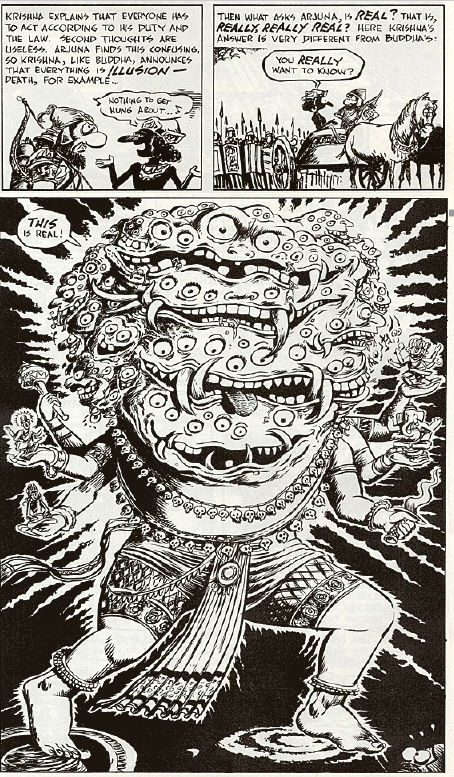
pp. 549-550: This revelation of the true nature of reality is reminiscent of, and quite possibly inspired by, Krishna’s self-revelation as the true nature of the universe, and as “death, the destroyer of worlds,” in chapter 11 of the Bhagavad-gita:
Having seen Thy great form,
which has many mouths and eyes,
which has many arms, thighs and feet,
which has many bellies,
and the mouths of which gape with many tusks,
O Mighty Armed One, the worlds tremble. And so do I.
Sky-touching, blazing, many colored, gaping-mouthed, with enormous fiery eyes; having seen Thee, trembling indeed in my inner self, I find neither courage nor tranquility, O Vishnu!
And having seen Thy mouths, bearing many tusks, glowing like the fires of universal destruction, I lose my sense of direction, and I do not find comfort. Have mercy! Lord of Gods, Dwelling of the Universe!
And yonder into Thee, all the sons of Dhrtarastra, along with the throngs of kings, Bhisma, Drona and the Son of the Charioteer thus yonder, together with ours, and also with our chief warriors, they quickly enter Thy fearful mouths, which gape with many tusks, some are seen with crushed heads, clinging between Thy teeth.
As the many torrents of the rivers flow toward the ocean, so yonder heroes of the world of men enter Thy mouths as they flame forth.
As moths enter the blazing flame to their destruction with great speed, so also, to their destruction, the worlds swiftly enter Thy mouths.
Thou lickest, swallowing from all sides, all the worlds, with flaming mouths. filling all the universe with splendor, Thy terrible rays consume it, O Vishnu!
Rand: Fountainhead III.4-9 & IV.1-2
III.5: The “queer conception” of “friendship with oneself” is of course Aristotle’s.
III.6: The work-model for the hard-drinking, tough-talking travel writer Lancelot Clokey is probably Ernest Hemingway.
Hemingway as he looked in the 1920s
Ibsen was of course one of Rand’s favourite playwrights:
“Merde d’oie” means “goose shit.” The phrase seems to be a pun on “Mère l’Oie” (“Mother Goose”).
Ike’s surreal play No Skin Off Your Ass brings to mind Thornton Wilder’s surreal play The Skin of Our Teeth (I was in it, in high school!). But Wilder’s play premiered in late 1942, so close to the completion of Rand’s manuscript that the similarity is probably a coincidence.
Toohey contrasts the kind of modern architecture he (now) approves of (no ornamentation – as in brutalism or the Bauhaus) with the kind he disapproves of (non-traditional ornamentation à la Henry Cameron). Here’s a sample of Sullivan’s ornamentation:
And one of Wright’s:
III.7: Toohey saying he’d give his life for the Banner is nicely ambiguous: give his life to serve it, or give his life to control it? (We don’t dislike them at all, these good little lambs ....)
III.8: The idea that evil is not “single and big,” but rather “many and smutty and small,” echoes Leo’s complaint in We the Living that it is harder to fight lice than to fight lions, and likewise Timoshenko’s regret that his enemies are lice rather than dragons.
III.9: “Control of the world,” says Wynand, “belongs to men like me. The Tooheys of this earth wouldn’t know how to dream about it.” This theme of whether Wynand or Toohey better represents the nature of power will be further developed.
IV.1: Rand originally opened this section with the following epigraph from Nietzsche:
But grant me from time to time ... the sight, but one glance of something perfect, wholly achieved, happy, mighty, triumphant, something still capable of arousing fear! Of a man who justifies man, of a complementary and redeeming lucky hit on the part of man for the sake of which one may still believe in man! (Genealogy I.12 (BW, p. 480))
While this describes Rand’s attitude toward Roark generally, it also describes the boy on the bicycle’s taking inspiration from Roark’s Monadnock designs.
The boy on the bicycle identifies the
first movement of Tchaikovsky’s First Concerto and the third movement of Rakhmaninov’s Second as embodying the sense of human exaltation he craves. Here they are:
Later in the novel we’re told of Dominique’s liking for Rakhmaninov’s Second.
Rand was not a fan of classical music – using “classical” here in the strict sense of the musical period from 1750-1820, dominated by Haydn, Mozart, and Beethoven. (Rand herself used the term “classical” in the broader, popular slang sense that covers everything from Bach through Puccini.) Rand’s preference was strongly for 19th-century Romantic composers like Chopin, Tchaikovsky, Rakhmaninov, and Verdi. In a later interview, Rand says:
Of all the serious composers, Rachmaninoff is my favorite. There, I hear an enormous, heroic sense of life. ... There is an almost tragic benevolence in him – tragic in the sense that there is always a massive struggle and sometimes a great deal of pain in his music. But he always projects the victory. (Objectively Speaking, p. 128.)
The Monadnock managers make the same mistake as the protagonists of Mel Brooks’ film The Producers: trying to pick the worst person they can find for their project in order to ensure its failure, only to find to their horror that the project is a success.
Wright was once invited to contribute to an exposition, and, like Roark, said he would accept it only if he were given sole charge of the project – thus ensuring the invitation’s withdrawal.
Magee, ch. 17: “Wagner and Nietzsche”
p. 286: As I’ve mentioned previously, the supposedly “widespread assumption” that Nietzsche was a major influence on Wagner is one I’ve never seen encountered. It usually seems to be assumed (correctly) that the influence went the other way.
p. 293: Referring to Wagner as “the Master” reminds me of:
p. 316: Magee’s description of Nietzsche’s account of Jesus’s motivations is hard to reconcile with what Nietzsche actually says about Jesus in The Antichrist. And as we’ve seen, Nietzsche’s attitude toward Socrates is a bit more complex than Magee’s presentation also.
p. 317: The inclusion of Luther on this list is odd, given Nietzsche’s mostly negative attitude toward Luther. Maybe Magee meant Luthor:
Here Magee seems to attribute to Nietzsche the “art for art’s sake” doctrine that Nietzsche explicitly repudiates.
pp. 320-323: Magee seems to be arguing that an evaluation of the philosophical content of an artwork is, or ought to be, irrelevant to an aesthetic appreciation of the work. (Rand officially thought the same, however much she violated that precept in practice – and at any rate she held to the precept enough to appreciate the novels of Dostoyevsky, with whose ideas she could have had little sympathy.) I agree that philosophical content is not decisive to aesthetic appreciation, but the claim that it’s irrelevant seems too strong, for reasons I go into here.
pp. 334-342: Magee’s hypotheses as to the real reason behind the Nietzsche-Wagner break strike me as a tad reductive; but YMMV.
Rand: Fountainhead IV.3-11
IV.3: Wynand describes how his experiences led him to desire power; Roark explains why his own similar experiences did not.
IV.5: When Roark bends a branch to show Wynand the meaning of life, Wynand asks: “Your strength?” Roark corrects him: “My work.” Wynand’s misunderstanding expresses what Rand would consider his Nietzschean orientation; Roark’s correction is reminiscent of Birkin’s preference for volonté de pouvoir over Wille zur Macht.
IV.6: Toohey’s encounter with the policeman is reminiscent of the Professor in Joseph Conrad’s Secret Agent, who “walked frail, insignificant, shabby,” and “passed on unsuspected and deadly, like a pest in the street full of men.”
IV.7: The “March of the Centuries” exposition is based on the real-life “Century of Progress” exposition held in Chicago in 1934, which showcased modern architecture as its 1893 predecessor had showcased neoclassical. Wright was deliberately excluded. The real exposition, unlike its fictional counterpart, was quite successful.
Juanita Fay, who dances wearing only a peacock, is based on Sally Rand (no relation to Ayn!), who danced at the exposition wearing only a fan:
Sally Rand was the inspiration for Cab Calloway’s song “Lady with the Fan”:
Louisa Keating’s suggestion that Peter now marry Catherine after all (an impossible idea, as we’ll see) may be a sign that her affection for her son is to some degree genuine after all, and the description of her courage in suggesting it represents a partial redemption for her character. (Negative characters in Rand do sometimes get partial redemption; recall Kira’s neighbor Marisha.)
Toohey’s dressing gown with the pattern of Coty’s face powder, “white puffs on an orange background,” was a real item on the market. I couldn’t find a picture of the dressing gown, but here’s a Coty’s box with the same design:
Rand later said that on aesthetic grounds she regretted, as too “journalistic,” having referenced a real company. In contrast to The Fountainhead, her next novel would be nearly devoid of specific real-world references.
Peter says his belief in Toohey is all that keeps him goimg. This is perhaps unfortunate.
IV.8: Peter’s quiet dignity in speaking to Roark constitutes a partial redemption for his character – which doesn’t mean it’ll be enough to save him. Peter is generally a more interesting and complex figure then one might expect for a character whose chief role is to serve as a counterpoint to Roark.
Roark explains that he feels no resentment against Peter, because one person can never either help or hurt another in any fundamental way. This sounds like Stoicism, but Roark’s difference from Dominique’s Stoic-like attitude seems to be this. Dominique, truer to traditional Stoicism, holds that we can avoid being hurt by not letting ourselves care about things outside our power, and particularly (for Dominique) things vulnerable to destruction by human evil. Roark, by contrast, seems to regard Dominique’s solution as a pseudo-solution, since her retreat (or attempted retreat) from engagement counts as a harm, a self-inflicted one; instead he holds something like this: we can care passionately about things that are outside our power and vulnerable to destruction, and still not be made vulnerable ourselves by them, because our caring, while passionate, only goes down “to a certain point.” Roark’s freedom from resentment may explain why Peter can describe him as paradoxically “the most egotistical and the kindest man I know.”
Roark says: “before you can do things for people, you must be the kind of man who can get things done,” but “to get things done, you must love the doing, not the secondary consequences,” i.e., the “work, not the people.” One could see this as an indirect utilitarian justification of egoism, though for Rand it is not the justification – rather a reply to a counterargument.
Roark complains that most architects are “screaming for planned cities,” as though each architect were “sure that the plan adopted will be his own.” Rand’s opposition to this central-planning urge may explain why she deleted the passage in “Roark and Cameron” where Cameron imagines himself the “only builder in the world ... reshaping the face of America” by explosively sweeping away “thousands of miles of houses.”
Back in I.7, during a previous Roark-Keating collaboration, Roark refused to have a drink with Peter. His willingness to have a drink with him now is a recognition of Peter’s partial redemption. At the same time, Roark still perceives Keating as “a man without worth or hope ... not to be redeemed.” Just how unredeemable is Peter, at this point, and why? (When reading this book, I always wish I could save Peter and Catherine.)
Roark’s condemnation of pity is interesting, inasmuch as the grounds for it seem different from Nietzsche’s.
IV.9: The description of Roark’s design for the Wynand house – “horizontal rectangles rising toward a slashing vertical projection” – is reminiscent of Wright’s 1935 design for Fallingwater:
It also resembles the house that Wright designed for Rand herself (though this was after the publication of The Fountainhead and so could not have influenced the description here). Although the Rand house was never built (the price Wright asked turned out to be more than she could afford), Rand loved the design, writing to Wright on 10 October 1946: “The house you designed for me is magnificent. I gasped when I saw it. It is the particular kind of sculpture in space which I love and which nobody but you has ever been able to achieve.” So that gives us good sense of what Roark’s designs are supposed to look like:
The description of Cortlandt Homes as involving triangles radiating from a central shaft is slightly reminiscent of Wright’s design for the Pilgrim Congregational Church, though the church is not “fifteen stories high”:
Wynand’s hope of gentrifying Hell’s Kitchen has come true in real life, if not quite in the same way he envisioned (though either method would involve driving thousands of poor people out of their homes). The area where Wynand wants to build the Wynand building is roughly where the High Line runs today:
IV.10: This final meeting between Peter and Catherine strikes me as one of the most powerful passages in the novel; but most writers about The Fountainhead barely mention it.
Keating notes that the sight of buildings vanishing into the fog makes him uneasy; Rand will revisit that idea in a famous passage in Atlas:
Clouds had wrapped the sky and had descended as fog to wrap the streets below, as if the sky were engulfing the city. She could see the whole of Manhattan Island, a long, triangular shape cutting into an invisible ocean. It looked like the prow of a sinking ship; a few tall buildings still rose above it, like funnels, but the rest was disappearing under gray-blue coils, going down slowly into vapor and space. This was how they had gone – she thought – Atlantis, the city that sank into the ocean, and all the other kingdoms that vanished, leaving the same legend in all the languages of men, and the same longing. (Atlas II.9)
It’s a sign of Catherine’s corruption that she prefers “grown-up” Washington (the nation’s political and bureaucratic capital) to New York (the nation’s commercial and cultural capital); Rand’s preference was the opposite. (I’m reminded of the fate of Susan in the Narnia books, when she becomes grown-up and dismisses her time in Narnia as “those funny games we used to play when we were children.”)
Catherine suggests they go to “Thorpe’s,” and adds that there’s “one around the corner,” implying that Thorpe’s is a chain. From the description of the restaurant once they get to it, I’m guessing the model is Schrafft’s, an NYC cafe-and-ice-cream-parlour chain that had 25 locations throughout the city during the 1930s. Here are some vintage photos of a Schrafft’s with the candy-and-pastry counter:
– and the tables “too small, set close together”:
(In the 1958 film Auntie Mame, it’s at Schrafft’s that Patrick attempts to order lunch in French, to the amusement of his fiancée Gloria.)
Peter’s description of Catherine as putting on “an act inside, for oneself,” with “no way out, no reality,” reminds me once again of C. S. Lewis – specifically of the self-made unreachability of the damned, as represented by the dwarves at the end of The Last Battle, or by Peggy in his short story “The Shoddy Lands.”
IV.11: The scenes between Roark and Wynand on the boat could be interpreted – despite Rand’s denials – as having a homoerotic aura reminiscent of the relation between Birkin and Gerald. Certainly the two relationships are alike in other ways. (For further discussion, see Chris Matthew Sciabarra’s exploration of homoerotic and homophobic strands in Rand’s work, in his book Ayn Rand, Homosexuality, and Human Liberation.)
Rand has Roark condemn anyone “whose sole aim is to make money.” This might seem surprising, coming from an author who wore a gold dollar-sign pin and famously said that “love of money is the root of all good.” But it’s clear from the context of that quote in Atlas Shrugged that by the “love of money” Rand means not the love of having money, but the love of the idea of money, as a symbol of social interaction based on production and exchange rather than conquest and exploitation.
Roark’s speech about second-handers is very Nietzschean, but his final thought – that going after power is the most extreme second-handedness of all – is a clear challenge to Nietzsche. As we’ve seen, Nietzsche himself compared his higher men and masters to arboreal parasites (the Sipo matador); but he never clearly answered the question: how can a parasite claim to be a lonely creator? Here Rand is instead following Rostand’s Cyrano (“too proud to be a parasite”), as well as Aristotle – not the Aristotle of Politics I with its defense of natural slavery and male supremacy, but the Aristotle of Nicomachean Ethics I (where Aristotle dismisses social status [“honour,” reputation] as an account of the human good on the grounds that it is too dependent on other people) and Politics VII (where Aristotle maintains that nothing counts as genuine human flourishing if it is achieved through the conquest of others).
Nietzschean Tune of the Week
“O weint um sie” (“Oh, weep for them”) – the text is inspired by Psalm 137, with perhaps an echo of such prophetic writings as Ezekiel 6 also:







 Rand has Roark condemn anyone “whose sole aim is to make money.” This might seem surprising, coming from an author who wore a gold dollar-sign pin and famously said that “love of money is the root of all good.” But it’s clear from the context of that quote in Atlas Shrugged that by the “love of money” Rand means not the love of having money, but the love of the idea of money, as a symbol of social interaction based on production and exchange rather than conquest and exploitation.