Audiovisual Companion
to my Spring 2021 seminar on
Nietzsche and Modern Literature

Roderick T. Long


Nietzsche (center); Mann (upper left); Gide (upper right); Lawrence (lower left); Rand (lower right)


WEEK THREE:

Nietzsche: Untimely Meditation 2: Advantage and Disadvantage of History for Life

p. 16: Here Nietzsche references what he will later call the Eternal Recurrence or Eternal Return, though without endorsing it as he will later.

pp. 20-21: Nietzsche’s account here of how the antiquarian approach to history can develop into a hostility to life and change is presumably an influence on Mann’s description of Dr. Cornelius in “Disorder and Early Sorrow.” (Mann mentions liking The Advantage and Disadvantage of History.)

pp. 25-27: Although Nietzsche’s focus remains on German culture here, one can sense his gaze just on the verge of wandering southward, as it will in Phase II. French culture is still bad (Nietzsche is not yet at the point of dedicating a book to Voltaire), but in rebelling against it, German culture has ended up even worse.

p. 36: The reference is to an anecdote in Chapter 7 of Martinus Scriblerus’s Peri Bathous, or the Art of Sinking in Poetry, where Scriblerus makes fun of the verse “None but himself can be his parallel” by comparing it to “the thought of that master of a show in Smithfield, who writ in large letters of the picture of his elephant, This is the greatest elephant in the world, except himself.” “Martinus Scriblerus” was the collective pseudonym of the Scriblerus Club, whose members included Jonathan Swift, Alexander Pope, John Gay, John Arbuthnot, and others. This particular Scriblerian work, however, was (at least principally) the work of Pope, not Swift or any of the others.

p. 38: Nietzsche’s lines about “A Fighter Against His Time,” and his call for education “against the modern fashion,” help to explain what he had in mind in calling these meditations “untimely.”

p. 49: In Goethe’s early novel Sorrows of Young Werther, the lovesick hero Werther commits suicide, inspiring numerous copycat suicides in real life among Goethe’s romantic fans, and consequently leading the book to be banned in several countries. (In other words, Goethe was the Judas Priest or Ozzy Osbourne of his day.) Goethe responded by having the epigraph “Be a man and do not follow me” added to later editions.

pp. 51-52: Nietzsche’s disgust with Hartmann’s utopia of mediocrity prefigures his discussion of the “Last Man” in Zarathustra.

p. 53: The “doughty Englishman” that the editor is unable to identify is Matthew Arnold, in the Preface to his Literature and Dogma.

p. 54: In Greek mythology, the Danaids killed their husbands on their wedding nights, and were punished in the underworld by being required to attempt, for eternity, to refill a cistern by carrying water in sieves.

p. 55: animae magnae prodigus means “prodigal of a great soul.” Whether that “approximates” to what the footnote says I’ll leave you to judge.

p. 63: The reference to the youth of the future as “serpent-slayers” recalls Siegfried, the dragon-slaying hero whose mission (in Wagner’s version) is to break the bonds of the past.


Nietzsche: Untimely Meditation 3: Schopenhauer As Educator

p. 184: “Plato was for a time a court philosopher”: Nietzsche refers to Plato’s visits to Sicily to attempt to convert the tyrant of Syracuse to the philosophical life. (Spoiler alert: it went badly.)

p. 185: noli me tangere: the footnote translates it, but neglects to mention that it’s a reference to the resurrected Jesus addressing Mary Magdalene (John 20:1).

In this section Nietzsche’s enthusiasm for the state seems to have waned since writing “The Greek State.”

p. 192: Nathan the Wise was a controversial play by Lessing dramatising the theme of religious tolerance; during the crusades, a Jew, a Christian, and a Muslim become friends and decide that all three religions are equally valid.


Nietzsche: Untimely Meditation 4: Wagner in Bayreuth

At the time that Nietzsche was writing this hagiographic treatment of Wagner, he was already beginning to jot down increasingly hostile notes about Wagner in his private notebooks (see, e.g., Portable Nietzsche, p. 47). Phase I was about to yield to Phase II.


Nietzsche: Ecce Homo: “Untimely Ones” and “Why I Am So Clever”

This and several more readings are from Nietzsche in Phase III, looking back at his Wagnerian period in Phase I, and explaining his mature attitude to Wagner. I’ve pulled them forward because it makes more sense to consider them in conjunction with his pro-Wagner writings. That’s also why the first novelist we’re reading is Mann, even though he’s not the first chronologically (that would be Gide) – because Mann’s writings are the ones that have the closest connection with the concerns of Nietzsche’s early writings.

p. 704: “Reichsdeutsch” literally means “imperially German.”

p. 707: “I myself am still enough of a Pole”: on the basis of his last name, Nietzsche assumed he had Polish ancestry, but he probably didn’t.

Nietzsche lists the Siegfried Idyll as one of the Wagner pieces he would still place in his top rank; here it is:


“I should not know how to get along without Rossini”; here’s a sample (in both cases the bombastic part comes first and the more subtle part a few minutes in; in particular, the most famous part of each piece begins at a little after the two-minute mark):


Nietzsche also lists Liszt; here’s Liszt’s best-known work:


Nietzsche: Beyond Good and Evil, § 240

More from Phase III.

p. 363: Nietzsche discusses the overture to Die Meistersinger; here it is:


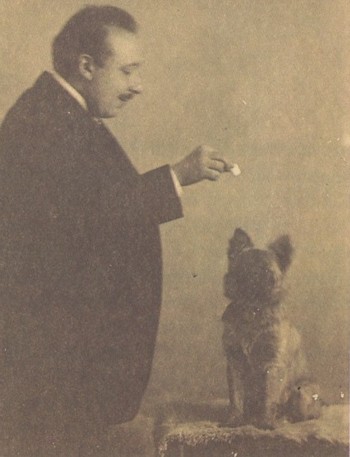
Mann: Doktor Faustus, chs. 28-47 & Epilogue ch. 28: Chaim Breisacher is based on Oskar Goldberg, a writer who (despite being Jewish) was a forerunner of German fascism. He looks pretty innocent here, though (but then, Hitler liked dogs too).


Readers of Mann have sometimes wondered why, with so many proto-Nazi theorists running around in Germany at the time the story takes place, Mann chose to depict one of the few who were Jewish. (They’ve also wondered why, as a symbol of German culture’s slide into Nazism, Mann chose the twelve-tone technique of Arnold Schönberg, a Jewish composer whose works were banned by the Nazis.)

ch. 34: Note that chapter 34 comes in three parts! In the syllabus I’ve labeled them 34a, 34b, and 34c.

ch. 34c.: Mann mentions the crowd shouting “Barabbas!” in Bach’s St. Matthew Passion. Here’s the relevant section (the shout comes at 2:00):


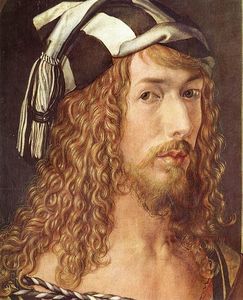
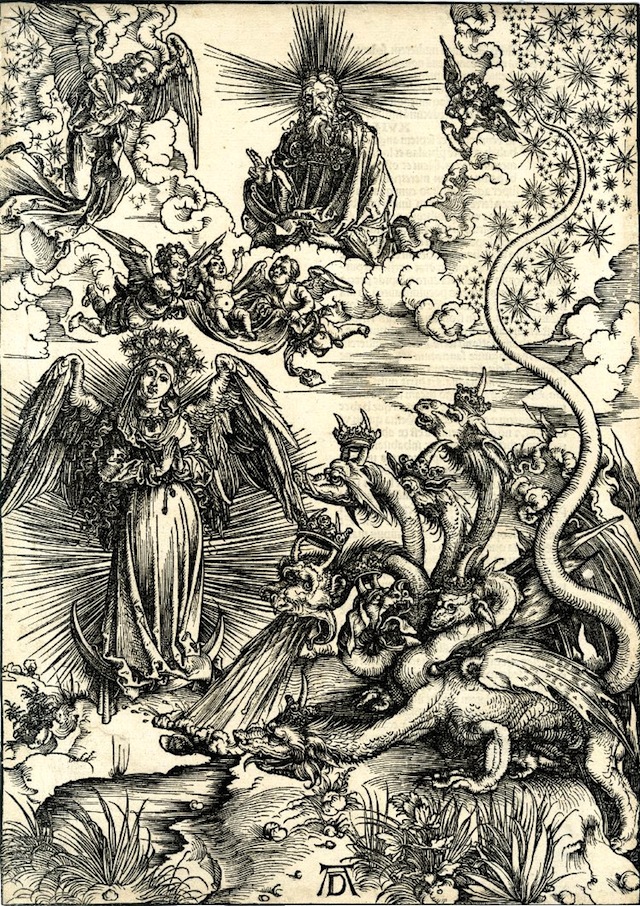
In his Story of a Novel (p. 151), Mann tells us that the inspiration for Adrian’s Apocalypse music was the set of Apocalypse woodcuts by Albrecht Dürer. Here’s Dürer:


And here’s one of the woodcuts:


My own mental image of Adrian’s Apocalypse music is the Kyrie from Ligeti’s Requiem (better known as the “monolith” theme from 2001: A Space Odyssey):


ch. 35: Clarissa’s suicide is based directly on the suicide of Mann’s sister Carla.

ch. 37: Doktor Faustus is a book that desperately needs notes – probably more than any other novel we’re reading – yet has none, at least in the Vintage edition. (Contrast the plentiful notes in the Lawrence books, at least in the current Penguin editions.) This lack is way more than I have time to remedy fully; there are references and allusions on almost every page. Moreover, there’s lots of untranslated French in the book, to which I’ve just had to abandon you. But in chapter 37, Saul Fitelburg’s dialogue contains so much French that the chapter can seem virtually unintelligible without translations (though it really isn’t), so voilà:

French original English translation
cher Madame my dear Madame
petite Maman little Mama
Arrangements musicaux. Représentant de nombreux artistes prominents. Musical arrangements. Representing numerous prominent artists.
Cher Maître, comme je suis heureux, comme je suis ému de vous trouver! Même pour un homme gâté, endurci comme moi, c’est toujours une expérience touchante de rencontrer un grand homme. – Enchanté, Monsieur le professeur. My dear Maestro, how happy, how moved I am to find you! Even for a jaded, impervious man like me, it’s always a touching experience to encounter a great man. – Enchanted, Monsieur Professor.
Vous maudirez l’intrus, cher Monsieur Leverkühn. Mais pour moi, étant une fois à Munich, c’ était tout à fait impossible de manquer .... You will curse the intruder, my dear Monsieur Leverkühn. But for me, finding myself for once in Munich, it was entirely impossible to miss ....
Du reste, je suis convaincu .... Besides, I am convinced ....
Mais après tout .... But after all ....
Maître ... Mais oui, certainement ... merci, mille fois merci! Maestro ... But yes, certainly ... thank you, a thousand thanks!
et puis, cette maison pleine de dignité avec son hôtesse maternelle et vigoreuse. Madame Schweigestill! Mais ça veut dire: ‘Je sais me taire. Silence, silence!’ Comme c’est charmant. and then, this house so full of dignity, with its motherly and vigorous hostess. Madame Schweigestill! But that means: ‘I know how to keep quiet. Silence, silence!’ How charming that is. [“Schweige still” does mean “keep quiet.”]
figurez-vous just imagine
ridiculement exagérée ridiculously exaggerated
C’est la vérité pure, simple et irrefutable It is the pure, simple, and irrefutable truth
À qui le dis-je? Au commencement était la scandale. To whom am I telling this? In the beginning was the scandal.
à la longue in the long run
vis-à-vis counterpart [in this context]
un creux, une petite caverne ... nommé Théâtre des fourberies gracieuses. a hollow, a little cave ... called the Theatre of Graceful Trickeries
je vous assure I assure you
En un mot In a word
Crème de la crème cream of the cream [i.e., best of the best]
Ah, madame, oh, madame, que pensez-vous, madame, on me dit, madame, que vous êtes fanatique de musique! Ah, Madame, oh, Madame, what do you think, Madame, they tell me, Madame, that you have a passion for music!
Enfin At last
J’y trouve ma satisfaction et mes délices That’s where I find my satisfaction and my delights
et nous nous rencontrons dans ce désir and we meet one another in this desire
que fournit le sujet which furnishes the subject
Insulte! Impudence! Bouffonerie ignominieuse! Insult! Impudence! Disgraceful buffoonery!
Quelle précision! Quel esprit! C’est divin! C’est suprême! What precision! What spirit! It’s divine! It’s supreme!
un boche qui par son genie appartient au monde et qui marche à la tête du progrès musicale! a kraut who by his genius belongs to the world, and who marches at the head of musical progress!
snobisme snobbishness
Ah, c’est bien allemande, par exemple! Ah, that’s very German, for example!
cher Maître, pourquoi pas le dire? my dear Maestro, why not say it?
cette ‘Phosphorescence de la mer’ that ‘Phosphorescence of the Sea’
et que vous enchaîner votre art dans un système de règles inexorables et néoclassiques and that you enchain your art in a system of inexorable and neoclassical rules
qualité d’Allemand German quality
grossièreté coarseness
en effet, entre nous in fact, just between us
non, j’en suis sûr! no, I’m sure of it!
C’est ‘boche’ dans un degré fascinant. It has the ‘kraut’ quality to a fascinating degree.
énormément caractéristique enormously characteristic
ce cosmopolitisme généreux et versatile this generous and versatile cosmopolitanism
Cher Maître, je vous comprends à demi mot! My dear Maestro, I understand you without your having to be explicit! [literally: I understand you at the half-word.]
Mais c’est dommage, pourtant. But it’s a pity, though.
Particulièrement à Paris particularly in Paris
Tout le monde sait, madame, que votre jugement musical est infaillible. Everybody knows, Madame, that your musical judgment is infallible.
Entre nous Just between us
Dites-moi donc So tell me
sévérité severity
un état d’âme solennel et un peu gauche a solemn and somewhat awkward state of the soul
embarras embarrassment
ce réfuge étrange et érémitique this strange and hermitic refuge
Eh bien Oh well
demi-foux excentriques eccentric semi-madmen
un espèce d’infirmier, voilà a kind of nurse, you see
dans quelle manière tout à fait maladroit in what an utterly maladroit manner
destin / destinées destiny / destinies
pénible painful
anéantissement annihilation
le dernier ennui the final tedium
avec quelque raison with some reason
qui sont simplement stupéfiants which are simply stupefying
Tout cela est un peu embarrasssant, n’est-ce pas? Une confusion tragique. Tragique, messieurs. All this is a bit embarrassing, is it not? A tragic confusion. Tragic, gentlemen.
À la bonne heure. Well done. [in this context]
Ah, ah, comme c’est mélancolique, tout ça! Ah, ah, how melancholy all that is!
Sincèrement Sincerely
pour saluer un grand homme to salute a great man
répugnance repugnance [I probably didn’t need to do this one]
en psychologue as a psychologist
valse brillante sparkling waltz
qui est essentiellement anti-sémitique which is essentially antisemitic
pour prendre congé as a parting valediction
une marguerite a daisy [but with a pun both on “pearl” and on Marguerite/Margaret/Gretchen, the heroine of Faust]
Laisse-moi, laisse-moi contempler Let me, let me contemplate [quoting Faust’s lines to Marguerite, in Gounod’s opera: “Let me, let me contemplate your face.”]
lui aussi him too
Tiens! There you go!
Comme c’est respectable! Pas précisément humain, mais extrèmement respectable. How respectable it is! Not exactly human, but extremely respectable.
Une analogie frappante! A striking analogy!
nom de guerre pseudonym [literally “war name,” i.e., an alias used for wartime activities]
je vous le jure I swear it to you
médiateur mediator
Mais c’est en vain. Et c’est très dommage! ... Cher Maître, j’étais enchanté. J’ai manqué ma mission .... Mes respects, Monsieur le professeur. Vous m’avez assisté trop peu, mais je ne vous en veux pas. Mille choses à Madame Schwei-ge-still. Adieu, adieu. But it’s in vain. And it’s such a great pity! ... My dear Maestro, I’ve been enchanted. I’ve failed in my mission .... My respects, Monsieur Professor. You have assisted me too little, but I don’t hold it against you. A thousand things to Madame Schwei-ge-still. Farewell, farewell.


Some readers see Fitelburg as a demonic tempter figure. But why does Adrian need a tempter when he’s already sold his soul?

ch. 41: Adrian’s indirect approach to proposing marriage to Marie Godeau echoes Nietzsche’s to Lou Salomé; he reportedly asked Paul Rée to propose to her on his behalf, but Salomé was more interested in Rée than in Nietzsche. Some scholars have cast doubt on this story; but it needn’t have been true to have influenced Mann. Another example likely to have been on Mann’s mind (especially since it was originally to have been the subject of the story that became Death in Venice) was Goethe’s likewise unsuccessful proposal to Ulrike von Levetzow, which was likewise conveyed through a friend.

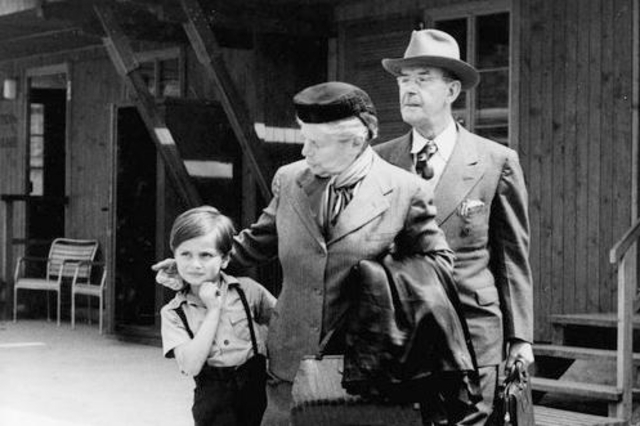
chs. 44-45: Nepomuk is based on Mann’s grandson Frido. Frido was a bit longer-lived than his fictional counterpart; in fact he is still alive, as of January 2021.

Frido, Katia, and Thomas Mann in 1947


The name “Nepomuk” derives from the Czech saint Jan Nepomuk. Unbeknownst to Mann, “Nepomuk” was also one of the many middle names of the real-life model for Tadzio.

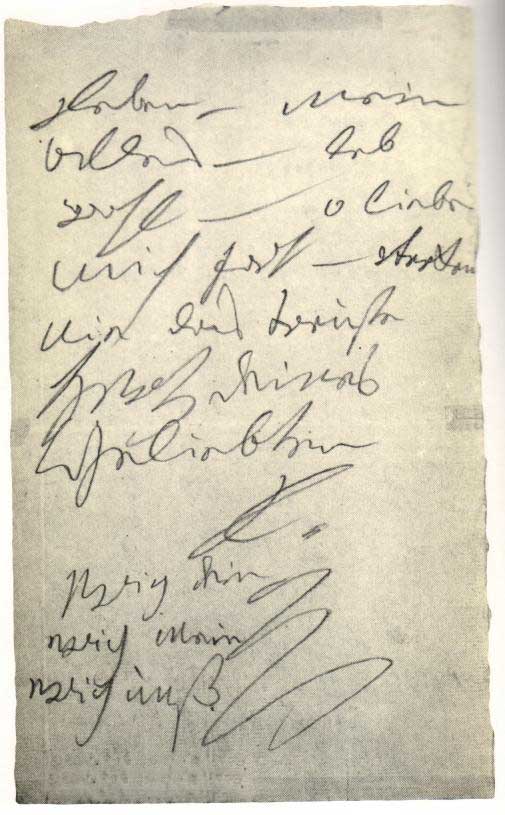
Epilogue: Mann’s description of the mute, staring Adrian mirrors the condition of the real Nietzsche after his mental collapse; here’s the famous drawing:


Two anecdotes from this period:

1. While completing Faustus, Mann looked at some “facsimile reproductions of letters of Beethoven” and had the following reaction: “I looked at them for a long time, those scrambled and scratched lines hurled onto the paper, that desperate orthography, all that half-wild inarticulateness – and could find no love for it in my heart. Once again I sympathized with Goethe’s rejection of the ‘untamed human soul’ ....” (Story of a Novel, p. 216.)


2. Mann’s criticisms of the Nazi regime had gotten him placed on Hitler’s shit list. (I bet you can’t say “Hitler’s shit list” three times fast.) Katia Mann reports:

From Malmö we flew back to London via Amsterdam. It was shortly after the outbreak of the war, a dreadful flight. We were flying terribly low. It bothered me, and I asked the stewardess why.

“Nazi Germany will permit us to fly over their territory only if we fly very low. Yesterday they even forced us to reduce our speed, and they flew so close beside us that they could look in through all the windows to find out who was in the plane.”

“Oh, so that’s the reason.”

Then I said to my husband, “I would like to have a turn sitting next to the window.”

He said, “But I always sit by the window.”

“But I would like to for a change.”

Well, he begrudgingly made room for me on the window seat.

Diagonally across from us sat a robust, Jewish-looking gentleman. He had obviously heard what the stewardess said, and he fainted. But nothing happened.

The next day someone on the same flight was shot to death through the window by a German air force pilot. They probably thought the man was Thomas Mann, because the Nazis of course knew about his stay in Stockholm and his return to the United States. (Unwritten Memories, pp. 106-7)


Magee: “Jews – Not Least in Music”

pp. 20-22: Magee tells us that prior to the 19th century, the Jews produced no first-rate artists or composers, and also (with the sole exception of Spinoza), no first-rate philosophers; and he offers as the reason for this that Jewish artists did not begin to break with their traditions until the 19th century, and only breaking with tradition makes great art possible.

Against this judgment, I offer some examples of what I think is some pretty good medieval Jewish music:


And also some pretty good Jewish philosophers – such as Saadiya Gaon, Ibn Gabirol, Maimonides, Gersonides, Leone Ebreo, and so on.

Now Magee would of course answer that these works and thinkers were not first-rate, because they worked within their traditions rather than challenging them. But then his thesis risks becoming vacuous. At first it looked as though not challenging tradition was being offered as a causal explanation of the alleged inferiority of medieval Jewish creative work, but it can hardly be that, if challenging tradition is also to serve as a stipulative criterion for what counts as first-rate creative work. It’s pointless to offer a causal explanation of why all swans are white if I start by defining swans as white.

In any case, the line between working within a tradition and challenging that tradition is not necessarily as sharp as Magee takes it to be. Was Maimonides’ advance over previous Jewish thought really so radically different in kind from Spinoza’s advance over previous Cartesian thought?

Certainly there are many reasons to oppose the reign of hidebound tradition in art. But the claim that hidebound tradition is incompatible with great art per se is just not plausible. Hidebound tradition restricts the variety of art, and thus prevents certain kinds of great art, but that’s not the same thing.

Magee also dismisses “classical China and India” and “medieval Christendom” as relatively “barren” periods creatively – which strikes me as fantastically false. As far as philosophical achievement goes, I’m happy to put Xunzi, Prabhakara, and Scotus in the same pantheon as Spinoza.

p. 23: Magee seems to agree with Wagner that there were no great Jewish composers in Wagner’s day. Nietzsche evidently disagreed, since he says in Ecce Homo (Basic Writings, p. 707) that all the best so-called German composers are either foreigners or Jews.


Nietzschean Tune of the Week

Here’s Nietzsche’s “Eine Sylvesternacht” (New Year’s Eve). Clearly Nietzsche doesn’t share Adrian’s aversion to tonality:


Back to the main page