Audiovisual Companion
to my Spring 2021 seminar on
Nietzsche and Modern Literature

Roderick T. Long


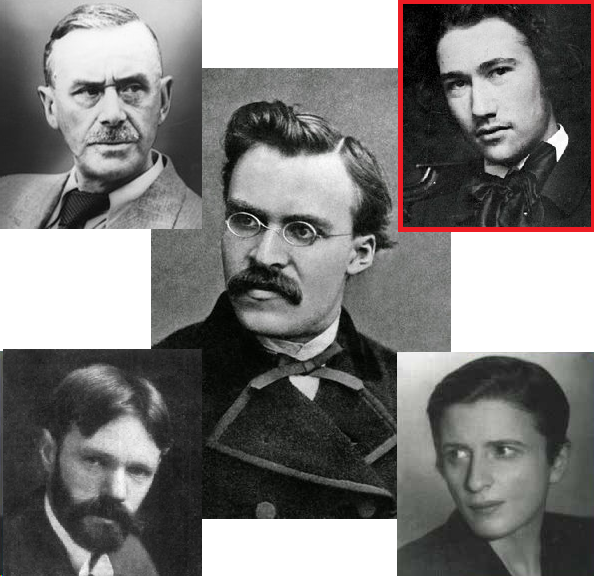
Nietzsche (center); Mann (upper left); Gide (upper right); Lawrence (lower left); Rand (lower right)


WEEK FIVE:


[Note: Out of some sort of befuddlement I included my notes on Assorted Opinions and Maxims and The Wanderer and His Shadow on the page for Week 4 when they properly belong here on the page for Week 5. So I’ve now deleted them from the Week 4 page and moved them here.

Also, again, bear in mind that my citations are to page numbers, not section numbers; that’s to make it easier for you to find the assigned reading. But when you cite Nietzsche in your essays you should ideally do it by section numbers.]


Nietzsche: Human, All-Too-Human IIa: Assorted Opinions and Maxims

Nietzsche was capable of coming up with some powerful, punchy titles for his works (e.g., Beyond Good and Evil). But his inspiration seems to have failed him when he came up with the title Assorted Opinions and Maxims. I’m reminded of Herbert Spencer’s later works, which have gripping titles like Facts and Comments and Various Fragments. P.R. was not Spencer’s strong suit.

p. 268: the footnote identifies the myth of Io (more or less) but fails to point out that “Io” is also the first person singular in Italian; hence Nietzsche’s pun.


Nietzsche: Human, All-Too-Human IIb: The Wanderer and His Shadow

HAH, p. 378: The idea that the “modern military machine” is an atavistic survival of an older, pre-liberal culture was a commonplace among liberals and radicals of the 19th century (e.g., Spencer), but Nietzsche here reverses the evaluation.

HAH, p. 379: This seems a good description of what has befallen the British monarchy.

HAH, p. 384: And now we get the European Union.

HAH, p. 385: See the footnote contrasting Poussin’s style with that of Lorrain (“Lorraine” is a misspelling). Here’s a typical Poussin:


And here’s a typical Lorrain:


Nietzsche: Ecce Homo: Human, All-Too-Human

p. 741: The “charming Parisienne” was Louise Ott, a married Wagnerian with whom Nietzsche seems to have had a somewhat flirtatious friendship:


Nietzsche: Daybreak/Dawn

Note that the numbers at the top of the page are section numbers, while the numbers at the bottom of the page are page numbers.

p. 60: The penultimate sentence (beginning “It goes without saying ....”) in § 103 is extremely important.

p. 61: So is the section on pseudo-egoism here.

p. 106: “Credat Judaeus Apella” means “let the Jew Apella believe it” (because I won’t); in other words, “go peddle your bullshit to someone more gullible.” The English equivalent would be “tell it to the marines” – originally a pejorative saying about the Royal Marines popular with British sailors.

p. 111: Gewaltmenschen are men of violence; strongmen; thugs.

p. 149: Here’s Nietzsche on the superiority of pure to mixed races; yet a few pages earlier (p. 127) he was suggesting improving the European breed by an admixture of Chinese blood.


Gide: Lafcadio’s Adventures (a.k.a. The Vatican Cellars or The Vatican Vaults)

The translator’s (or publisher’s?) decision to rename this book Lafcadio’s Adventures strikes me as unfortunate, as it implies that Lafcadio is the main character. (He’s admittedly the most important character; but he’s not the main character because there isn’t one.)

The insouciant young schemer Lafcadio is another immoralist; he shows his position beyond good and evil by committing an “acte gratuit” (free/gratuitous act) – namely deciding, on a whim, to shove a random stranger (or someone he thinks is a stranger) off the train. As this is a lighter, more comic novel than The Immoralist or Strait Is the Gate, no heavy moral weather is made of it – none of Michel’s agonising over Marceline, for example. Lafcadio is a bit like Dorian Gray, except that where Dorian Gray keeps his conscience in his attic, Lafcadio has none at all. (His background in a “remote castle in the Carpathians” suggests another literary ancestor, namely Dracula.)

One early reviewer of the book remarked that after reading it, he would be afraid to share a railway car with Gide. But Lafcadio (unlike Michel) does not seem to be based on Gide himself; if anything it is Julius who is closest to being a Gide stand-in.

While one of Lafcadio’s actes gratuits is a murder, another (not included in the excerpt) is a conventionally heroic act (saving people from a fire).

As for the murder: by a series of coincidences so unlikely as to be intentionally ridiculous, Lafcadio turns out to have been already connected to his victim in multiple ways, and his decision to kill him turns out to enmesh him in yet a further tangle of connections and conspiracies. Moreover, his half-brother Julius – one of the many nodes in the aforementioned network of connections – turns out to be writing a novel about the very act which Lafcadio, unbeknownst to Julius, has just committed.

Julius’s interest in the acte gratuit concerns not so much its ethical status as its literary realism; he maintains that it is only in fiction, not in real life, that people behave predictably, with definite motives, and in accordance with established character traits. This is an idea to which Gide will recur in The Counterfeiters.


Gide: Counterfeiters

The Counterfeiters (Les faux-monnayeurs – literally “The False Coiners”) was originally intended as a sequel to The Vatican Cellars, to feature Lafcadio once more; but Gide dropped Lafcadio from the second book when it began turning out to be a more serious book than the first. (As an example of the difference in tone between the two books, the novel’s closest equivalent to Lafcadio’s acte gratuit – a scene in which a bunch of schoolboys, for kicks, bully one of their classmates into killing himself – is presented as morally horrific, rather than the light-hearted romp as which Lafcadio’s crime is portrayed.) Nevertheless The Counterfeiters shares a number of themes in common with its predecessor, including an interest in the nature of fiction and its relation to reality; for example, Edouard (a stand-in for Gide, and the closest the book has to a main character) is, like Julius, writing a novel, also titled The Counterfeiters, that turns out, unbeknownst to him, to mirror, or be mirrored by, the events happening to the people around him – like Julius. (Edouard is also keeping a journal about the writing of the fictional Counterfeiters, just as Gide did about his writing of the actual Counterfeiters. And just as Gide based Edouard on himself, so Edouard is basing a character in his own Counterfeiters on himself.)

The title is a reference both to a literal scheme involving counterfeit money, and to broader concerns with authenticity and inauthenticity.

p. 64: The French epigraph (why did the translator leave it untranslated?) means: “One must choose between loving women and knowing them; there is no middle ground.”

The character of Robert de Passavant is inspired in part by the filmmaker Jean Cocteau, whom Gide regarded as a charlatan and a corrupting influence. Part of Gide’s hostility may derive from the fact of Cocteau’s influence on Gide’s lover, the filmmaker Marc Allégret (the basis for Olivier in the novel).

Jean Cocteau making himself handy Marc Allégret with just the two hands


pp. 66-68: Although Laura is not much like Madeleine, Edouard’s relationship with her, as described on these two pages, owes a fair bit to Gide’s relationship with Madeleine.

pp. 68-69: This discussion of sincerity links up to the “counterfeiters” of the title; and Edouard’s disintegrating sense of property is reminiscent of Michel’s pleasure at helping poachers on his own land or seeing Moktir steal his scissors. Edouard’s and Michel’s lack of concern for property mirrors Gide’s own (though a cynic might say that such lack of concern for property is easy enough for someone like Gide who was born into wealth and never lacked for money).

p. 70: Both Lafcadio and Edouard are in the habit of losing the keys to their suitcases; one suspects an autobiographical element here.

pp. 71-72: Gide described The Counterfeiters as his “only novel” – a surprising claim, since by most standards he wrote at least half a dozen novels. This passage here casts some light on what he may have meant. (See also pp. 166-167.)

pp. 72-73: Bernard is this book’s closest equivalent to Lafcadio, though his mischief with Edouard’s cloakroom ticket is rather milder than Lafcadio’s mischief, and Bernard seems to have a few more scruples.

p. 77: The Saint-Lazare train station, where Edouard meets Olivier, is the subject of a famous painting by Monet:


de trop: too much, superfluous – in this context, Bernard’s worry is of being an unwanted third party.

p. 78: The Place de la Concorde is about fifteen minutes’ walk from the Saint-Lazare station. During the 1790s it was the site of the Guillotine, but it has since mellowed a bit:


p. 80: This incident is reminiscent of Moktir and the scissors. The boy, George, seems a younger mirror of Bernard.

p. 82: Algeria, of course!

pp. 165: Madame Sophroniska is based on the psychoanalyst Eugénie Sokolnicka:


p. 167: “L’état c’est moi” (“I am the State”) was the famous remark of Louis XIV.

pp. 167-168: Mithridate and Athalie are both tragedies by Racine; Cinna is a tragedy by Corneille; Tartuffe, a comedy by Molière. Gide’s own plays are likewise very stylised and abstract, much more so than most of his novels.

p. 171: chef d’oeuvre: masterpiece.

p. 289: The nihilist Strouvilhou might be described as “Nietzsche in a bad mood,” or even “Gide in a bad mood”; he has their darker aspects but not their lighter and more benevolent ones. Strouvilhou’s dictum that “If there’s anything more contemptible and more abject than a man, it’s a lot of men” is essentially a transposition into a more malevolent key of Gide’s own dictum that “Each man is more valuable than all men.”

p. 290: Bernard Palissy was a 16th-century ceramic artist who burned his furniture and the floorboards of his house – but, pace Strouvilhou, not his wife and children – to provide fuel for his kiln:

Palissy’s self-portrait


p. 291: “Coré” and “Proserpine” are alternative names of Persephone; “Ceres” is an alternative name of Demeter.

pp. 291-292: More exploration of what “counterfeiters” might mean.

en attendant: “while waiting,” i.e., “in the meantime”

p. 293: ex uno: short for “ex uno disce omnes,” i.e., “from one case, learn all the cases.”

p. 294: Here Edouard suggests ending his novel with the line “Might be continued” (in the original French, “Pourrait être continué”). Thomas Merton ends his book-length poem Cables to the Ace with precisely those words, in French. Possible Gidean influence?

Star Trek villain
Thomas Merton


pp. 295-296: Here Edouard recapitulates Julius’s claims, in The Vatican Cellars, about consistency of character in literature vs. in life.

esprit de suite: “spirit of sequentiality” or “spirit of following-up,” i.e., consistency.

justum et tenacem propositi virum: “the man who is just and firm of purpose.” A quotation from Horace.


There’s a movie version of The Counterfeiters:


Gide Speaks!

Some audio clips of Gide:


Lawrence Writes!

D. H. Lawrence’s handwriting:


Lawrence: The Rainbow and Women in Love

D. H. Lawrence, like most of the characters in his books, came from the coal-mining regions of central England (the Midlands), and more precisely Nottinghamshire. Like Nietzsche with Germany, Lawrence started out thinking of his task as the cultural regeneration of England, but later became disgusted with England (a feeling exacerbated by government censorship of his books, and government harassment of him personally during the First World War), preferring to live in Italy, Australia, or New Mexico. (Notice how in a 1912 letter he describes his mission to England in messianic terms even as he is inclining toward renouncing it: “Why, why, why was I born an Englishman? – my cursed, rotten-boned, pappy-hearted countrymen, why was I sent to them? Christ on the cross must have hated his countrymen.”)

If Mann and Gide seem torn between the Apollonian and the Dionysian, no comparable degree of ambivalence is detectable in Lawrence. Contrasting two kinds of poetry – one that is “complete and consummate,” with “exquisite form” and “perfect symmetry,” such as the “treasured gem-like lyrics of Shelley and Keats,” and on the other hand one that is “immediate,” with “nothing finished,” and the “strands ... all flying, quivering, intermingling,” Lawrence expresses a clear preference for the latter. (Complete Poems, Penguin ed., p. 182) And in a 1913 letter, he writes: “My great religion is a belief in the blood, the flesh, as being wiser than the intellect. We can go wrong in our minds. But what our blood feels and believes and says, is always true. The intellect is only a bit and a bridle. What do I care about knowledge. All I want is to answer to my blood, direct, without fribbling intervention of mind, or moral, or what not.” (Though Lawrence’s considered views are arguably a bit more nuanced than that quotation suggests.)

And Lawrence condemns Mann as, in effect, insufficiently Dionysian:

Thomas Mann seems to me the last sick sufferer from the complaint of Flaubert. The latter stood away from life as from leprosy. And Thomas Mann, like Flaubert, feels vaguely that he has in him something finer than ever physical life revealed. Physical life is a disordered corruption, against which he can fight with only one weapon, his fine aestheticism, his feeling for beauty, for perfection, for a certain fitness that soothes him, and gives him an inner pleasure, however corrupt the stuff of life may be. (Quoted in Icon Critical Guide, p. 61)


The Rainbow and Women in Love were originally conceived as a single massive book, to be called either The Sisters or The Wedding Ring (of the Nibelung?). Having mercy on his publishers, Lawrence split the planned book into two; after the first book was successfully prosecuted for obscenity in 1915, Lawrence had a hard time finding anyone willing to publish the second one, which consequently didn’t come out until 1920.

Both The Rainbow and Women in Love have excellent explanatory notes in the back (in the New Penguin ediitons that I’ve assigned). A pity that no edition of Mann’s Faustus is similarly equipped.

The very first review of The Rainbow, by a James Douglas, was a tad negative:

There is no doubt that a book of this kind has no right to exist. It is a deliberate denial of the soul that leavens matter. These people are not human beings. They are creatures who are immeasurably lower than the lowest animal in the Zoo. There is no kindness in them, no tenderness, no softness, no sweetness. ... Art is not anarchy. ... The artist is not his own law-giver. He must bow before the will of the generations of men. ... Life can be made very horrible and very hideous, but if literature aids and abets the business of making it horrible and hideous, then literature must perish. (quoted in Icon Critical Guide to The Rainbow and Women in Love, p. 18)


The reviews that followed were often in much the same vein. Some reviewers were even fired for attempting to review it positively.

The Rainbow begins as a family saga, covering several generations of the Brangwen family (and drawing heavily on Lawrence’s own family history). It’s not until Chapter 8, nearly halfway through the book, that its focus narrows to Ursula; the rest of the book is then essentially a Bildungsroman for Ursula, with her sister Gudrun being only a minor character. Gudrun will be much more important (though still secondary to Ursula) in Women in Love.

Lawrence based Ursula on his own wife, Frieda von Richthofen (1879-1956). (Yes, the “Red Baron” was her cousin.) The model for Gudrun was the New Zealand writer Katherine Mansfield (1888-1923). Neither was English, although the Brangwen sisters are. Here they are:

Frieda (von Richthofen) Lawrence
(Ursula)
Katherine Mansfield
(Gudrun)


While Ursula may be like Frieda in personality and appearance, the former’s working-class roots set her apart from the latter’s pampered aristocratic background. Early in their relationship, Lawrence was startled to discover that Frieda had no idea how to turn on the stove to make tea. Likewise, Ursula’s frustrations as a schoolteacher are derived not from Frieda (who never held that or any job) but from Lawrence’s own experience.

Why did Lawrence pick the names “Ursula” and “Gudrun” for his fictional sisters? “Ursula” means “little she-bear”; but beyond that, both her name and Gudrun’s have connections with sanguinary legends about the Huns; I doubt that that’s coincidental.

According to Catholic tradition, St. Ursula was a Celtic British princess around the 5th century who was leading a pilgrimage of 11,000 virgins (the notes for Women in Love (p. 539) say “1100” but most sources give the larger figure). When the party reached Cologne/Köln (where Nietzsche played the piano in the brothel), which was being besieged by the Huns, the Hunnish chieftain demanded that Ursula marry him, and that her virgins marry his soldiers. Upon being refused, the Huns massacred them all. For choosing chastity over forced marriage (or forced extramarital sex – versions differ), Ursula was declared a saint, and the Order of Ursulines was eventually named after her. So think of her when you’re strolling down Ursulines Avenue in New Orleans, or Elftausendjungfern-Gässlein (Alley of Eleven Thousand Virgins) in Basel (the Swiss city where Nietzsche was a classics professor).

Thus for Ursula. What about Gudrun? Well, in the Sigurd/Siegfried legend, after Sigurd’s death (and thus in the part of the story that Wagner ignores), his widow Gudrun/Gutrune/Kriemhild is persuaded by her brothers Gunnar/Gunther and Högni/Hagen to marry Atli/Etzel (i.e. Attila), the chieftain of the Huns. Later, when the brothers go to visit the newly married couple, hostilities break out and the Huns slaughter the brothers and their entourage. (This is based on an actual historical conflict in (again) the 5th century between the Huns and the Burgundian tribe led by king Gundahar (the basis for Gunnar), though well after Attila’s time.) Gudrun’s role in the massacre varies greatly between the Icelandic version (in the Völsungasaga and the Eddas) and the Germanic version (in the Nibelungenlied). In the Icelandic version, Attila is scheming against the Burgundians in order to obtain their treasure (the cursed Nibelung hoard); Gudrun is loyal to her family, and tries to get a warning to them not to accept Attila’s invitation; when her warning fails and her brothers are killed, Gudrun takes revenge by first feeding Attila’s sons to him (à la Atreus, Titus Andronicus, and Arya Stark), and then killing him. In the Germanic version, matters are more or less reversed: Attila has no hostile intentions toward the Burgundians, but Gudrun wants revenge against them for Sigurd’s death, so she manipulates the two sides into fighting and thereby engineers her brothers’ deaths, whereupon she is executed by one of Attila’s allies.

Make what you will of those connections; they do at least suggest that Gudrun – in both the Icelandic and Germanic versions – is a bit more dangerous and vengeful than Ursula. (Note: in most cases the Icelandic and Germanic versions of the characters’ names are recognisable variants of each other – Sigurd/Siegfried, Odin/Wotan, Gunnar/Gunther, etc. – but “Gudrun” and “Kriemhild” are obviously pretty different. However, in the Icelandic version, Gudrun’s mother is named Grimhild; so at some point the mother and daughter must have gotten confused with each other. In a similar case, the poem Beowulf (an Anglo-Saxon product, but drawing on Norse sources) refers to “Sigemund the Waelsing” (i.e. Sigmund/Siegmund the Völsung/Wälsung) as the dragonslayer, whereas in standard versions of the legend it is Sigmund’s son Sigurd/Siegfried who is the dragonslayer.

Lawrence’s official view was that women should be subordinate to men; yet he filled his novels with women whose refusal to accept any such subordination he seems to celebrate, and Ursula is the finest of his insubordinate heroines.


Lawrence: Rainbow, ch. 1 :

pp. 10-11: Here we learn (“the woman wanted another form of life than this ... her deepest desire hung on the battle that she heard, far off ....”) that the Brangwen women have for generations been feeling a call toward the wider world and away from domesticity – a call that will subsequently be identified with the “rainbow” of the title. Ursula will be the first one to answer that call.


Magee: “Opera as Greek Drama”

p. 83: The description of liberal individualism as “atomistic” is one of my pet peeves. Even a cursory familiarity with the history of liberal individualism, in both its “capitalist” and “anti-capitalist” forms, makes it obvious that, apart from a handful of exceptions, the inherent sociality of human beings is one of the tradition’s chief themes, all the way back to Grotius and Adam Smith. As I’ve ranted elsewhere: it is precisely because liberal individualists “see human interests as harmonious and social cooperation as natural” that they are “social individualists, encouraging autonomy and independence, and economic and political individualists, trusting individuals to pursue their goals without coercive control.” Atomists, by contrast, see human beings as “radically separate selves locked in a struggle for survival or power,” and for that reason tend to be anti-individualist and anti-liberal (think of Hobbes, for example); since atomists “see human interests as naturally conflictual,” they “do not expect social order to emerge unless it is imposed on society by coercive authority,” which is why atomists generally “reject economic and political individualism” and are “wary of social individualism” – whereas for liberals, “sociality [is] constitutive of human identity,” and thus not “something which must be imposed by coercive government or conformist social pressure.” (“The Classical Roots of Radical Individualism,” p. 262-265)

p. 86: Magee says that “attendance was free” at ancient Greek drama. It wasn’t, though costs were sometimes subsidised for the poor.

p. 87: One difference between Greek drama and a Wagnerian Bayreuth festival that Magee doesn’t mention, though it would presumably be important for Nietzsche, is that Greek drama was a competition among rival dramatists, whereas a Bayreuth festival features just one composer, Wagner.

p. 96: One would like to see some evidence for Magee’s assertion that the obscurity of the writing style of the philosophers he criticises is motivated solely by cynicism and manipulativeness. (Nietzsche offers a different explanation in The Gay Science [handout, p. 160], namely the assumption that anything important must sound like legalese or bureaucratese. Notice too how, e.g., police officers in public statements always say things like “we ascertained that this individual was (etc.),” whereas no one in ordinary life talks that way.)


Nietzschean Tune of the Week

Here’s Nietzsche’s “Ungarischer Marsch” (“Hungarian March”):


Back to the main page