In that which moved Zarathustra, Moses, Mohammed, Jesus, Plato, Brutus, Spinoza, Mirabeau – I live, too. – Nietzsche
Nietzsche: The Gay Science
The phrase “gay science” (“gaya scienza,” “gai saber”) is a Provençal term for the art of the troubadour.
BW, p. 171: The cave with Buddha’s shadow was in Nagarahara, in present-day Afghanistan. I don’t know whether its present location is still known. (If it is, I imagine the Taliban may have destroyed it.)
This is the first occurrence in Nietzsche’s writings of the line “God is dead.”
PN, p. 95: And this is the second. (It will be introduced with even more fanfare in Zarathustra.)
PN, p. 97: This passage is the origin of the phrase “live dangerously.”
PN, p. 101: This is a more favourable judgment on Socrates than is usual from Nietzsche.
PN, pp. 101-102: Here’s the first explicit endorsement of the Eternal Recurrence – but as a thought-experiment, not yet as a positive doctrine. The passage (particularly with its mention of a “demon”) seems to echo Goethe’s version of Faust’s pact with the devil, wherein Faust agrees to be taken to hell if he is ever tempted to say to the passing moment, “linger a while, thou art so fair” (“verweile doch, du bist so schön”).
PN, p. 447: Another occurrence of “God is dead,” but this one comes from Book 5 of The Gay Science, and so postdates Zarathustra.
PN, p. 449: “polytropoi” means “those of many ways” or “those of many turnings,” which might mean anything from “well-travelled” to “versatile.” The word’s most famous use is in the opening lines of Homer’s Odyssey, which describe Odysseus as andra polytropon, the man of many ways. (Both “well-travelled” and “versatile” would apply to him.)
GS, p. 32: Nietzsche refers to The Gay Science as a product of convalescence. While Nietzsche had poor health all his life, he had been especially seriously ill in 1879, forcing him to resign his professorship at Basel (though he’d been growing increasingly dissatisfied with academia anyway, as is obvious from his writings on education). He didn’t begin writing The Gay Science until 1882, however.
Nietzsche’s theme (here and elsewhere) of the “intoxication of convalescence” is an obvious influence on Gide’s Immoralist (as is Nietzsche’s habit of constantly discussing the influence of weather on his moods).
GS, p. 37: The kind of art that embodies “romantic uproar and tumult” probably includes Wagnerian opera. The contrasting kind of art that is“mocking, light, fleeting,” and “like a pure flame, licks into unclouded skies” evidently describes Nietzsche’s own emerging writing style. It’s also somewhat reminiscent of Gide’s description of Arabic art in The Immoralist: “What is so wonderful about the Arab people is that they live their art; they sing it and dissipate it on a day-to-day basis. They don’t preserve it, embalm it in works ....” (And of course Gide shares Nietzsche’s obsession with “unclouded skies.”)
Incidentally, Gide’s claim that Arabs don’t preserve art in enduring physical form is ... problematic:
GS, p. 38: The Schiller poem in question is about a youth “athirst for knowledge” who – asking “What ... is worth a part of Truth? What is my gain unless I gain the whole?” – enters an Egyptian temple and insists on tearing off the veil that covers the statue of ultimate Truth – only to be struck dead by whatever it is he sees. You can read the poem here.
That poem may be the origin of the now-hackneyed science-fiction / fantasy trope – of which the scene below is just one of many, many examples – where a character seeks to learn ultimate truth and they die or go mad or their brain explodes:
GS, p. 77: It’s common to see Nietzsche as akin to Socrates’ sophistic antagonists in Plato’s dialogues – figures like Polus and Callicles in the Gorgias, or Thrasymachus in the Republic. And there’s surely something to that. Nevertheless, in this passage Nietzsche describes their attitude to Socrates pretty clearly – and condemns it (though describing nobility as a matter of passion rather than reason certainly doesn’t fit with how Plato intends to portray Socrates).
GS, p. 78: Notice that the “injustice” that Nietzsche ascribes to the noble at the bottom of p. 78 – namely the dubious assumption that “its own passion is present but kept concealed in all men” – is precisely the injustice that Nietzsche ascribes to himself at the top of p. 77. (This is presumably the kind of injustice that consists in giving people more than their due, rather than less.)
GS, p. 84: Nietzsche’s Homer reference is to the opening of the Odyssey, where Zeus complains: “Look you now, how ready mortals are to blame the gods. It is from us, they say, that evils come, but they even of themselves, through their own blind folly, have sorrows beyond that which is ordained.”
GS, p. 87: Nietzsche’s claim that hurting others is a sign that one lacks true power (which is also the theme of Plato’s Gorgias) shows that a common critique of Nietzsche already has roots in Nietzsche himself.
GS, pp. 88-89: Nietzsche’s discussion of love here, and his hope for a better kind of love in the future, prefigure one of the central themes in Lawrence’s Women in Love.
GS, pp. 89-90: Compare the main character in J. R. R. Tolkien’s story “Leaf By Niggle,” who reflects that prior to arriving in the afterlife, he “never had been able to walk into the distance without turning it into mere surroundings.”
GS, p. 133: I suspect the poet here described is once again Wagner (especially since he shows up in the next section).
GS, p. 159: Recall Mann’s reaction (on the Week 3 page) to Beethoven’s handwriting.
GS, pp. 167-168: The lingering influence of Kantian natural teleology that has shown up in previous readings now seems to be definitely rejected.
GS, p. 172: On the idea that what we call understanding causation is just a more thorough identification of sequences, see this passage by Brand Blanshard.
GS, p 233: Nietzsche describes Genoa; here it is:
GS, p. 303: What is the difference between being an “actor,” as Nietzsche pejoratively describes it here, and “giving style to one’s character,” as Nietzsche admiringly describes it on p. 232?
GS, p. 305: “Without Hegel there could have been no Darwin”: a striking judgment, for those of us who are accustomed to trace Darwin’s intellectual ancestry to Scottish and English influences (Hume, Smith, Malthus, etc.).
GS, p. 334: This passage supports my suspicion that Nietzsche’s diatribe against the “Last Man” in Zarathustra has Spencer as one of its primary targets. (Whether it is a fair criticism is a different question.)
a strong, cold, northwesterly wind that blows from southern France into the Gulf of Lion in the northern Mediterranean, with sustained winds often exceeding 66 km/h (41 mph), sometimes reaching 185 km/h (115 mph). It is most common in the winter and spring, and strongest in the transition between the two seasons. ... The mistral is usually accompanied by clear, fresh weather, and it plays an important role in creating the climate of Provence. ... The mistral helps explain the unusually sunny climate (2700 to 2900 hours of sunshine a year) and clarity of the air of Provence. When other parts of France have clouds and storms, Provence is rarely affected for long, since the mistral quickly clears the sky. In less than two hours, the sky can change from completely covered to completely clear. The mistral also blows away the dust, and makes the air particularly clear, so that during the mistral it is possible to see mountains 150 kilometres (93 miles) and farther away. This clarity of the air and light is one of the features that attracted many French impressionist and post-impressionist artists to the South of France.
One can see why Nietzsche would find it an attractive symbol. The reference to Provence should remind us that the “gay science” is itself a Provençal concept.
While Nietzsche was an Emerson fan, I don’t know whether he was familiar with Emerson’s poetry; but this poem is strikingly reminiscent of Emerson’s “The Humble-Bee.” Compare in particular Nietzsche’s lines “Mistral wind, you rain cloud leaper, / sadness-killer, heaven-sweeper, / how I love you when you roar” with Emerson’s “Thou animated torrid-zone, / zigzag-steerer, desert-cheerer, / let me chase thy waving lines.”
Nietzsche: Ecce Homo: Gay Science
p. 750: D. H. Lawrence also liked to call himself Vogelfrei; quite possibly he was influenced by Nietzsche’s usage.
Nietzsche: Notes and Letters
PN, p. 441: The last full note on the page poses a paradox for Nietzsche’s own aims. It may also remind us of Michel’s ambivalence in Immoralist II.2 as to whether he should expect all his friends to be different.
Magee: “Some of The Ring’s Leading Ideas”
p. 111: “Odin, whom Wagner now renames Wotan”: that’s a bit misleading, in that it makes it sound as though “Wotan” is a name Wagner invented. In fact “Wotan” or “Woden” is the traditional Germanic equivalent of the Norse “Odin.” Even though Wagner for the most part followed the Norse rather than the Germanic version of the Sigurd/Siegfried legend, he mainly used the Germanic versions of the characters’ names. (His choice of “Gutrune” over “Kriemhild” is an exception.)
Incidentally, “Loge” – Wagner’s name for the god we know as Loki – is not the Germanic equivakent of “Loki”; indeed it’s not any sort of equivalent. Wagner decided to make Loki a fire-god, and so he named him Loge, which is the Norse fire-god. Despite the similarity in names, Loki and Loge/Logi are not the same person in the original sources; indeed, the Younger Edda portrays an eating-contest between Loki and Logi (which Loki loses).
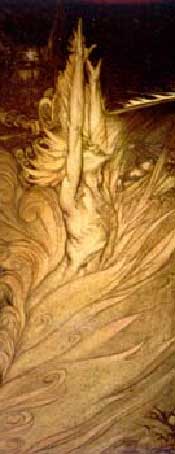
Here’s Loki/Loge as a fire-god in one of Arthur Rackham’s illustrations for Wagner’s Ring:
p. 113: Magee makes it sound as though anarchists generally are anti-civilisation, which is certainly not true. William Godwin, the founder of modern anarchism, writes:
Innocence is not virtue. Virtue demands the active employment of an ardent mind in the promotion of the general good. No man can be eminently virtuous who is not accustomed to an extensive range of reflection. ... Ignorance, the slothful habits and limited views of uncultivated life, have not in them more of true virtue, though they may be more harmless, than luxury, vanity and extravagance. Individuals of exquisite feeling, whose disgust has been excited by the hardened selfishness or the unblushing corruption which have prevailed in their own times, have recurred in imagination to the forests of Norway or the bleak and uncomfortable Highlands of Scotland in search of a purer race of mankind. This imagination has been the offspring of disappointment, not the dictate of reason and philosophy.
... Civil society maintains a greater proportion of security among men than can be found in the savage state: this is one of the reasons why, under the shade of civil society, arts have been invented, sciences perfected and the nature of man, in his individual and relative capacity, gradually developed. (Godwin, Enquiry, 3rd ed. I.7, VIII.2.)
Godwin’s aim is not to replace civil society, but rather to replace government with civil society.
pp. 115-116: Magee discusses the Valhalla, Ring, Spear, and Giants motifs. Here they are:
While we’re on the subject, here are two of the best-known tunes from The Ring:
DIGRESSION:
One of the greatest Wagner parodies ever is Warner Brothers’ 1957 “What’s Opera, Doc?” wherein Elmer Fudd chases Bugs Bunny across a German expressionist landscape to the tune of “Ride of the Valkyrie” and other Wagner melodies. The sequence from 2:20-2:38, and again from 5:25-6:00, where Elmer demonstrates his magic helmet, is a direct nod to Mickey Mouse in the “Sorcerer’s Apprentice” segment in Disney’s Fantasia:
Lawrence: Rainbow, chs. 6-12
ch. 6: “A faint, gleaming horizon, a long way off, and a rainbow like an archway, a shadow-door with faintly coloured coping above it. Must she be moving thither?” – The rainbow seems to represent the call that Anna receives and fails to act on, but which her daughter Ursula successfully pursues. (What about Ursula’s sister Gudrun? Does she count as responding to the call or not? Certainly she doesn’t lapse into cowlike domesticity; yet she seems to represent some sort of failure that contrasts with Ursula’s success.)
Rainbows have other associations. We’ll see a nod to the Biblical rainbow in chapter 11; and here too the rainbow seems to serve as a promise of worldwide renewal. Another precedent is the Norse (and Wagnerian) concept of the rainbow as Bifröst, the “shimmering road” or magical bridge that leads from Midgard (the realm of humans) to Asgard (the realm of gods).
And of course there’s also Nietzsche’s invocation, in Zarathustra I.11, of “the rainbow and the bridges of the overman.” Ursula’s ambivalence between anarchy and aristocracy suits the Overman pretty well too.
Nowadays we’re also likely to think of Oz as the land “over the rainbow,” but that conceit is found only in the 1936 movie (well after Lawrence’s death), not in the original books.
The chapter title “Anna Victrix” means “Anna Victorious,” but is she? Victorious over her husband, maybe, but refusing the rainbow’s call seems like a failure.
Bamberg Cathedral:
ch. 7: Lincoln Cathedral:
ch. 10: Ursula is horrified by a Peter-Paul Rubens painting featuring “storms of naked babies” and titled “Fecundity.” No such painting seems to exist. (Rubens has a painting, “Birth of the Dauphin,” in which the allegorical figure of Fecundity features, but no storms of babies.) The editor of the Penguin edition (p. 486) suggests that Lawrence might have had in mind either Rubens’ Feast of Venus or his Sacrifice to Venus:
Rubens: Feast of Venus
Rubens: Sacrifice to Venus
But to my mind, Rubens’ Feast of the Holy Innocents does a better job of conveying “storms of naked babies” and terrifying fecundity:
The lines about Elaine and Lancelot are from Idylls of the King, a cycle of Arthurian poems by Tennyson.
“Il était une bergère” (“There was a shepherdess”), which Theresa doubts is a Sunday song, is a 17th-century French folksong, nowadays thought of mainly as a children’s song, about a shepherdess who kills her kitten for stealing her cheese, and then immediately repents her action. (Remember, Rudolf stabbing Mariechen was a children’s song too.) In one somewhat-less-for-children version, the shepherdess then goes to her priest to confess her deed, and the priest demands sexual favours from her as her penance. (So it’s sort of a Sunday song.) Here’s a recording, lecherous priest and all:
Ursula’s father is mentioned as being fond of Raphael’s Dispute of the Sacrament and Fra Angelico’s Last Judgment. Here they are:
Raphael: Dispute of the Sacrament
Fra Angelico: The Last Judgment
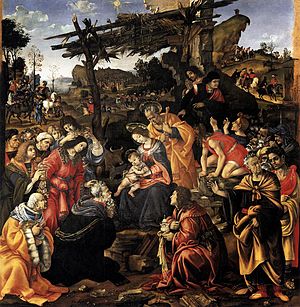
The text doesn’t mention which “beautiful, complicated renderings of the Adoration of the Magi” Lawrence has in mind, but since Giotto and Lippi are namechecked, here are their versions:
Giotto: Adoration of the Magi
Lippi: Adoration of the Magi
ch. 11: Ursula’s uncle Tom is compared to “the cynical Bacchus in the picture.” The editor of the Penguin edition suggests Caravaggio’s Bacchus; there are two versions:
In the conflict between Ursula and Skrebensky over the value of war, Lawrence is on Ursula’s side; he was an antiwar activist during the nationalistic fervor of World War I. As an English national married to a German national, Lawrence came under suspicion from both sides; he was briefly arrested as an English spy while visiting Germany before the war, and again as a German spy in England during the war. He and Frieda were forced to give up their cottage in Cornwall (despite having paid a year’s advance on it which they could ill afford) because the government forbade them to live near the coast (the idea being that they might be signaling to German vessels offshore). This governmental lunacy, combined with the banning of The Rainbow, was part of what drove Lawrence into voluntary exile after the war.
(During World War II, my mother was a schoolgirl in Denver, where there were air raid drills, and mandatory blackouts so that German or Japanese bombers would not be able to see their bombing targets. In Denver. A city with no major military value, over a thousand miles from the nearest coast. Who were these mad Axis bombers, that would supposedly fly a thousand miles inland, with no opportunity to refuel, somehow evading u.s. radar, to hit a pointless target in the Rocky Mountains, bypassing the more tempting naval targets along the coast? I’m reminded of how, in the wake of the 9/11 attacks, the Auburn stadium immediately heightened its security, apparently on the theory that if the World Trade Center and the Pentagon were the terrorists’ top two targets, Jordan-Hare must be target number three.)
The passage from Genesis about God’s setting a “bow in the cloud” after the flood is a reminder of the book’s title.
ch. 12: “Shame” was, as the editor of the Penguin edition notes, a “common term for homosexual love at this period.” Lawrence himself does not seem to have regarded homosexual relationships as “shameful,” though his views on the subject are complex. As we’ll see in Women in Love, he thought the ideal situation was for a man to have a sexual relationship with a woman and, at the same time, an intensely homoerotic but non-sexual relationship with a man. (Whether such a pairing would be ideal for a woman as well, he fails to say.) In his letters he writes that, as he sees it, in homosexual relationships “a man projects his own image on another man, like on a mirror,” whereas “from a woman he wants himself re-born, re-constructed.” Hence homosexual relationships are more easily satisfying, but also more superficial and limiting, whereas heterosexual relationships hold out greater promise of growth, but precisely because their ambitions are harder to achieve, they tend to be more frustrating. Scholars do not agree as to whether Lawrence ever had a sexual relationship with a man. But Lawrence did say that he “should like to know why nearly every man that approaches greatness tends to homosexuality, whether he admits it or not.” (Letters of D.H. Lawrence, vol. 2, p. 115) Certainly three of our four novelists had some sort of homosexual tendencies.
Lawrence does not seem to have put a terribly high premium on fidelity; he and Frieda were both repeatedly unfaithful to each other (Frieda more often and more insouciantly than Lawrence), but each seems to have regarded the other’s infidelities as merely annoying. (Lawrence was somewhat more annoyed by Frieda’s infidelities than she was by his, but then Lawrence was generally more annoyed by everything, whereas Frieda tended to take things more easily in stride.)
Ursula “standing before a great ash, in worship,” is reminiscent of the Norse myth of Yggdrasil, the great ash tree that ties the cosmos together, and upon which Odin hung for nine days, sacrificing himself to himself in order to gain secret knowledge.
The passage about lions vs. lambs and eagles vs. doves is very Nietzschean.
Although this is Nietzsche’s best-known book, most people probably know the title (or its German form, Also sprach Zarathustra) rather as the title of a piece of music (by Richard Strauss, though they may not know the composer); and they know the piece of music mainly because its first movement figures as the opening and closing music of 2001: A Space Odyssey.
Since that movie opens with the first stage of apes’ development into humans, and closes with a human’s development into a superhuman child, it seems appropriate to connect it with Zarathustra, a book that begins with the proclamation:
Once you were apes, and even now, too, man is more ape than any ape. ... What is the ape to a man? A laughingstock or a painful embarrassment. And man shall be just that for the overman: a laughingstock or a painful embarrassment. ... I teach you the overman. Man is something that shall be overcome.
And then Zarathustra goes on to describes the Overman as a child: “innocence and forgetting, a new beginning.”
But why does Nietzsche pick the name “Zarathustra”? Historically, Zarathustra (or Zarathushtra) is the Persian name of the religious leader usually known in the west as Zoroaster, founder of Zoroastrianism (i.e. the Magi or Parsees). (Another western version of his name is “Sarastro” under which moniker he figures in Mozart’s Magic Flute.)
The historical Zarathustra’s dates are disputed. We know he lived no later than the 6th century BCE. Some scholars place him precisely then; others place him earlier, by anywhere from a century to a millennium. Both Zoroastrian and ancient Greek sources place him still earlier by several thousand years.
The central idea of Zoroastrianism is that the universe is a battleground between two forces or entities: a God figure, manifested in fire, light, order, and truth, and known as Ahura-mazda or Ohrmazd; and a Satan figure, manifested in darkness, chaos, and falsehood, and known as Angra-mainyu or Ahriman. Zoroastrians look forward to a final battle at the end of time, in which the evil force will be defeated finally and forever, and the virtuous will be resurrected in paradise.
So far this looks rather familiar to a Judeo-Christian audience; indeed many scholars (evidently including Nietzsche) think that Judaism and Christianity got these ideas originally from the Zoroastrians, during the period when Jerusalem was under Persian rule. But there are some important differences. For one, the Zoroastrian God is not omnipotent; the reason he doesn’t defeat Satan instantly is that he can’t. He’s powerful enough that his eventual victory is assured, but Satan will make him fight every inch of the way. Another important difference is that Satan is not a former angel who fell to the dark side; instead his nature has always been evil. And Satan wasn’t created by God; God and Satan have both always been here as basic features of the universe. This is Zoroastrianism’s solution to the theological problem of evil. (Though one branch of Zoroastrianism, called Zurvanism, represented God and Satan as twin offspring of a cosmic entity called Zurvan [or Father Time] who was himself beyond good and evil. This does not seem to be the oldest form of the doctrine, however.)
If all this sounds like the Manichean doctrine that the young Augustine flirted with before his conversion to Christianity, that’s because Manicheanism was in large part an offshoot of Zoroastrianism. The main thing that Manicheanism adds to Zoroastrianism is the idea that matter as such is inherently evil. (One of the things that eventually drove Augustine away from Manicheanism was his rejection of the idea that anything can be evil by nature; for Augustine, evil is always the perversion of a thing’s nature, not the fulfillment of that nature. Hence Satan must be a fallen angel, not an intrinsically evil power.)
At some point in the Indo-Iranian past, Zoroastrianism, or perhaps more precisely the older religious tradition that would develop into Zoroastrianism, seems to have branched off from (the religious tradition that would develop into) Hinduism. That the parting was acrimonious is suggested by the fact that the Zoroastrian term for a god or angel (ahura) corresponds to the Hindu term for a demon (asura), while the Zoroastrian term for a demon (daeva) corresponds to the Hindu term for a god (deva). (Despite the similarity, daeva/deva is not cognate with “devil”; it is with “divine,” though.) This is similar to the way in which the ancient Hebrews went from using Baal as a synonym for Jehovah, to using it as a synonym for the Canaanite god Hadad, regarded by the Jews as a demon. (The fact that “Baal” is originally a title, meaning “Lord,” rather than a proper name, makes the shift less surprising.)
Why would Nietzsche pick as his mouthpiece someone like Zarathustra, whose central ideas seem so alien to his own? Nietzsche’s own answer in Ecce Homo is as follows: “Zarathustra was the first to consider the fight of good and evil the very wheel in the machinery of things: the transposition of morality into the metaphysical realm, as a force, cause, and end in itself, is his work.” In short, Zarathustra is the originator of the idea of a “moral world order”; and since he is the one who “created this most calamitous error,” it is fitting that he “also be the first to recognize it.” (Basic Works, pp. 783-4)
This by itself would be an inadequate explanation; after all, if I were writing what I intended as the ultimate refutation of Nazism, I wouldn’t sign the book “Adolf Hitler.” But Nietzsche goes on to say that there’s something admirable in Zoroastrianism that would naturally lead it to develop into its atheistic and immoralistic opposite, namely the fact that it “posits truthfulness as the highest virtue.”
Whether truthfulness is indeed a great virtue is something Nietzsche himself seems of two minds about. Sometimes he prides himself on his unwillingness to accept or perpetuate any illusions. At other times he insists that the will to truth should be subordinated to the will to life, and thus that certain deceptions or illusions may be necessary. In Ecce Homo he writes: “How much truth does a spirit endure, how much truth does it dare? More and more that became for me the real measure of value.” (Basic Writings, p. 674; cf. also Beyond Good and Evil, § 39 (BW, p. 239.)
Yet we’ve also seen him, on the last page of Nietzsche contra Wagner, praising the Greeks for knowing how to “stop courageously at the surface.”
In the passage where Nietzsche connects the historical Zarathustra with truthfulness, he adds: “To speak the truth and to shoot well with arrows, that is Persian virtue.” (Basic Writings, p. 784) This recapitulates a line in Zarathustra itself: “‘To speak the truth and to handle bow and arrow well’ — that seemed both dear and difficult to the people who gave me my name.” (Portable Nietzsche, p. 171) Nietzsche is likely drawing on the following passage on Persian customs in Herodotus:
Their sons are carefully instructed from their fifth to their twentieth year, in three things alone – to ride, to draw the bow, and to speak the truth. ... The most disgraceful thing in the world, they think, is to tell a lie; the next worst, to owe a debt: because, among other reasons, the debtor is obliged to tell lies.
Nietzsche’s book calls for a higher type of being, the Overman (Übermensch; rendered “Superman” in older translations). Hence Zarathustra is not himself the Overman; he falls short of the ideal he proclaims. Is Zarathustra, then, a stand-in for Nietzsche? To some extent, yes; but Nietzsche often writes as though Zarathustra represents a higher form of human achievement than Nietzsche’s own. We might think of Zarathustra, then, as an intermediate stage between Nietzsche and the Overman.
Prologue: PN, pp. 127-128: The model here seems to be the Sermon on the Mount; Zarathustra’ list of those who are beloved is similar (in form) to Christ’s list of those who are blessed.
PN, pp. 129-130: If the Overman is one possible future for humankind, the Last Man is the other. I’ve mentioned before that the Last Man seems inspired in part by Herbert Spencer’s vision of future evolution (as portrayed in such works as Social Statics, Principles of Ethics, and Principles of Sociology). Spencer’s view was that since, among social animals, those who are better at cooperation tend to outcompete those who are not, human beings are gradually becoming better and better adapted to social existence, and their capacities for sympathy are being gradually heightened (for example, we no longer enjoy gladiatorial combats or public executions), so that eventually we will feel other people’s pains as strongly as our own, at which point the distinction between egoism and altruism will dissolve, human beings will cease to pose any danger to one another’s interests, and so there will be no no more need for government (hence Nietzsche’s description “no shepherd and one herd”).
To Nietzsche this sounds like a tepid, conformist nightmare – though given Spencer’s stress on self-realisation and the inevitability of human differences, what Nietzsche took away from Spencer’s vision of an ideal future may not be entirely what Spencer intended. (Incidentally it’s striking, reading the third chapter of J. S. Mill’s On Liberty, how much Mill’s paean to an individualistic social order that will transcend the dichotomy between “pagan self-assertion” and “Christian self-denial” sounds both like Nietzsche’s critique of Spencer, and like Spencer himself.
I.1: PN, pp. 137-139: Here Nietzsche gives us three stages of spiritual development: camel, lion, and child. In a note written about a year later, Nietzsche describes the same threefold progression:
“Thou shalt” — unconditional obedience in Stoics, in the Christian and Arab orders, in the philosophy of Kant (it is immaterial whether to a superior or to a concept).
Higher than “thou shalt” is “I will” (the heroes); higher than “I will” stands “I am” (the gods of the Greeks). (Will to Power § 940; WP, p. 495)
(Associating “I am” with the gods of the Greeks is a bit surprising, since there’s another deity more famously associated with that phrase.)
When I first read Zarathustra, back in the mists of circa-1980, I thought the threefold musical progression at the opening of Strauss’s composition (see above) was supposed to represent these three stages (since Strauss makes the first effort sound like a failure [albeit a noble one], makes the second sound like a success, and makes the third sound like a triumph). But apparently Strauss intended that music to represent the sunrise in the Prologue instead. (Which Kubrick evidently understood better than I did.) Oh well.
I.4: PN, p. 146: “soul is only a word for something about the body.” This is the passage Wittgenstein is referring to when he says “Am I saying something like, ‘and the soul itself is merely something about the body’? No. ... I am not that hard up for categories.” (Remarks on the Philosophy of Psychology, vol. II, § 690)
I.9: PN, pp. 157: “Yellow the preachers of death wear, or black”: a reference to the saffron-yellow robes of the Buddhist monk, and the black garments of the Christian priest.
“They encounter a sick man or an old man or a corpse”: this is a reference to the sights that according to Buddhist tradition led the previously sheltered prince Siddhartha Gautama to discover the suffering-laden and transitory nature of human existence, thus setting him on the path to becoming the Buddha.
p. 158: The idea that those for whom “life is furious work” are “ripe for the preaching of death” may remind us of Aschenbach.
Lawrence: Rainbow, chs. 13-16
ch. 13: “Sweet Thames run softly” (or “Sweete Themmes runne softlie”) is the refrain of Edmund Spenser’s poem Prothamalion.
“C’est la Mère Michel” is another 17th-century French song, somewhat similar in theme to the last one, though the cat is a bit luckier – at least in the short run:
Here’s a translation (omitting the nonsense refrain):
It’s Mama Michel who has lost her cat,
who cries from the window for someone to return it to her.
It’s Papa Lustucru who replied to her:
“Come on, Mama Michel, your cat isn’t lost.”
It’s Mama Michel who asked him:
“My cat is not lost? You have found it, then?”
It’s Papa Lustucru who replied to her:
“Give a reward; it will be returned to you.”
And Mama Michel told him: “It’s decided –
if you give me back my cat, you shall have a kiss.”
And Papa Lustucru, who didn’t want one,
told her: “Your cat has been sold as a rabbit.”
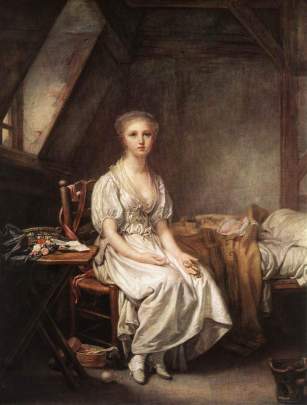
“reproductions from Greuze”; here’s a sample of J. B. Greuze’s work:
And here’s Joshua Reynolds’ “Age of Innocence”
“some work about ‘Woman and Labour’”: probably a reference to Woman and Labour by the South African writer Olive Schreiner, best known for her novel Story of an African Farm. Schreiner’s works explore issues of interest to Lawrence, including sexuality, socialism, atheism, antimilitarism, and women’s independence:
“sportive as a fawn” from Wordsworth’s poem “Lucy.”
ch. 14: Lawrence mentions a number of Renaissance artworks. Here’s Della Robbia’s Madonna:
One of Donatello’s reliefs:
Botticelli’s “Primavera” (or “Springtime”):
Botticelli’s “Aphrodite”:
And Botticelle’s “Nativity”:
ch. 15: “the big college built of stone”: University College Nottingham, at that time housed in its original headquarters on Shakespeare Street. Lawrence had studied there:
Ursula’s increasing disillusionment with the goals of higher education resembles Nietzsche’s.
I suspect a joke in the fact that a Dr. “Frankstone,” whose name is almost “Frankenstein,” is given lines about how life can ultimately be understood in terms of electricity and chemistry.
In the space of a single page Ursula rejects democracy in favour of aristocratic rule, because she feels superior to other people, and then attacks Skrebensky for wanting to rule over the native population in India because he thinks he’s superior. Lawrence’s political commtments can be as elusive as Nietzsche’s.
ch. 16: Willey Green and Willey Water are based on Moorgreen and Moorgreen Reservoir, in Lawrence’s hometown of Eastwood (here transformed into Beldover); they show up again in Women in Love, as the site of Gerald Crich’s estate, “Shortlands.”
The novel ends with a vision of the rainbow once more.
Lawrence: Women in Love, chs. 1-4
The first half of The Rainbow was a generational saga; the second half focused narrowly on Ursula. Ursula continues to be the most important character in Women in Love, but the focus expands to cover four principal characters: Ursula, her sister Gudrun, Rupert Birkin, and Gerald Crich (with a long I).
Most of the characters in Women in Love are based on real people; the portraits are unflattering enough, and their targets obvious enough, to have destroyed friendships and inspired lawsuits. (The appendices in the Penguin edition offer some details as to persons and places.) Just as Lawrence based Ursula and Gudrun on Frieda von Richthofen and Katherine Mansfield respectively, so he based Birkin and Gerald, the sisters’ love interests, on their models’ real-life husbands – Birkin on Lawrence himself (notice that the names “D. H. Lawrence” and “Rupert Birkin” are similar in rhythm), and Gerald, in part, on the essayist John Middleton Murry (1889-1957).
Here are Richthofen and Mansfield again:
Frieda (von Richthofen) Lawrence (Ursula)
Katherine Mansfield (Gudrun)
And here they are with their significant others:
D. H. and Frieda Lawrence
J. M. Murry
Mansfield and Murry
The other chief model for Gerald was Thomas Philip Barber, head of a coal mining company (and, believe it or not, sometime Sheriff of Nottinghamshire, though he seems not to have had any run-ins with Robin Hood).
Birkin is to a considerable extent Lawrence’s mouthpiece in the book; yet interestingly, Lawrence allows Ursula to push back quite a bit against Birkin’s ideas and manner, and her doing so is presented largely sympathetically. The Ursula-Birkin relationship seems to function as a way of giving Lawrence some critical distance on himself.
Women in Love was filmed in 1969 by Ken Russell; here’s an (incredibly pretentious) trailer:
Two decades later (1988-1989), Russell returned to film the prequel The Rainbow. Glenda Jackson, who played Gudrun in Women in Love, plays Gudrun’s mother Anna this time around; it’s also got Paul McGann (the eighth Doctor Who) as Skrebensky. Here’s a trailer:
Around the same time (1988), The Rainbow was likewise filmed as a miniseries, directed by Stuart Burge. Here’s a trailer:
In 2011, Women in Love was filmed again, this time also as a miniseries; Miranda Bowen directed.. For some reason Gerald has become the main character (and looks more like Birkin than Birkin does). Here’s a trailer:
I own all four! (Some of them are damn hard to find, at least in Region 1 format.) I might show them, or parts of them, to the class, were we differently circumstanced.
ch. 1: Women in Love opens with Gudrun half-heartedly recommending marriage and Ursula resisting it. Recall the tales of their fifth-century originals: St. Ursula was killed for refusing to marry a Hunnish chieftain, while Gudrun/Kriemhild reluctantly married a Hunnish chieftain, and then either killed him or got killed herself.
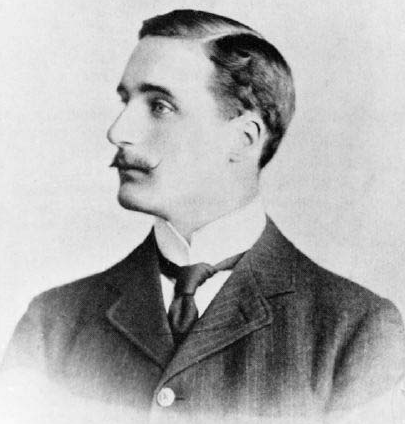
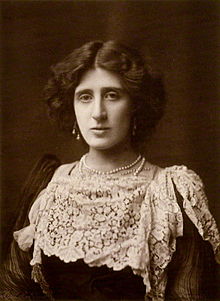
Hermione Roddice is based on Lady Ottoline Morrell, best known among philosophers for being Bertrand Russell’s lover:
Morrell was also a friend of André Gide, of whom she took a number of famous photos. She may in addition have been a model for Lawrence’s most famous character, Lady Chatterley, despite the substantial differences between Chatterley and Hermione. Despite Hermione’s romance with Birkin in Women in Love, there was no similar relationship between Lawrence and Morrell. She was not happy about her portrayal in Women in Love – for good reason, as you’ll see.
ch. 2: As mentioned above, Shortlands, Gerald’s estate on the Willey Water, is based on Lamb Close House, an estate on the Moorgreen Reservoir belonging to Thomas Philip Barber, one of the two main models for Gerald’s character.
Gerald inherits one of Barber’s real-life tragedies: having accidentally, in childhood, killed his brother.
The dispute among Birkin, Gerald, and Hermione over government and nationality mirrors a similar dispute between Ursula and Skrebesnky in The Rainbow (ch. 11).
Skrebensky: “[I]f there were no nation .... you’d just be a prey to everybody and anybody. ... They’d come and take everything you’d got.”
Ursula: “Well, they couldn’t take much even then. I don’t care what they take. I’d rather have a robber who carried me off than a millionaire who gave me everything you can buy.”
Hermione: “A man does not come and take my hat from off my head, does he?”
Gerald: “Only because the law prevents him.”
Birkin: “Not only. ... Ninety-nine men out of a hundred don’t want my hat. ... And if he does want my hat, such as it is ... why, surely it is open to me to decide, which is a greater loss to me, my hat, or my liberty as a free and indifferent man. If I am compelled to offer fight, I lose the latter. It is a question which is worth more to me, my pleasant liberty of conduct, or my hat.”
Birkin should take Hermione more seriously when she threatens lethal violence against anyone who would take her hat. Lawrence isn’t hanging this detail on the wall for nothing.
ch. 4: While watching Gerald swimming, Ursula tells Gudrun that he looks like a Nibelung. Strictly speaking, a Nibelung or Niflung is a dwarf – an inhabitant of Niflheim (the “world of mist”), one of the Nine Realms of Norse cosmology. But because the cursed treasure of Andvari/Alberich the dwarf, stolen by Sigurd/Siegfried from the dragon Fafnir/Fafner, eventually fell into the hands of Gunnar/Gunther and his Burgundian tribe, the ambiguity of the phrase “treasure of the Niflungs/Nibelungs” led to the term being applied to the Burgundians; thus we find Gunnar and his brothers being referred to as Niflungs or Nibelungs in both the Icelandic and Germanic traditions (which would make the original Gudrun, as Gunnar’s sister, a Nibelung also, in that sense). Wagner’s opera restores the original meaning; his Nibelungs are dwarves.
While physically Gerald looks more like a Burgundian warrior than like a dwarf, Ursula probably has the Wagnerian meaning in mind: at the beginning of Das Rheingold, Alberich the dwarf plunges into the Rhine to get the attention of the Rhinemaidens, just as Gerald is waving to the Brangwen sisters while swimming (though Gerald seems not to share Alberich’s lustful intentions).
Alberich the Nibelung trying to swipe right on a Rhinemaiden
Moreover, as an industrialist Gerald has some affinity with the dwarves, whose lives focus on mining and metalworking. (Heigh ho, heigh ho, it’s off to work we go, we must away ere break of day, to seek the pale enchanted gold.)
Nietzschean Tune of the Week
Here’s Nietzsche’s “So lach doch mal” (“So laugh already”). The tune doesn’t particularly seem to match the title: