PN, p. 608: In Greek mythology, Zeus disguises himself as the mortal human Amphitryon in order to have sex with Amphitryon’s wife Alkmene; the result is the demigod Herakles.
PN, p. 618: Paul’s hometown, Tarsus, was a center of Stoic learning, which is perhaps why Paul’s writings paraphrase Stoic authors and make use of Stoic concepts.
PN, p. 625: Oh look, Petronius.
PN, p. 628: Kaufmann points out in a footnote that, contrary to what Nietzsche implies, Eve’s name does not resemble any Hebrew word for snake. This is true; however, it does resemble the Aramaic word for snake. Ha ha, I have the internet and Kaufmann didn’t.
PN, p. 634: “In hoc signo decadence triumphed”: a reference to Constantine’s vision of a cross with the words “In hoc signo vinces”: “In this sign you shall conquer.”
PN, p. 635: “ephexis” means restraint, caution, unwillingness to decide too quickly.
PN, p. 645: “pulchrum est paucorum hominum”: see last week.
PN, p. 647: “Christian” and “anarchist” rhyme in German.
PN, p. 654: “peccatum originale”: “original sin.”
There Must Be Some Way Out of Here
If you’re wondering how accurate the portrayal of Rand’s salons was in Rothbard’s satirical play “Mozart Was a Red” from last week, check out my interview with Tulane philosopher Eric Mack, who describes his encounter with Rand, Branden, and the Inner Circle at 4:30-9:45.
Rand: Fountainhead I.12-15 & II.1-2
I.12: Bats and vampires I understand, but why werewolves? Werewolves can’t fly.
That Dominique mocks the irresponsibility of both the wealthy landlords and their lower-class tenants is striking, given that (from Rand’s reputation as an apologist for the rich) one might expect her to mock only the latter.
Dominique’s lines to Alvah about everyone being trapped in a net of dependence as soon as they give in to a single desire sounds like a mixture of Stoicism and Buddhism – though of the two, it’s Stoicism that Rand is more likely to have in mind, since she was familiar with – and respected – Greek philosophy, while she was contemptuous toward Indian philosophy and seems to have known nothing about it. (Nevertheless there are a number of interesting parallels between Indian philosophy and Rand’s ideas, as I’ve discussed here, though when I wrote that I didn’t think of this particular passage.)
Dominique’s and Peter’s parents are both in favour of their relationship. Guy Francon’s motive seems, at least mostly, to be concern for her happiness; his genuine affection for his daughter is one of his few redeeming qualities. Louisa Keating’s relationship with her son is much more complicated, and it’s harder to know whether her affection is genuine, as she is much more manipulative, and also has a strong desire to promote Peter’s ambitions so that she can bask in his reflected glory. We’ll see her and Guy Francon paralleled again.
I.13: Rand’s original title for The Fountainhead was Second-hand Lives (just as We the Living, Anthem, and Atlas Shrugged were originally titled Airtight, Ego, and The Strike, respectively). She changed it because it seemed to put the focus on the supporting characters rather than the hero. The two second-hand lives she had primarily in mind were presumably Peter Keating and Gail Wynand, but Roark’s would-be clients Mrs. Wilmot and Robert Mundy also fit the bill.
Of particular interest is Rand’s claim that there was “no such person as Mrs. Wayne Wilmot; there was only a shell containing the opinions of her friends. the picture post cards she had seen, the novels of country squires she had read ... this immateriality which could not hear him or answer, deaf and impersonal like a wad of cotton.” This description is reminisicent of Nietzsche’s reference (in Daybreak II.105) to those pseudo-egoists who live in a “fog of habits and opinions” in the form of “the phantom of their ego which has formed itself in the heads of those around them.”
Also of interest in filling in Rand’s conception of independence is Roark’s claim that in trying to imitate those who intimidated him, Mundy is “not challenging” other people’s supremacy over himself, but rather “immortalizing it.”
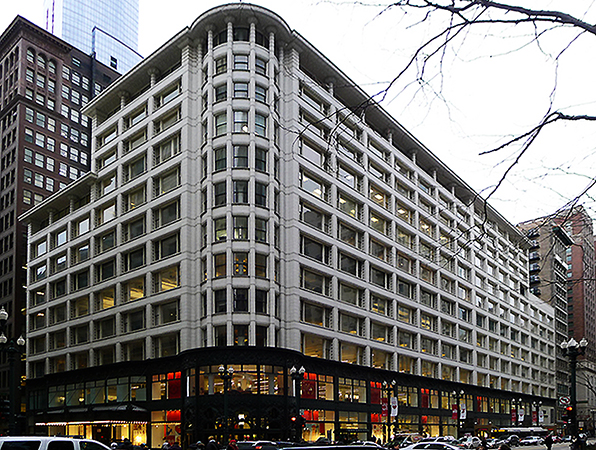
The Fargo department store may be inspired by Sullivan’s Carson-Pirie-Scott department store:
Dominique tells Peter that the only way she would ever marry him is in order to punish herself for “something terrible.” This is worth remembering.
I.15: This chapter presents two opposing conceptions of selfishness. First, Peter’s determination to badger Lucius Heyer into retirement – a determination that instead leads to Heyer’s death – is described as exemplifying the supposed truism that “everybody is selfish.” But is everybody really selfish, in Rand’s sense? Is Peter genuinely selfish, in Rand’s sense?
Second, Roark describes his decision to turn down the Manhattan Bank commission rather than compromise his artistic integrity as “the most selfish thing you’ve ever seen a man do,” even though it means he has to close his office, give up his career, and take up work as a manual labourer – for how long he doesn’t know. By conventional standards, Peter’s act is self-interested and Roark’s is self-sacrificing; but Rand is inviting us to reverse these judgments.
II.2: And this brings us to the notorious rape scene, which seems to create two problems for Rand’s novel.
The first is simply the general, moral problem of glamourising rape. The idea of the “salutary rape,” of the rape’s being what the victim really and secretly needs, isn’t unique to Rand; it’s a well-established trope in literature and popular entertainment, showing up in movies from 1939’s Gone With the Wind to 1974’s Young Frankenstein, as well as in authors one would have hoped would know better, such as Zora Neale Hurston (in Seraph on the Suwanee), Kurt Vonnegut (in “Welcome to the Monkey House”), and Michael Moorcock (in the first edition of Gloriana). But I don’t think the fact that Rand is reflecting a popular trope gets her off the hook here; if anything, her depiction is more harmful if it contributes to an existing oppressive pattern than it would be if it were simply one author’s idiosyncratic fantasy.
But in addition to that general, moral problem, there’s a more specific, aesthetic problem, one that applies to The Fountainhead in particular. This isn’t the only salutary-rape scene in Rand’s work; the other is in Night of January 16th, where the hero Bjorn Faulkner rapes the heroine Karen Andre. (Technically this isn’t a rape scene, since the rape occurs before the play begins, and so is described in dialogue rather than depicted, but that’s a minor detail.) But while the Bjorn-Karen rape remains morally problematic, it doesn’t create a tension within the play’s aesthetic purpose, because Bjorn is explicitly portrayed as a Nietzschean immoralist and criminal who respects no constraints on his will. Whether Rand was a literal immoralist when she wrote it or was only (as she claimed) using immoralism symbolically (or somewhere in between), a “justified rape” is not incongruous for a superman beyond good and evil.
But one of the major themes of The Fountainhead is the rejection of Nietzschean domination, as a mistaken conception of self-interest. So a justified rape doesn’t seem consistent with the novel’s aesthetic purpose.
I’ve mentioned above that Rand, like D. H. Lawrence, was torn on the issue of relations between the sexes. On the one hand, both liked creating strong, independent, career-minded heroines like Ursula (for Lawrence) or Kira and Dagny (for Rand). Yet both, at the same time, had a strong inclination toward male supremacy; Rand called man “metaphysically the dominant sex”; loved the ultra-chauvinistic heroes of detective novelists Mickey Spillane and Donald Hamilton; was thrilled when the economist Ludwig von Mises called her the “most courageous man in America”; and claimed that no woman should be president because a psychologically healthy woman couldn’t bear to be in a position of authority over all the men around her. (Ironically, most of the men around Rand were either her rather passive husband or a bunch of awe-stricken disicples.) Nietzsche seems to have been a bit torn too, since he loudly proclaimed male supremacy, yet was attracted to decidedly unsubmissive women like Lou Salomé.
Rand herself claimed that the Roark-Dominique scene “was not an actual rape, but a symbolic action which Dominique all but invited. This was the action she wanted and Howard Roark knew it.” (quoted in Essays on We the Living, p. 230) But for a libertarian like Rand, with her emphasis on the sanctity of individual choice, the difference between “invited” and “all but invited” should be crucial – as should the difference between “wanted” and “consented.” (If I’m trying to diet, but am tempted by the slice of pizza on the table in front of me, the fact that I want the pizza doesn’t make it legitimate for you to force it down my throat against my will.) Libertarian feminist Wendy McElroy likewise argues (in Gladstein & Sciabarra, Feminist Interpretations of Ayn Rand, p. 165) that the scene merely represents “rough sex” rather than rape, and assimilates it to the similarly violent sex scene between Dagny and Rearden in Atlas Shrugged. But the two scenes seem importantly different; the Dagny-Rearden scene, though violent, is clearly consensual in a way that the Dominique-Roark scene doesn’t seem to be.
For that matter, even if it were a merely symbolic rather than literal rape, we could still wonder what a symbolic rape is doing in this novel, given that Rand’s explicit artistic credo requires that every element of an artwork advance the theme. Furthermore, Rand writes:
If one saw, in real life, a beautiful woman wearing an exquisite evening gown, with a cold sore on her lips, the blemish would mean nothing but a minor affliction, and one would ignore it.
But a painting of such a woman would be a corrupt, obscenely vicious attack on man, on beauty, on all values .... (Romantic Manifesto, p. 25)
We may think Rand has underestimated the range of possible meanings of such a painting. Still, we can take her main point: that various things that are unproblematic in real life might be a mistake to include in a novel, if their inclusion would give them an artificially exaggerated significance. Suppose that simulated, mutually consensual, play-acting rape is compatible with being a proper ethical individualist (whether it is so or not is an interesting matter for debate); it still doesn’t symbolise such individualism. Rather, it symbolises Nietzschean domination – and so makes an odd inclusion in a work whose aesthetic aim is to symbolise an ethic of non-domination. “It’s perfectly fine for anti-domination people to symbolise domination in their sex lives,” even if we accept it, doesn’t imply “It’s perfectly fine to present symbolic domination positively in a novel with an anti-domination theme.”
Nietzsche: Will to Power 1. European nihilism
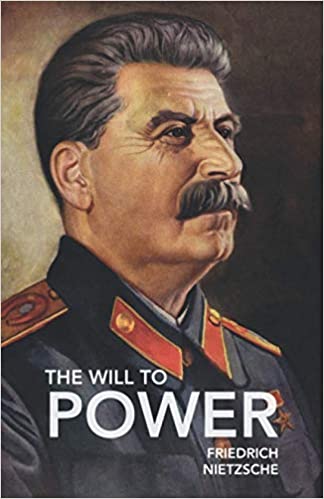
While Nietzsche had plans to write a book titled The Will to Power, this is not that book. Instead, it’s a collection of Nietzsche’s notes, edited and arranged under the supervision of Nietzsche’s sister after his death. The notes date from various different years, and might never have been intended by Nietzsche to go together in the same work. She also cut, pasted, and moved around texts in dubious ways, and deleted passages hostile to antisemitism. So the book should be used with caution. Still, it’s all stuff that Nietzsche genuinely wrote (while Elisabeth seems to have forged some of Nietzsche’s correspondence, she doesn’t appear to have outright forged any of the remarks in this volume) and so is worth our attention.
One recent edition (of an outdated and incomplete translation) makes the bizarre decision to put Stalin on the cover:
p. 11: Kaufmann’s footnote correctly informs us that “tout comprendre” means “understanding everything,” but without saying more, Kaufmann might leave us with the impression that Nietzsche is talking about some sort of intellectual ambition. In fact it’s a reference to the French saying “tout comprendre, c’est tout pardonner” (“to understand all is to forgive all”), also found in the variant “tout comprendre rend très-indulgent” (“to understand all renders one very indulgent”).
p. 17: Tartuffe, a character in Molière’s play of the same name, is a hypocrite who disguises his lust and greed under a false show of extreme piety. Why Nietzsche associates utilitarianism with such hypocrisy is unclear.
p. 63: the citizen of Geneva is Rousseau; the seigneur of Ferney is Voltaire.
Rand: Fountainhead II.3-7
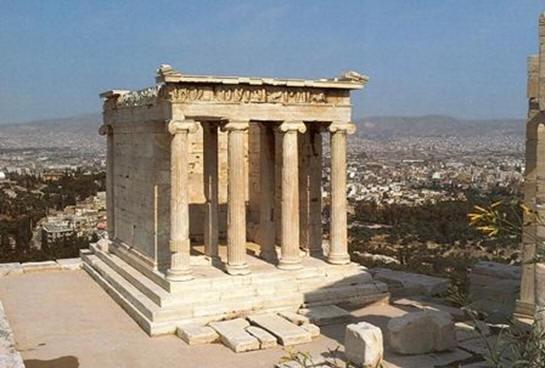
II.3: Toohey praises the temple of Nike Apteros at the expense of the Parthenon, and Keating pretends agreement. Here’s the temple in question, which stands next to the entrance of the Acropolis, near the Parthenon:
The name “Nikē apteros” means “wingless Victory,” because unlike most statues of Victory (see the one on the Doktor Faustus page) the now-lost statue in the temple had no wings, supposedly to ensure that Victory could never abandon Athens. (If so, it didn’t work.) (“Pter(on/yx)” means “wing,” as in “pterodactyl” (“wing-finger”), “pteranodon,” (“winged-no-teeth,” becasue it had a birdlike beak rather than teeth), “archæopteryx” (“ancient-wing“) or “helicopter” (“helix-wing,” “spiral-wing”), so “a-pteros” means “without a wing.” This is your Greek lesson for today. Also your paleontology lesson. Two taste treats in one!)
Toohey’s reaction to Keating’s description of Steve Mallory’s motive for trying to shoot Toohey presumably reflects the fact that Keating has come too close to describing, not Mallory’s psychology, but Toohey’s own. (Though while Rand does seem to have cast Toohey as the resentful incompetent, Toohey always seems rather too competent to fit that role well; that may be why, in Rand’s next novel, the role of resentful-incomptent is inherited by the much less competent – but also much less interesting – James Taggart. Toohey is really the only Rand villain it would be bearable to have lunch with.)
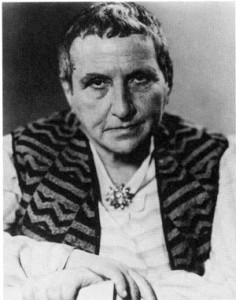
II.4: The work-model for the poet Lois Cook is Gertrude Stein:
The lines from Cook that Rand quotes at the beginning of the chapter – “Toothbrush in the jaw toothbrush brush brush tooth jaw foam dome in the foam Roman dome come home home in the jaw Rome dome tooth toothbrush toothpick pickpocket socket rocket” – are clearly a parody of such real-life Stein lines as “Never sink, never sink sinker, never sink sinker sunk, sink sink sinker sink” and “Once in a while and where and where around around is as sound and around is a sound and around is a sound and around.”
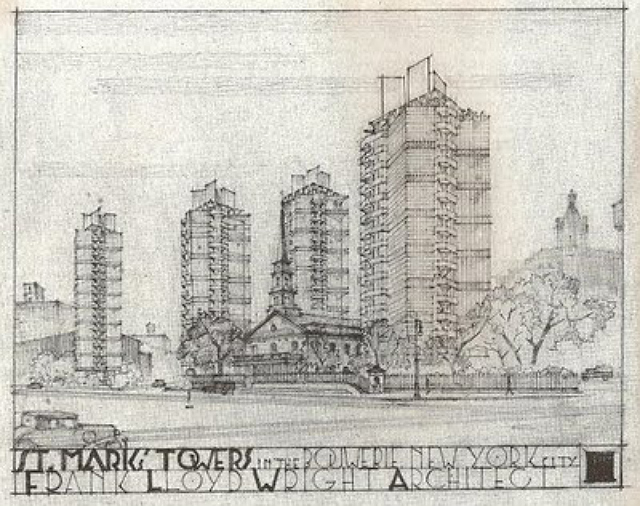
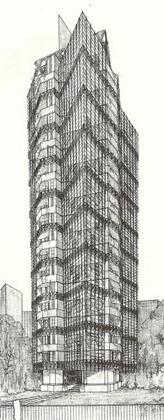
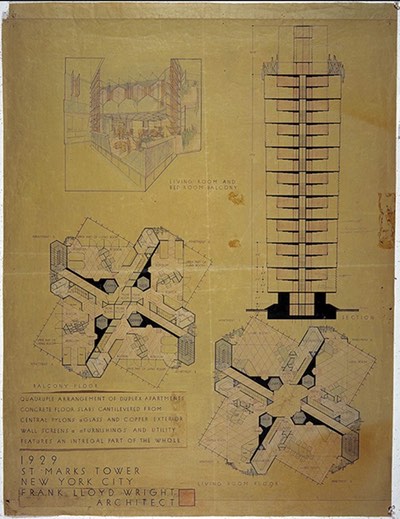
Cook’s formless, chaotic style is contrasted with the “severe mathematical order” of Roark’s sketches for the Enright House. The description of the Enright House as a conglomeration of separate domiciles held together like rock crystals is somewhat reminiscent of Frank Lloyd Wright’s designs for his (never built) St. Mark’s Towers project:
Certainly it’s a closer match than the model of the Enright House used in the 1949 film:
The fact that Peter, unlike Catherine, is seriously affected by Toohey’s observations about sweating palms and Mickey and Minnie Mouse shows that, at this point at least, he is in seriously greater psychological danger than Catherine. But the “harsh little note in her voice, defiant and unpleasant,” when Catherine talks about her nursing work is a sign that psychological danger is looming for her too.
II.5: Dominique gives Peter an important warning. As is the way with warnings in novels, he will forget it.
II.6: Toohey’s remark that “brains are a dangerous confession of weakness,” one which human beings develop only when “they have failed in everything else,” sounds rather like Nietzsche. This is not one of the areas where Rand is ever tempted by Nietzscheanism.
In I.15, we’re told that Keating hates Roark and will hate him forever. In the present chapter, we’re told that Keating loves Roark and will love him forever. Both seem to be true. Recall Hugo’s Grantaire (in Les Misérables) and Barkilphedro (in The Man Who Laughs).
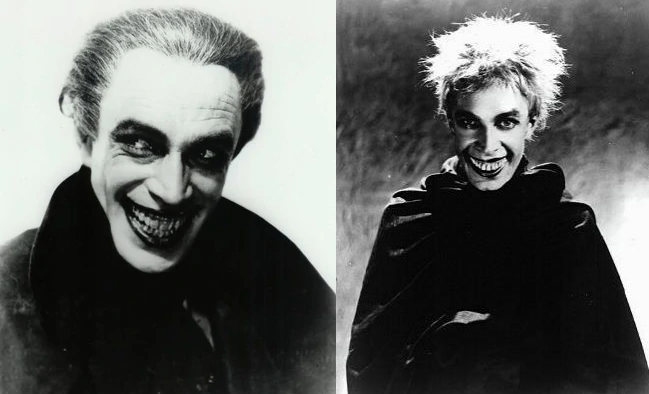
While mentioning The Man Who Laughs I should perhaps note that in the 1928 movie version (of which Rand was not fond, despite its featuring one of her favourite actors, Conrad Veidt, in an adaptation of a work by one of her favourite authors) the depiction of Gwynplaine, the titular man-who-laughs (because he had a grin carved onto his face in childhood – “do you want to know how I got these scars?”), was the original inspiration for the Batman villain the Joker, introduced in 1940 – although Gwynplaine, despite his appearance, is a pure innocent, more joked against than joking.
II.7: Toohey summarises the plot so far.
Nietzsche: Will to Power 2. Critique of the highest values hitherto
p. 88: “in puncto puncti” is a Latin phrase especially popular in German. Literally it means “concerning the point of the point,” i.e., concerning the most important point. This can be applied to anything, but is often used (as here) specifically to refer to female chastity.
p. 89: The Plato reference is to the “noble lie” in the Republic, whereby the lower orders are persuaded to be reconciled to their status by falsely telling them this status is based on the proportion of precious metals in their physical makeup. The Vedanta reference is to the “two truths” doctrine, whereby the world of ordinary experience is granted a provisional reality but at a higher level is to be understood as illusory.
p. 92: The aspects of Judaism to which Nietzsche most objects turn out to be the result of Aryan influence! One wonders why his sister let this passage slip through.
p. 127: Here we get two rather different accounts of how the ruling classes ended up being converted to Christianity.
p. 231: Nietzsche says that Plato wanted the doctrine of personal immortality to be taught even though he didn’t believe it himself. It’s not clear what Nietzsche has in mind here. One possibility is the contrast between the Apology, where Plato has Socrates say that he doesn’t know or care whether there’s an afterlife, and the Phædo, where Plato has Socrates defend the doctrine of immortality in detail. (Though this might be a simple change of mind.) Another possibility is that Plato in the Symposium discusses various ways (having children; creating artworks; influencing friends) whereby one can obtain vicarious immortality, which might be an odd quest if one believed in literal immortality. (Woody Allen famously said: “I don’t want to achieve immortality through my work; I want to achieve immortality through not dying. I don’t want to live on in the hearts of my countrymen; I want to live on in my apartment.” Why would one seek vicarious immortality if one believed in the real thing? On the other hand, the Symposium also says that changing our beliefs and character states over time counts as a kind of mortality, so perhaps even literally immortal souls would still want even more immortality than that.)
pp. 231-234: Back in the Gay Science, Nietzsche seemed rather hostile to the sophists (and in Beyond Good and Evil, he describes Hobbes, the chief modern exponent and rehabilitator of the sophists, as an abasement of the philosophic spirit). Yet here the sophists are lauded.
p. 235: “Inter pares”: “among equals” or “among peers.”
Nietzsche: Will to Power 3. Principles of a new evaluation (through p. 303)
p. 276: The wording of remark 508 suggests that Nietzsche has in mind Empedocles’ account of natural selection, as described by Aristotle (in Physics 198 b 28-33):
In cases where a coincidence brought about such a combination as might have been arranged on purpose, the creatures, it is urged, having been suitably formed by the operation of chance, survived; otherwise they perished, and still perish, as Empedocles says of his “man-faced oxen.”
Here Nietzsche is more favourable to natural selection than he usually is; most of the time Nietzsche rejects the struggle for survival in favour of the struggle for maximum discharge of one’s energies.
pp. 276-277: Here we have again the same critique of abstraction that Nietzsche gave us back in “On Truth and Lie in an Extramoral Sense” – and I continue to make the same objection, namely that Nietzsche is confusing precisive with non-precisive abstraction.
pp. 301-303: Strip away all of a thing’s properties and relations, and what’s left is nothing; therefore the subject is a myth. So argues Nietzsche, and likewise so argue the Madhyamaka Buddhists. But – so also argues Aristotle. (See Metaphysics VII.3.) So while Nietzsche intends his argument to scotch any metaphysics of substance, Aristotle apparently thinks one can embrace Nietzsche’s point while happily endorsing a metaphysics of substance. So perhaps Aristotle has a more nuanced conception of substance than the conception Nietzsche is attacking? (My question mark is for the sake of politeness only, as Nietzsche might say.)
Magee: “The Crowning Achievement”
p. 266: “a subject community of gorgeous women with the task of seducing knights of the grail”: yes yes, we’ve all seen that:
p. 275: “the most beautiful music ever composed”: judge for yourself:
(I like Wagner. But not as much as Magee does.)
Rand: Fountainhead II.8-12
II.8: “Every loneliness is a pinnacle”: a very Nietzschean-sounding sentiment from Toohey. But then Toohey is a Randian Satan: he knows the good, even while preferring the bad.
Toohey’s suggestion that Dominique “sell [her] matchless body ... in exchange for commissions for Peter Keating” shows that the stratagem he will later enact in III.1 he already had in mind in embryo way back here in II.8.
Toohey’s speech about the twelve men on whom all history depends prefigures Atlas Shrugged.
Sex, according to Rand, is an “act of violence,” an “act of clenched teeth and hatred,” as required by “the nature of the act.” Oooookay....
The passage beginning “She liked to wander around his room” is probably the inspiration for this old Fountainhead cover:
The work-model for Athelstan Beasely, the humourist of the A.G.A., is Kenneth Murchison.
Gordon Prescott’s rather Taoist-sounding speech about architecture’s being the art of emptiness was inspired by an article Rand read by architect Kurt Jonas.
II.9: Here we get Toohey’s supervillain origin story, which confirms his status as Rand’s most interesting villain.
“Toohey seldom let a boy pursue the career he had chosen”: this aspect of Toohey was later spun out into a novel, The Watcher, by former Rand disciple Kay Nolte Smith. Later, after her relationship with Rand had further soured, she wrote another novel, Elegy for a Soprano, that gives the premise of The Watcher a twist by turning the Toohey-based character into a character based on Rand herself.
A number of members and ex-members of Rand’s Inner Circle have written Rand-inspired fiction, but Smith is probably the best (IMHO). The Watcher and Elegy for a Soprano are both murder mysteries, as are Catching Fire and Mindspell (the latter is also a critique of parapsychology). Country of the Heart is a mystery, though not a murder mystery. Smith’s last two works, Tale of the Wind and Venetian Song, are Hugoesque historical romances. All out of print now, alas. Here’s her photo (she’s the one on the right).
Toohey’s motivation for taking Catherine in may be the creepiest thing in the novel.
The suggestion at the end is obviously that Toohey’s pet artists are not genuine individualists.
II.10: “there’s quite a school of it in Germany”: this seems to be Rand’s way of distinguishing her favoured Sullivan/Wright approach to modern architecture from the Bauhaus variety, which she disliked.
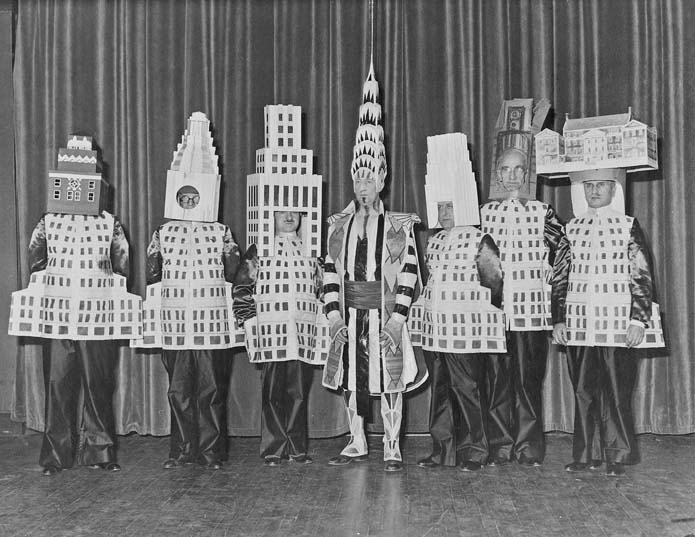
II.11: The costume ball is based on a real event. As Rand wrote in her journals:
The Beaux-Arts Ball (January 23, 1931) where famous architects wore costumes representing one of their buildings. “Human Skyline for Beaux-Arts Ball.” ... Note the little guy with the glasses peering through a hole in his headpiece – the Waldorf-Astoria. (Journals, p. 160)
Here, presumably, is the photo Rand saw:
LEFT TO RIGHT: A. Stewart Walker as the Fuller Building; Leonard Schultze as the Waldorf-Astoria Hotel; Ely Jacques Kahn (Rand’s employer) as the Squibb Building; William Van Alen as the Chrysler Building; Ralph Walker as 1 Wall Street; D.E. Ward as the Metropolitan Tower; Joseph H. Freelander as the Museum of the City of New York
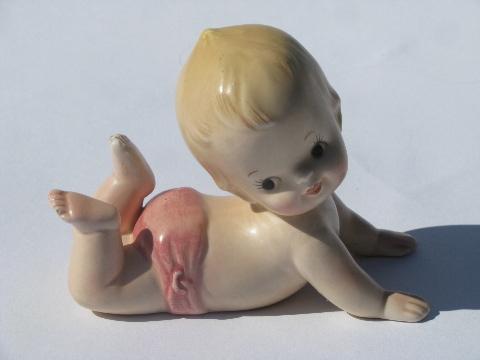
Baby plaques of the kind Rand describes were very common in the early 20th century; here’s a sample:
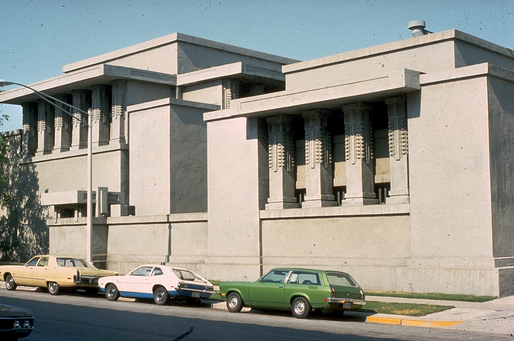
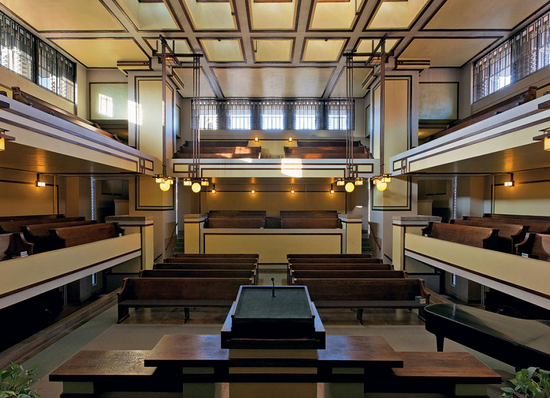
The Stoddard Temple seems inspired by Wright’s Unity Temple (minus the statue):
Rand made use of an anecdote, in Wright’s autobiography, about a model posing for a sculptor in a shack on the lot of the building for which the statue was destined (though this was not the Unity Temple).
II.12: Toohey starts off paraphrasing Lewis Carroll (“The time has come, the walrus said ....”) and then moves on to paraphrasing Nietzsche, whom he calls “a philosopher whom we do not like.” (Toohey’s dislike of Nietzsche arguably counts as an indirect endorsement of Nietzsche on Rand’s part.) The line “It is not our function ... to be a flyswatter” is based on Nietzsche’s line in Zarathustra I.12, “It is not your lot to shoo flies” (or, in the translation Rand would have read, “It is not thy lot to be a fly-flap”).
The caption in The Banner, “Are you happy, Mr. Superman?,” is another Nietzsche reference (and presumably not a comic-book reference, since the events of the novel predate the superhero’s 1938 debut, even if the novel itself does not).
Roark’s conversation with Dominique attempts to clarify in what way his attitude is and in what way it isn’t Stoic. One might describe his attitude as one of passionate engagement with the world, but with an inner core of detachment. “I’m not capable of suffering completely. ... It goes only down to a certain point and then it stops. As long as there is that untouched point, it’s not really pain.” Roark’s stance is reminscent of (though not necessarily identical with) the Aristotelean position that a virtuous person can fall short of happiness (contrary to Socrates and the Stoics) but cannot be made wretched (contrary to the “many”).
In Toohey’s speech to Dominique, note Toohey’s (and Rand’s) assumption that respectable society ought to be pro-Roark while the proletarian radicals ought to be anti-Roark. (Try telling that to Benjamin Tucker.)



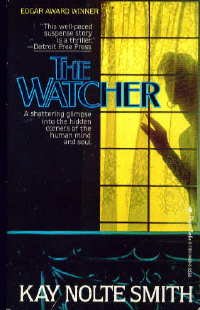
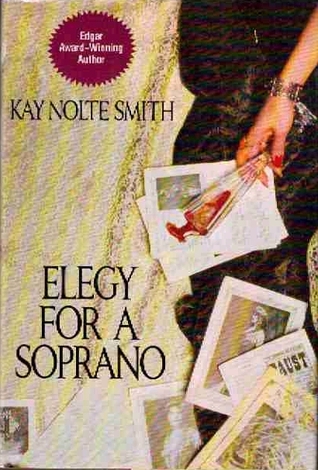
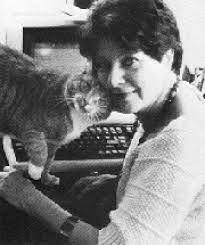 A number of members and ex-members of Rand’s Inner Circle have written Rand-inspired fiction, but Smith is probably the best (IMHO). The Watcher and Elegy for a Soprano are both murder mysteries, as are Catching Fire and Mindspell (the latter is also a critique of parapsychology). Country of the Heart is a mystery, though not a murder mystery. Smith’s last two works, Tale of the Wind and Venetian Song, are Hugoesque historical romances. All out of print now, alas. Here’s her photo (she’s the one on the right).