I strongly feel that the chief task of the economic theorist or political philosopher should be to operate on public opinion to make politically possible what today may be politically impossible, and that in consequence the objection that my proposals are at present impracticable does not in the least deter me from developing them.
– Friedrich A. Hayek, 1978
On general principles, when we are looking for a solution of a social problem, we must expect to reach conclusions quite opposed to the usual opinions on the subject; otherwise it would be no problem. We must expect to have to attack, not what is commonly regarded as objectionable, but what is commonly regarded as entirely proper and normal.
– John Beverley Robinson, 1897
One day societies will be established to agitate for the freedom of government, as they have already been established on behalf of the freedom of commerce.
Tracy was a philosopher and free-market economist, and a friend of Thomas Jefferson (who translated and published several of Tracy’s writings, including the one Thierry is discussing here). Thierry, primarily a historian, was one of the radical liberal triumvirate who (along with Charles Comte and Charles Dunoyer) developed an important version of liberal class theory in their journal Le Censeur Européen; Karl Marx would later refer to Thierry as “the father of the ‘class struggle’ in French historiography.” Montesquieu was a massively influential social and legal theorist, broadly liberal but not quite radical enough for Tracy and Thierry. Like many of Thierry’s book reviews, this one is in large part a springboard for Thierry to talk (particularly in the second half – which Weinburg makes the first half) about his own developing views in ways that don’t necessarily have all that much to do with either Tracy or Montesquieu.
This piece is especially famous for Thierry’s inspiring (but, in the event, unduly optimistic) prediction of what the coming century would bring:
“Federations will replace states. The despotism of men and of the law will be replaced by the loose but indissoluble bonds of interest. The inclination towards government, the first passion of the human race, will yield to the free community, the real need of civilized men. The era of empires has ended. The era of association is beginning.”
Roderick Long is working on his own translation of Thierry’s article (as part of an exciting larger project about which you will learn more later), but in the meantime, enjoy!
And now the schedule is up for the Molinari Society meeting at the Pacific APA later this week.
30 December 2016
The schedule is up for the Molinari Society meeting at the Eastern APA next week.
5 November 2016
This past summer saw the publication of the first issue of the Molinari Review (details here), as well as Roderick Long’s Rituals of Freedom: Libertarian Themes in Early Confucianism (details here).
The 2008 anthology Anarchism/Minarchism: Is a Government Part of a Free Country?, including articles by our own Roderick Long and Charles Johnson, is now being released in paperback; details here.
William Gillis has previously served as designer, developer and sysadmin for the Center’s various web resources, and before that as editor and publisher of physical media.
Gillis was introduced to anarchism by his activist father as a child and has been organizing politically as an anarchist since 1999. He has consistently and diligently worked to highlight the necessity of markets to leftists and radicals since 2003. His conversion started while locking down the Burnside Bridge in Portland, Oregon the day the US invaded Iraq, when he ended up spending a marathon 8 hours debating a right-libertarian counter-protester and then stayed up through the morning reading.
His writing has emphasized the boundless promethean aspirations of anarchism, highlighted the sometimes complex interpersonal and philosophical commitments entailed by liberty, and has sought to bridge the gaps between various discourses on anarchist economics. He has blogged at Human Iterations since 2003, authoring rants, articles, and monographs that have been republished in numerous collections, including Markets Not Capitalism.
As an anarchist he has organized, founded, led, and collaborated in countless struggles, projects, actions, spaces, and organizations. At the same time he is also the author of Organizations Versus Getting Shit Done.
Former Coordinating Director James Tuttle has stepped down, and will stay on as Financial Coordinator, a new position created to decentralize C4SS’s daily work. Tuttle has served as Director of the Center for over four years to wide and continued praise.
25 March 2016
The schedule is up for the Molinari Society meeting at the Pacific APA later this week.
2 January 2016
The schedule is up for the Molinari Society meeting at the Eastern APA later this week.
Both Seymour and Tarn occasionally appeared in the pages of Benjamin Tucker’s Liberty. Curiously, there’s currently an institute named after Tarn; but its website doesn’t have much information.
13 June 2015
We’re pleased to announce the addition of our newest Research Fellow, Roger Bissell.
8June 2015
Pick the Molinari Institute as your preferred charity and Amazon.com will donate 0.5% of your purchase price to us through their Amazon Smile program. Details here.
1 June 2015
We’ve now set up a special page devoted to information about our tax-exempt status.
16 May 2015
The Molinari Institute’s tax-exempt status is now officially listed on the IRS website. (It took a while because they only update the list once a month.)
15 April 2015
The Molinari Institute is delighted to announce that it has been declared by the IRS to be a tax-exempt 501(c)(3) nonprofit organisation; hence donations to the Molinari Institute – and thus to the Institute’s media center, the Center for a Stateless Society – are tax-deductible.
We’re pleased to tell you we determined you’re exempt from federal income tax under Internal Revenue Code (IRC) Section 501(c)(3). Donors can deduct contributions they make to you under IRC section 170. You’re also qualified to receive tax deductible bequests, devises, transfers or gifts under Section 2055, 2106, or 2522. ... We determined you’re a public charity under the IRC section [509(a)(2)].
The mission of the Molinari Institute is to promote understanding of the philosophy of market anarchism as a sane, consensual alternative to the hypertrophic violence of the State. The Molinari Institute hosts an online open-access library of rare libertarian classics, including new translations of 19th-century French works, and publishes two periodicals: a magazine, The Industrial Radical, and an academic journal, the Molinari Review. The Molinari Society, a daughter organisation, hosts annual symposia at the Eastern and Pacific Divisions of the American Philosophical Association.
The Center for a Stateless Society (C4SS), an autonomous extension of the Molinari Institute, develops and publishes timely written commentary on current events, research pieces and other content from a market anarchist perspective. Each week the Center submits several op-ed pieces to thousands of newspapers and other media outlets globally, and has received about 2500 mainstream media pickups since 2010. The Center’s student affiliate network, the Students for a Stateless Society (S4SS), offers opportunities for campus outreach and activism.
Future projects for both the Institute and the Center include book publishing (both classic and original works), conferences, courses (online and otherwise), new translation projects, and media presentations.
Both the Institute and the Center are part of the Alliance of the Libertarian Left, which opposes statism, militarism, cultural intolerance, and the prevailing corporatist capitalism falsely called a free market. The Alliance’s Distro, in partnership with the Institute and Center, produces and distributes zines and booklets on anarchism, market anarchist theory, counter-economics, and other movements for liberation.
You can donate to support the work of the Molinari Institute here, and the work of the Center for a Stateless Society here.
30 March 2015
The call for abstracts for the Molinari Society meeting at the Eastern APA has been posted.
The Center for a Stateless Society, and thus by extension the Molinari Institute, have severed all ties with recently confessed child molestor Brad Spangler; details here.
24 December 2014
The Molinari Institute is pleased to announce a new interdisciplinary, open-access libertarian academic journal, the MOLINARI REVIEW, edited by Roderick T. Long.
We’re looking for articles, sympathetic or critical, in and on the libertarian tradition, broadly understood as including classical liberalism, individualist anarchism, social anarchism, anarcho-capitalism, anarcho-communism, anarcho-syndicalism, anarcha-feminism, panarchism, voluntaryism, mutualism, agorism, distributism, Austrianism, Georgism, public choice, and beyond – essentially, everything from Emma Goldman to Ayn Rand, C. L. R. James to F. A. Hayek, Alexis de Tocqueville to Michel Foucault.
(We see exciting affiliations among these strands of the libertarian tradition; but you don’t have to agree with us about that to publish in our pages.)
Disciplines in which we expect to publish include philosophy, political science, economics, history, sociology, psychology, anthropology, theology, ecology, literature, and law.
We aim to enhance the visibility of libertarian scholarship, to expand the boundaries of traditional libertarian discussion, and to provide a home for cutting-edge research in the theory and practice of human liberty.
All submissions will be peer-reviewed. We also plan to get our content indexed in such standard resources as International Political Science Abstracts and The Philosopher’s Index.
The journal will be published both in print (via print-on-demand) and online (with free access); all content will be made available through a Creative Commons Attribution license. We regard intellectual-property restrictions as a combination of censorship and protectionism, and hope to contribute to a freer culture.
We’re especially proud of the editorial board we’ve assembled, which at present includes over sixty of the most prestigious names in libertarian scholarship.
The journal’s Associate Editor is Grant Mincy (a Fellow of the Center for a Stateless Society), whose pathbreaking work in the field of anarchist environmentalism you should check out here and here.
For more information on the journal, including information on how to submit an article, check out our website. (Information on subscribing, or ordering individual copies, will be available later.)
We’re excited about this new publishing opportunity, and we hope you’ll help us make it a success!
17 September 2014
The schedule is up for the Molinari Society meeting at the Eastern APA.
6 July 2014
Added to our online library: PDF files of Thomas Hodgskin’s 1825 Labour Defended and an entry on anarchism from the 1897 Encyclopedia of Social Reforms, with material on individualist anarchism by Victor Yarros, and material on communist anarchism by Pëtr Kropotkin. Thanks to Shawn Wilbur and Matt Zwolinski for assistance in locating these!
3 May 2014
The call for abstracts for the Molinari Society meeting at the Eastern APA has been posted.
11 March 2014
The schedule is up for the Molinari Society meeting at the Pacific APA.
4 October 2013
Updated info on the Molinari Society meeting at the Eastern APA.
22 August 2013
Help fund Molinari/C4SS/ALL travel to Libertopia and elsewhere! Details here and here.
The Liberty Fund exchange on Molinari and his legacy is now completed.
12 May 2013
The Molinari Institute is having a fundraiser to pay for literature, speaker travel, and student scholarships for Libertopia 2013; details here.
2 May 2013
Liberty Fund is hosting an online exchange on Gustave de Molinari’s legacy for liberty. Participants include David Hart, David Friedman, and our own Gary Chartier and Roderick Long. Roderick’s opening essay has been posted.
1 May 2013
In honour of May Day, the website of the Center for a Stateless Society has just undergone a massive and beautiful redesign.
Law professor joins anarchist think tank
April 12, 2013
FOR IMMEDIATE RELEASE
Anarchist think tank adds professor of law and business ethics to its board of directors.
AUBURN, ALABAMA — April 12, 2013 — Molinari Institute —
“It’s a distinct honor to be associated with the Molinari Institute,” said Chartier. “I welcome this exciting opportunity to join a team of capable philosophers committed to highlighting the liberatory potential of bottom-up social organization and market freedom!”
Molinari Institute president Roderick T. Long added, “Gary Chartier is one of the best libertarian thinkers working today, and one of the foremost defenders of the liberatory potential of radically freed markets as a humane alternative to both hierarchical capitalism and the monopoly state. We’re absolutely delighted to have him on board.”
Chartier joins philosophers Roderick T. Long (Auburn University), Charles W. Johnson (Alliance of the Libertarian Left), and Jennifer McKitrick (University of Nebraska – Lincoln) on the Molinari Institute board.
###
ORGANIZATIONAL SUMMARY
The mission of the Molinari Institute is to promote understanding of the philosophy of Market Anarchism as a sane, consensual alternative to the hypertrophic violence of the State. The Institute takes its name from Gustave de Molinari (1819-1912), originator of the theory of Market Anarchism.
Added to our online library: Charles de Brouckère’s review of De Puydt’s Panarchy. For commentary, see Roderick Long’s blog entry for today.
18 March 2013
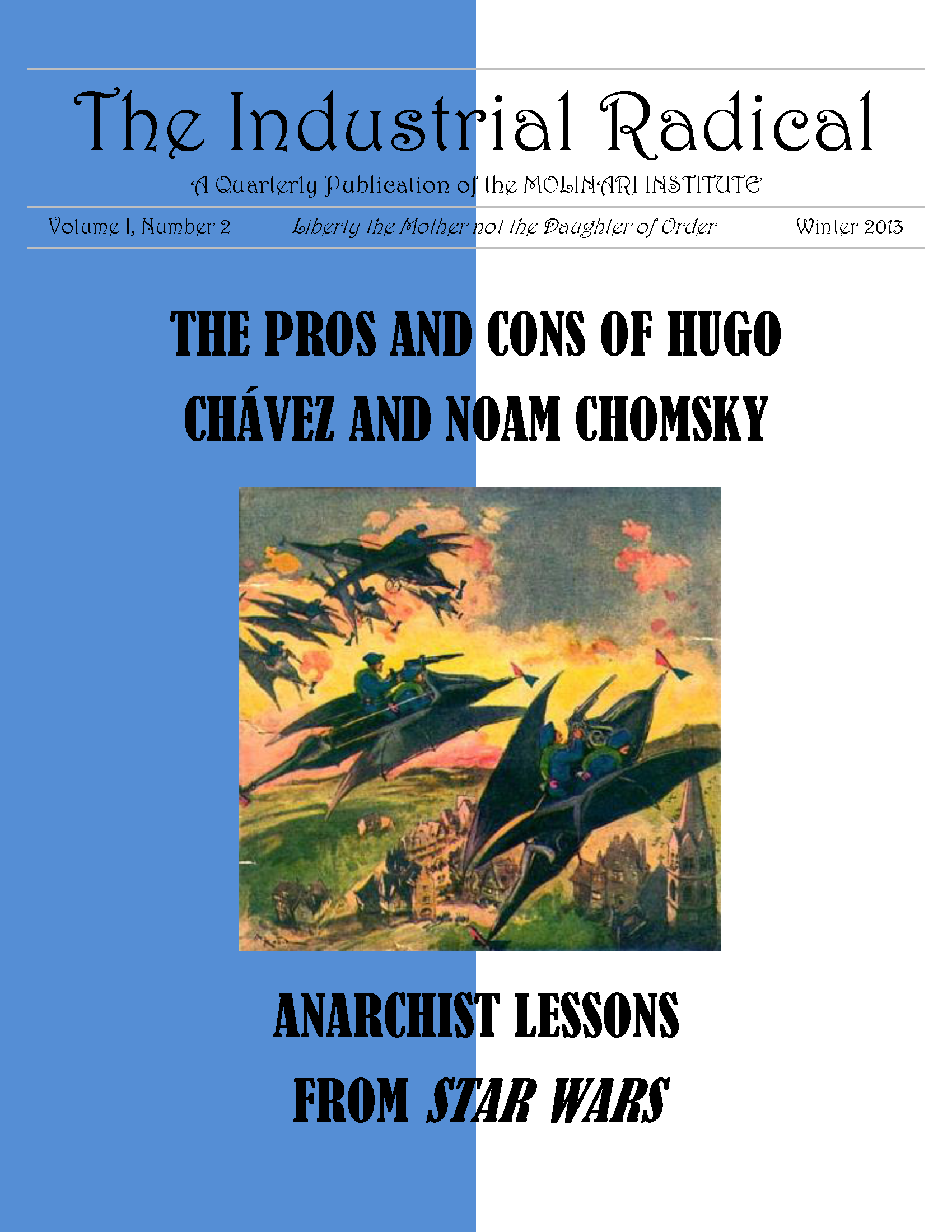
The second issue (Winter 2013) of The Industrial Radical goes to the printer today, featuring articles by B-psycho, Kevin Carson, Gary Chartier, William Gillis, Anthony Gregory, Thomas L. Knapp, Roderick T. Long, Anna Morgenstern, and Darian Worden, on topics ranging from police brutality, gun control, immigration policy, and left-libertarianism to Hugo Chávez’s mixed legacy, Noam Chomsky’s inconsistencies, Rand Paul’s anti-drone filibuster, the intersection between anarcho-syndicalism and agorism, and of course Star Wars. Subscribe here.
A pdf file of the first issue (Autumn 2012) is now available online.
There was a strong Molinari/C4SS turnout at Libertopia 2012, with presentations by Gary Chartier, Charles Johnson, Stephan Kinsella, Roderick Long, Stephanie Murphy, and Sheldon Richman; plus Less Antman and Ross Kenyon were around though not presenting. See the schedule. We also had a Molinari/C4SS booth with literature and buttons; and several of us were interviewed. More info here.
A preliminary draft of Liberty Fund’s new translation of Molinari’s 1849 Soirées on the Rue Saint-Lazare is now online.
19 May 2012
Added to our online library: Charles Gide’s 1899 review of Molinari’s Society of the Future. For commentary, see Roderick Long’s blog entry for today.
18 May 2012
Added to our online library: Thomas Hodgskin’s 1849 review of Herbert Spencer’s Social Statics. For commentary, see Roderick Long’s blog entry for today.
5 May 2012
New from David Hart and Robert Leroux: an anthology of French Liberalism in the 19th Century, including works by C. Comte, Dunoyer, Thierry, Say, Destutt de Tracy, Constant, Staël, Bastiat, Wolowski, Tocqueville, and Molinari. Details here.
The Molinari Society has posted a call for papers for December 2012.
10 April 2012
Check out these pics from the Molinari Society panel in Seattle (7 April 2012). Left to right at the table: Roderick Long, David Hart, Daniel Silvermint. Click for enhanced magnitude.
Photo credit: Norbert Chen.
27 March 2012
Check out the schedules for our Molinari/C4SS/ALL panels at APEE (Las Vegas, 1-3 April) and the Pacific APA (Seattle, 4-7 April).
The Molinari Society has posted information about its December 2011 symposium.
29 April 2011
We’re happy to announce (somewhat belatedly) the publication of our own Gary Chartier’s Conscience of an Anarchist. Some endorsements:
“I’m absolutely giddy about The Conscience of an Anarchist; this book could electrify a generation!” – Brad Spangler (Center for a Stateless Society)
“Given the popular myth that anarchists are masked kids in Circle-A T-shirts smashing windows, this book couldn’t have come at a better time. Clear and easy to understand, it’s the best basic explication of anarchist ideas since Alexander Berkman’s The ABC of Anarchism.” – Kevin A. Carson (author, The Iron Fist Behind the Invisible Hand)
“The best of the political ‘conscience’ books.” – Stephan Kinsella (Center for the Study of Innovative Freedom)
“Anarchism, it has been said, is the radical notion that other people are not your property. Gary Chartier eloquently demonstrates that, far from being a recipe for disorder – as the centers of power self-servingly wish us to believe – anarchism is rather the surest foundation for social cooperation, freedom, prosperity, and peace.” – Sheldon Richman (author, Tethered Citizens)
6 March 2011
The Molinari Society symposia originally scheduled for the Eastern APA (27-30 December 2010, in Boston) but cancelled owing to inclement blitzcraft and blizzardry have been rescheduled, with one moving to the Austrian Scholars Conference (10-12 March 2011, in Auburn) and the other to the Pacific APA (20-23 April 2011, in San Diego). Details here.
1 December 2010
Our own Gil Guillory has been awarded the Alford Prize for his co-authored article “The Role of Subscription-Based Patrol and Restitution in the Future of Liberty”; details here.
Good news for market anarchists: David Friedman’s The Machinery of Freedom, one of the most influential free-market anarchist works of the last 100 years, is now available online (in PDF format); and our own Kevin Carson’s latest book, The Homebrew Industrial Revolution, is now in print.
C4SS announces additional staff member and a promotion.
AUBURN, ALABAMA – January 1, 2010 – Center for a Stateless Society – The Center for a Stateless Society announced personnel changes today, with the addition of Darian Worden as the third C4SS News Analyst and promotion of Thomas L. Knapp to Senior News Analyst.
Worden becomes the Center’s sixth paid part-time staff member. C4SS Director Brad Spangler said “Darian is a rising young talent among anarchist writers and activists. When some angel donors came to us with a proposal to make earmarked contributions to pay for his first quarter of work with the Center, we pounced on it immediately.”
Darian Worden is an individualist anarchist writer with experience in libertarian activism. His fiction includes Bring a Gun To School Day and the forthcoming Trade War. His essays and other works can be viewed at his personal website. He also hosts an internet radio show, Thinking Liberty, on PatriotRadio.com.
###
ORGANIZATIONAL SUMMARY
The mission of the Molinari Institute is to promote understanding of the philosophy of Market Anarchism as a sane, consensual alternative to the hypertrophic violence of the State. The Institute takes its name from Gustave de Molinari (1819-1912), originator of the theory of Market Anarchism. The Center for a Stateless Society is the Molinari Institute’s media center.
The papers, and one of the commentaries, for the upcoming Molinari Society session in New York this coming week are now online.
19 August 2009
FOR IMMEDIATE RELEASE
Market anarchist media center names advisory panel.
AUBURN, ALABAMA – August 19, 2009 – Center for a Stateless Society (C4SS) – Center for a Stateless Society Director Brad Spangler today announced formation of an advisory panel for the market anarchist media center.
“As we gradually build our base of supporters and step up the operations their dedicated support enables, we want to ensure that first rate ideological and operational oversight is in place from prominent fellow advocates of market anarchism who are not otherwise affiliated with us organizationally,” remarked Spangler.
ORGANIZATIONAL SUMMARY
The Center for a Stateless Society is the Molinari Institute’s media center. The mission of the Molinari Institute is to promote understanding of the philosophy of Market Anarchism as a sane, consensual alternative to the hypertrophic violence of the State. The Institute takes its name from Gustave de Molinari (1819-1912), originator of the theory of Market Anarchism.
Several Molinari/C4SS-affiliated people are tentatively scheduled to speak at a forum on free-market anti-capitalism at the 2010 APEE meetings in las Vegas; details here.
7 August 2009
The Molinari Society has posted information about its December 2009 symposium.
Check out our own Charles Johnson talking about agorism:
27 April 2009
Gil Guillory named Research Associate
FOR IMMEDIATE RELEASE
Libertarian writer and entrepreneur Gil Guillory has been named Research Associate.
AUBURN, ALABAMA – April 27, 2009 – Libertarian writer and entrepreneur Gil Guillory has been named Research Associate of the Molinari Institute. In his role, Guillory will continue his research programme on a business model for private security, Subscription Patrol and Restitution.
Guillory has authored, co-authored, and presented papers on Subscription Patrol and Restitution since 2006. All of the work is licensed under Creative Commons Attribution, and is available on a web archive. Guillory has written for strike-the-root.com, anti-state.com, lewrockwell.com, and mises.org. His most recent publication was “The Role of Subscription Patrol and Restitution in the Future of Liberty,” co-authored with Patrick Tinsley, and published in Libertarian Papers.
Molinari Institute President Roderick Long said of the move “Gil has demonstrated a commanding knowledge of private security, taking a hard-nosed business approach to market anarchism. We’re very pleased to announce Gil is joining the Institute.”
###
ORGANIZATIONAL SUMMARY
The mission of the Molinari Institute is to promote understanding of the philosophy of Market Anarchism as a sane, consensual alternative to the hypertrophic violence of the State. The Institute takes its name from Gustave de Molinari (1819-1912), originator of the theory of Market Anarchism.
Veteran libertarian activist and internet news publisher becomes second C4SS paid staff member.
AUBURN, ALABAMA – March 20, 2009 – Center for a Stateless Society – Prominent libertarian activist and news publisher Thomas Knapp has joined the Center for a Stateless Society as the Center’s second paid part-time staff member. In his role as News Analyst beginning April 1st, 2009, Knapp will be producing one or more op-ed pieces per week as well as mentoring volunteer contributing writers.
Knapp has long been associated with “the libertarian wing of the Libertarian Party” and is the founder of its breakaway ultra-faction, the Boston Tea Party. As well as being a prolific blogger on the side, Knapp brings over a decades experience with online news writing, editing, publishing and team leadership; first for the former Free-Market.Net and later for his own publication, Rational Review. He is author of the e-book “Writing the Libertarian Op-Ed,” among other works.
C4SS Director Brad Spangler said of the move “Knapp was the logical choice for the position. His continuing editorship of Rational Review News Digest immerses him in the news cycle so thoroughly that it can only be likened to a fish in water. This is the man who produces the daily crib notes for an entire eco-system of libertarian online content producers. His wealth of experience means he is uniquely suited to explain to the general public how libertarian principles, consistently applied, reach beyond the inconsistent market liberalism of figures like U.S. Congressman Ron Paul into full-blown market anarchism. We’re very pleased to announce Tom is joining the Center.”
###
ORGANIZATIONAL SUMMARY The mission of the Molinari Institute is to promote understanding of the philosophy of Market Anarchism as a sane, consensual alternative to the hypertrophic violence of the State. The Institute takes its name from Gustave de Molinari (1819-1912), originator of the theory of Market Anarchism. The Center for a Stateless Society is the Molinari Institute’s media center.
A call for papers for the 2009 symposium is also online. Topic: intellectual property.
24 January 2009
Added to our online library: Wilson Follett’s 1916 review of Isabel Paterson’s novel The Shadow Riders. For commentary, see Roderick Long’s blog entry for today.
AUBURN, ALABAMA – November 15, 2008 – Center for a Stateless Society – Kevin Carson, author of Studies in Mutualist Political Economy and a forthcoming major work on anarchist organizational theory has joined the Center for a Stateless Society as the Center’s first paid staff member. In his role as Research Associate beginning January 1st of 2009, Carson will be producing quarterly short research studies for the Center to publish as well as writing news commentary.
C4SS director Brad Spangler said of the move, “We’re developing a new fundraising initiative and early on in that process an anonymous donor stepped up to fund the first quarter of Kevin’s research work and the first month of his news analysis for us. We’re very pleased to announce this, as Carson has been a key figure on the radical end of the libertarian movement. Supporting his work means he’ll be able to do more and better of what he already does amazingly well.”
###
ORGANIZATIONAL SUMMARY
The mission of the Molinari Institute is to promote understanding of the philosophy of Market Anarchism as a sane, consensual alternative to the hypertrophic violence of the State. The Institute takes its name from Gustave de Molinari (1819-1912), originator of the theory of Market Anarchism. The Center for a Stateless Society is the Molinari Institute’s media center.
Molinari gets a mention in two recent issues of The Economist:
Visiting the city of Colón in 1886, Gustave de Molinari, a liberal Dutch economist, noted that in comparison the worst parts of Genoa and Istanbul deserved a prize for good maintenance.
– Panama: The Poor Relation (The Economist, 15 May 2008)
SIR – You describe Gustave de Molinari as a “liberal Dutch economist” (“The poor relation”, May 17th). Even though Molinari was born in what was at the time the United Kingdom of the Netherlands, he became a Belgian at the age of 11 at the time of Belgium’s independence. His most important essays were written in French and he spent most of his life in France and Belgium. So he hardly qualifies as a Dutchman.
QUENTIN MICHON
Paris
– Questionable Cit[i]zenship (The Economist, 29 May 2008)
The Molinari Society has posted information about its December 2007 symposium.
Molinarians Charles Johnson and Roderick Long will also be presenting papers at the Alabama Philosophical Society’s September 2007 meeting; see abstracts here and
here.
Added to our online library: Florence Finch Kelly’s 1916 review of Isabel Paterson’s novel The Shadow Riders. For commentary, see Roderick Long’s blog entry for today.
10 October 2006
Anarchists launch major media offensive
October 10, 2006
FOR IMMEDIATE RELEASE
A tiny think tank has set out on a project to provide ongoing news commentary in order to promote their set of views, known as market anarchism.
AUBURN, ALABAMA – October 10, 2006 – Center for a Stateless Society – The Molinari Institute, a market anarchist think tank, today launched a new media effort aiming to put their agenda to abolish government front and center in US political discourse. Dubbing their project the Center for a Stateless Society (www.c4ss.org), institute officials laid out plans to publish and distribute news commentary written by anarchists with radically free-market oriented views on economics – taking market anarchism out of the realm of academia and obscure internet blogs in order to put it in the public eye.
Molinari Institute President Roderick Long explained “For too long libertarians, and I mean anarchist libertarians, have treated market anarchism almost as an esoteric doctrine. It’s time to put market anarchism front and center in our educational efforts, time to start making it a familiar and recognizable position. The Center for a Stateless Society aims to bring a market anarchist perspective to the popular press, rather than leaving it confined to scholarly studies and movement periodicals.”
Naming longtime radical libertarian activist and freelance web developer Brad Spangler as the first Director of the Center, Long unveiled the Center’s new web site at www.c4ss.org for Molinari Institute supporters and the public.
Said Spangler “I’m honored to accept the post. In anticipation of this moment, we’ve developed a database of thousands of US media outlets for email distribution of content which these publishers will be able to use free of charge. Additionally, the c4ss.org web site makes use of stable, reliable and ‘free as in freedom’ open source web technologies. We’ve developed the site in such a way as to make maximum possible use of social bookmarking services, web syndication feeds and search engine optimization techniques. With this site, we aim to awaken more Americans than ever before to the brutal reality that all governments everywhere are essentially nothing more than murderous bandit gangs – and show them the shining light of hope for a world without the State.”
###
ORGANIZATIONAL SUMMARY
The mission of the Molinari Institute is to promote understanding of the philosophy of Market Anarchism as a sane, consensual alternative to the hypertrophic violence of the State. The Institute takes its name from Gustave de Molinari (1819-1912), originator of the theory of Market Anarchism. The Center for a Stateless Society is the Molinari Institute’s new media center.
Added to our online library: three more chapters of Francis Tandy’s 1896 Voluntary Socialism. Chapter 6 attempts to reconcile the labour theory of value with the principle of marginal utility. (Followers of the Mutualist/Austrian debate, take note.) Chapters 7 and 8 defend a mutualist approach to money, credit, and banking along the lines of Proudhon, Greene, and Tucker.
For more information on these two founding classics of the Austrian School, see Roderick Long’s blog entry for today.
20 January 2006
Added to our online library: Robert Collyer’s poem Saxon Grit – not so much for its intrinsic merit, which is not enormous, but because it’s hard to find, and is referred to in another text we’ll be posting soon.
10 January 2006
The Molinari Institute is pleased to announce that later this year we will begin publishing a magazine of radical libertarian political and social analysis titled The Industrial Radical. (“Industrial” in Herbert Spencer’s sense, “Radical” in Chris Sciabarra’s sense.) We hereby invite submissions. (See our submissions guidelines and copyright policy. Also note that The Industrial Radical is a popular magazine, not an academic journal; formal, scholarly articles might be more appropriately submitted to, oh, um, say, the Journal of Libertarian Studies.)
Submissions may be of any length, from a brief paragraph to a lengthy essay; we also welcome a diversity of perspectives, whether you dance to the music of F. A. Hayek, Murray Rothbard, Benjamin Tucker, Henry George, or Emma Goldman. Previously published pieces are fine so long as they meet our copyright requirements. We plan to publish themed issues (see theme topics and submission deadlines here), but please don’t refrain from sending us an article just because it doesn’t fit an upcoming theme; the themes are designed to inspire submissions, not discourage them.
Please pass the word, by blogpost or email, to anyone you think might be interested in contributing. (Advance subscriptions are available too!)
Added to our online library: an anonymous 1887 critique of Molinari’s labour-exchange project, from the anarcho-communist journal Freedom founded by Charlotte M. Wilson and Peter Kropotkin.
In other news, the Molinari Society’s symposium on thick and thin libertarianism last week was a success; see Charles Johnson’s report here.
We are also pleased to see that the anthology Benjamin R. Tucker and the Champions of Liberty has been made available online, with articles by Paul Avrich, Kenneth Gregg, Wendy McElroy, S. E. Parker, Sharon Presley, Charles Shively, Carl Watner, and several others.
Happy New Year to all!
3 December 2005
Added to our online library: Johan Ridenfeldt has kindly sent us some early Swedish encyclopedia entries on Molinari, along with his translations. Check them out here. (We love the description of Molinari as “the law of supply and demand made into man.”)
2 November 2005
Today the Molinari Institute remembers Rosa Parks; see Charles Johnson’s notice here.
In Gustav Landauer’s words, “The State is a condition, a certain relationship between human beings, a mode of human behavior; we destroy it by contracting other relationships, by behaving differently.” Rosa Parks was a priceless pioneer of behaving differently.
1 October 2005
Hear the Molinari Institute President being interviewed by a Molinari Institute Research Fellow!
11 September 2005
Today marks the third anniversary of the Molinari Institute; see Roderick Long’s blog entry for today.
Things have been so hectic lately that we neglected to announce this earlier – but our own Roderick Long is the new editor of the Journal of Libertarian Studies, founded by Murray Rothbard in 1977. See the announcement here.
Of course this is just another step on our path to World Domination.
10 October 2004
Added to our online library: the introduction and first seven chapters of Love, Marriage, and Divorce, an 1853 debate among Henry James, Sr. (father of the novelist), Horace Greeley (of “o west, young man” fame), and Stephen Pearl Andrews (anarchist, abolitionist, feminist, and free-love advocate). Andrews’ arguments are strikingly relevant to the dispute over same-sex marriage today. More chapters to follow!
Also added: commentary by economist Frédéric Passy (the first libertarian Nobel laureate) and labour activist Hodgson Pratt on Molinari’s 1899 Society of the Future.
2 October 2004
Added to our online library: Roy Childs’ classic 1971 essay Big Business and the Rise of American Statism. Drawing on Austro-Randian methodology and New Left historiography, Childs develops a libertarian interpretation of the Progressive Era, showing that government regulations supposedly designed to curb the power of the big corporations were actually introduced at the instigation and for the benefit of those corporations. This is, to the best of our knowledge, the first time this excellent specimen of radical libertarian social analysis has been made available online; thanks to Reason magazine for permission to post it!
From these reviews we learn that Molinari was a hard-headed realist, and that he was a utopian idealist; that he was pessimistic about the past but optimistic about the future, and that he was optimistic about the past but pessimistic about the future; that he favoured regulation of marriage in the interest of eugenics, and that he wanted government out of people’s private lives; that he supported trade unions, and that he opposed them; that he was an orthodox conservative, and that he was an anarchistic radical; that he embraced a purely economic approach with no admixture of moral concern, and that he regarded economic analysis as barren unless supplemented by ethical considerations. Go figure. (As we slowly but surely get Molinari’s works translated and posted, you’ll be able to judge for yourself.)
25 September 2004
Added to our online library: the preface and first chapter, newly translated by Roderick Long, of Molinari’s 1898 book The Greatness and Decline of War. In these earliest sections Molinari traces the institution of war to its origin in primitive cannibalism. More to follow!
24 September 2004
Added to our online library: Grant Allen’s 1894 Reminiscences of Herbert Spencer (Allen’s claim that posterity will rank Spencer “high above” Aristotle, Newton, and Kant raises even our eyebrows – but the billiards story is classic!) and Ljëv Tolstoj’s 1900 antiwar broadside Thou Shalt Not Kill (Tolstoj’s portrait of warmongering heads of state so “perverted and stupefied” by the “servility and flattery of those who surround them” that “without ceasing to do evil, they feel quite assured that they are benefactors to the human race” is all too timely).
11 September 2004
Today marks the second anniversary of the Molinari Institute; see Roderick Long’s blog entry for today. Long’s anarchy lecture is now available in HTML and PDF. Percy Bysshe Shelley’s 1818 poem Ozymandias and Ralph Waldo Emerson’s 1844 essay Politics have been added to our online library.
12 August 2004
The Molinari Institute is pleased to announce the addition of a new Research Fellow, Daniel D’Amico. Check out his bio page here.
Roderick Long’s August 6th Mises Institute lecture on anarchism is now online.
11 August 2004
The Molinari Society’s first symposium has been scheduled for December 28th, at the Eastern APA in Boston. The topic is “Libertarianism and Feminism.” Details here.
4 August 2004
Good news! The Library of Economics and Liberty has just placed online the entire contents of Joseph Lalor’s massive 1881 Cyclopædia of Political Science, containing (mainly abridged) entries by many 19th-century libertarian writers, particularly the French économistes of the Say school – including Bastiat, Dunoyer, and Molinari. (For more information on the Cyclopædia see Roderick Long’s February 1st blog entry.) It’s a delight to have this libertarian classic available online at last.
Roderick continues his campaign against the defamers of Herbert Spencer; see his critiques of recent misrepresentations by Spencer-bashers Glen Gibbons and Susan Jacoby.
This is a great service that Elibron provides – though it’s a pity their books don’t have ISBN numbers.
10 July 2004
Reprints of Charles Dunoyer’s books La Révolution du 24 février and Le Second Empire et une nouvelle restauration – his analyses of France’s turbulent constitutional history from 1848 to 1862 – are available (in French) from Elibron. Dunoyer, a contemporary witness of the events he describes, delineates the effects of collectivist statism with a combination of libertarian logic and righteous wrath.
The eVentura edition of Molinari’s Soirées – “in French ... with index, bibliography, and an introduction by Molinari’s contemporary Yves Guyot,” as mentioned in our 16 September 2003 entry – is now available for online purchase. The Soirées, written in 1849, was the first book to defend Market Anarchism.
Philosophy professor and Molinari Institute director Jennifer McKitrick has just moved from the University of Alabama at Birmingham to the University of Nebraska-Lincoln. Congratulations to Jennifer on her new job!
Added to our online library: two pieces by Voltairine de Cleyre – her 1902 Letter to Senator Hawley (inviting him to shoot her) and her 1912 (?) Direct Action (an essay on strategy which has been read both as a call for violent revolution and as a call for pacifistic non-resistance) – and the Preface and Introduction (with more to follow) to Francis D. Tandy’s 1896 anarchist manifesto Voluntary Socialism: A Sketch, a synthesis of Proudhon, Mill, Spencer, Stirner, Spooner, Tucker, and even (strangely enough for a work that condemns lending at interest) Böhm-Bawerk.
You’ll notice some new photos of de Cleyre. (She described herself as ugly. Go figure.) We’ve also managed to track down photos of Liberty authors Victor Yarros and Sarah E. Holmes.
26 March 2004
The Molinari Institute is, thankfully, not the only organisation working to provide online versions of libertarian classics. Several such works have recently been added to Liberty Fund’s Online Library of Liberty (not to be confused with their other equally marvelous online project, the Library of Economics and Liberty).
Because Lysander Spooner’s best-known work, No Treason, argues against the North’s right to prevent the South from seceding in the American Civil War, Spooner is sometimes mistaken for a Confederate apologist. That nothing could be farther from the truth is clear from the latest addition to our online library: Spooner’s 1858 Plan for the Abolition of Slavery, a spirited call for slaves and abolitionists to wage a guerilla war against Southern slaveholders.
16 February 2004
The latest installment of Roderick Long’s debate over Market Anarchism with Robert Bidinotto is available here.
14 February 2004
Added to the online library: Mark Twain’s War Prayer (1904-5), written in protest against the Spanish-American War.
9 February 2004
Added to the online library: Oscar Wilde’s The Soul of Man Under Socialism (1891). Wilde wasn’t exactly a Market Anarchist; indeed he seems to have had no particularly clear conception of, or indeed interest in, how economies work. But the considerations his essay raises are ones that Market Anarchists need to take seriously – or so Roderick Long argues in today’s blog entry.
1 February 2004
Added to the online library: Lysander Spooner’s No Treason (1867-70), the classic anarchist deconstruction of social contract theory and state authority; Voltairine de Cleyre’s Sex Slavery (1890), an impassioned defense of free-love advocate Moses Harman; Ralph Waldo Emerson’s Self-Reliance (1841), a manifesto of individualism (more in the cultural than in the political sense); and Louis Wolowski and Émile Levasseur’s Property (1864?), a hard-to-find defense of property rights cited favourably by Rothbard. (For more information about the Wolowski-Levasseur piece, see Roderick T. Long’s blog entry for today.)
Three short pieces have just been added to the online library: The Dinner-Party by American individualist anarchist Stephen Pearl Andrews (from his 1852 Science of Society), and two biographical sketches of French individualist anarchist Anselme Bellegarrigue, by Max Nettlau and George Woodcock.
13 January 2004
For some time we’ve been trying to discover the significance of the reference to Rue St.-Lazare (a street in Paris) in the title of Gustave de Molinari’s 1849 Les Soirées de la Rue Saint-Lazare: Entretiens sur les lois économiques et défense de la proprieacute;té (the first book to defend Market Anarchism). Recently we’ve learned, with the gracious assistance of Cécile Philippe and Hervé de Quengo, that both the title and the three-person dialogue format of Molinari’s work were undoubtedly intended as a reference to a posthumously published (1821) work by the authoritarian conservative thinker Joseph de Maistre (1753-1821). The work in question is usually called the St. Petersburg Dialogues in English, but its French title is Les Soirées de Saint-Pétersbourg, ou Entretiens sur le gouvernement temporel de la Providence. (For online versions see here and here.) De Maistre is sometimes called “the French Burke,” but in his enthusiasm for warfare and bloodshed he seems even more antiliberal, and certainly creepier, than Burke. Molinari’s own Soirées, in which his Conservative antagonist is made to cite de Maistre several times, can be seen as in part a liberal response to de Maistre’s Soirées. While there may be an as-yet-unidentified reference to some salon or club that really met on the Rue St.-Lazare, the name was most likely chosen mainly to echo de Maistre’s “Saint-Pétersbourg.”
Speaking of de Maistre, we recently came across a page of quotations by him. At the top of the page the website editors have written: “Great quotes to inspire, empower and motivate you to live the life of your dreams and become the person you’ve always wanted to be!” And then the first de Maistre quote is: “In the works of man, everything is as poor as its author; vision is confined, means are limited, scope is restricted, movements are labored, and results are humdrum.” Um ... inspiring? empowering? If that were a fortune cookie we’d send it back.
5 January 2004
The Molinari Society, a “daughter organisation” of the Molinari Institute, has just been approved for affiliation with the American Philosophical Association. This means the Molinari Society will be able to sponsor symposia at the APA’s Eastern Division meetings. The Molinari Society seeks to promote “critical discussion and innovative research in radical libertarian theory,” in the tradition of Gustave de Molinari (1819-1912). While the Molinari Institute and the Molinari Society are distinct organisations, it is probable that they will work closely together.
Today we received in the mail Hans-Hermann Hoppe’s new anthology The Myth of National Defense. We were pleased to see that it is dedicated to the memory of Gustave de Molinari, the first theorist to show how defense services could be provided on the free market.
Unfortunately, the dedication page lists Molinari’s dates wrongly, as 1819-1911. In the introduction (p. 9) his dates are listed differently, but still wrongly, as 1818-1912. The correct dates are 1819-1912, as can be confirmed by a look at his tombstone.
10 December 2003
Our sister organization, the Institut Molinari in Brussels, has undergone a slight name change, to the Institut économique Molinari.
We’ve just revised the format of our online library page to distinguish more clearly between works hosted on our website and works hosted elsewhere.
On his blog page Roderick Long recently offered a reply to Robert Bidinotto’s critique of Market Anarchism. A further exchange between Bidinotto and Long is forthcoming.
We recently came across a previously unknown sketch of Gustave de Molinari, which appeared in L’opinion publique, Vol. 11, no. 48 (25 novembre 1880), p. 571. View it here.
In other news, Wirkman Virkkala has uncovered an 1864 review by Lord Acton of Molinari’s 1855 Course of Political Economy (a work which we plan eventually to post in both French and English in our online library). The review, titled Spiritual Economy?, is available here. (The justice or otherwise of Acton’s critique of Molinari will be more easily ascertained once we have posted the text of Molinari’s 1892 book titled Religion.)
20 October 2003
There’s good news and bad news in the world of the Internet.
The bad news is that David Hart’s website, with its wealth of material on the history of classical liberalism – including some excellent material on Gustave de Molinari and an indispensable book-length manuscript on Molinari’s radical colleagues Charles Comte and Charles Dunoyer – has lapsed into nonbeing. (The website was at the university where he formerly taught.) Dr. Hart plans eventually to resurrect the website elsewhere; but in the meantime an invaluable resource has been lost to the Market Anarchist community.
The good news is that Mary Ruwart has put the first edition of her book Healing Our World: The Other Piece of the Puzzle online. Dr. Ruwart’s book offers a clear, New-Age-friendly introduction to the principles of voluntary society. A link has been added to our Market Anarchist resources page.
(The more recent edition, titled Healing Our World in an Age of Aggression, updated to address the issue of terrorism, is available for purchase here.)
13 October 2003
The controversy over Edwin Black’s interpretation of Herbert Spencer continues. See Roderick Long’s reply to Black’s bizarre accusations.
8 October 2003
Yesterday’s issue of Le Monde carried a pair of articles about the Austro-libertarian movement, focusing on Mises, Rothbard, and Auburn’s other libertarian institute. It is startling, and gratifying, to see a major French newspaper writing casually and sympathetically about the Market Anarchist thesis that the “enemy is that entire elite that receives more from the State than it pays to it,” and that “statism, governmental intervention, will perish from its inevitable contradictions, [paving] the way to its eventual abolition.”
Roderick Long has made an English translation of the two articles; the translation has been added to our online library and is available here.
E. L. Godkin’s The Eclipse of Liberalism, a prophetic look at the decline of classical liberalism written in 1900, has just been added to the online library.
We learn that four of Molinari’s works in French – Les Soirées de la Rue Saint-Lazare (1849), Lettres sur la Russie (1861), Les clubs rouges pendant le siège de Paris (1871), and Grandeur et décadence de la guerre (1898) – have been republished by Elibron. Elibron also republishes a number of works by Herbert Spencer.
In addition, another version of Molinari’s Soirées in French, this one with index, bibliography, and an introduction by Molinari’s contemporary Yves Guyot, is available from eVentura, though their online ordering service is not yet up.
The line “les livres, les brochures et la conservation suffiraient” should read “les livres, les brochures et la conversation suffiraient.” The line “lphénomène de la consommation graduelle et de l’excitation finale” should read “phénomène de la consommation graduelle et de l’extinction finale.”
These errors have been corrected in our own online French version. We’ll notify you of other errors if we find them.
11 September 2003
Today is the first anniversary of the Molinari Institute, and the first day of this News & Announcements page.
It is also, of course, the second anniversary of the 9/11 attacks on the United States. For a discussion of the moral of 9/11 for the cause of Market Anarchism, see Roderick Long’s blog entry for today.
A number of additions have been made to our online library:
Gustave de Molinari’s Soirées de la Rue Saint-Lazare (1849), the first book to defend Market Anarchism, has never been translated into English, apart from David Hart’s translation of the eleventh chapter. Roderick Long has undertaken to translate the entire work; the preface and first chapter have been completed and are now online.
We recently discovered, to our surprise, that in 1877 the American novelist Henry James wrote a review of one of Molinari’s books. This review too is now online.
The Institute now has its own Yahoo discussion list; you can join here.
The Institute also now has a sister organization, the Institut Molinari in Molinari’s native Belgium.
Over the summer we were contacted by Maurice Gastaldi, the great-grandson of Molinari. He kindly sent us the Molinari family tree and coat of arms. According to the family tree, M. Gastaldi is the son of Marguerite de Molinari (d. 1966), daughter of engineer Edmond Léon de Molinari (1847-1914), son of the Institute’s namesake Gustave Henri de Molinari (1819-1912), who in turn was the son of Philippe de Molinari (1792-1870), the son of François Joseph de Molinari (who, as his Christian name suggests, was an officer in the service of Austria).
The Molinari coat of arms depicts a castle, a crescent moon, a wheel, and a bird, with the motto “IN CRUCE LUX.” The image is in black and white; I hope to obtain a colour image in the future and to put it online. The accompanying documentation describes the creation of the Molinari family title by Emperor Charles V in 1527.


 With Mark Weinburg’s kind permission, we have added to our online library his hard-to-find 1977-78 translation of Augustin Thierry’s 1818 review of Destutt de Tracy’s 1806 commentary on Montesquieu’s 1748 Spirit of the Laws.
 5 November 2016
 The Center for a Stateless Society has appointed William Gillis as Coordinating Director effective May 1st, replacing James Tuttle.
 The Molinari Institute is delighted to announce that it has been declared by the IRS to be a tax-exempt 501(c)(3) nonprofit organisation; hence donations to the Molinari Institute – and thus to the Institute’s media center, the Center for a Stateless Society – are tax-deductible.

 1 May 2013
 The Molinari Institute, a left-wing market anarchist think tank based in Auburn, Alabama, announced today the addition of Gary Chartier to its board of directors. Chartier is Professor of Law and Business Ethics and Associate Dean of the Tom and Vi Zapara School of Business at La Sierra University in Riverside, California; author of Economic Justice and Natural Law, The Conscience of an Anarchist, and Anarchy and Legal Order: Law and Politics for a Stateless Society; co-editor with Charles W. Johnson of Markets Not Capitalism: Individualist Anarchism Against Bosses, Inequality, Corporate Power, and Structural Poverty; and a blogger at Bleeding Heart Libertarians. He already serves as Senior Fellow and Trustee of the Center for a Stateless Society, a media center that serves as an autonomous extension of the Molinari Institute.
 18 March 2013


 27 September 2012
 25 September 2012
 19 September 2012
 18 September 2012


 8 January 2012
 We’re happy to announce the publication of Markets Not Capitalism: Individualist Anarchism Against Bosses, Inequality, Corporate Power, and Structural Poverty, edited by our own Gary Chartier and Charles Johnson, and featuring contributions by a number of Molinari/C4SS/ALL regulars. Details here.
 29 April 2011
 The Molinari Society symposia originally scheduled for the Eastern APA (27-30 December 2010, in Boston) but cancelled owing to inclement blitzcraft and blizzardry have been rescheduled, with one moving to the Austrian Scholars Conference (10-12 March 2011, in Auburn) and the other to the Pacific APA (20-23 April 2011, in San Diego). Details here.
 4 June 2010
 1 March 2010
 AUBURN, ALABAMA – January 1, 2010 – Center for a Stateless Society – The Center for a Stateless Society announced personnel changes today, with the addition of Darian Worden as the third C4SS News Analyst and promotion of Thomas L. Knapp to Senior News Analyst.
  “As we gradually build our base of supporters and step up the operations their dedicated support enables, we want to ensure that first rate ideological and operational oversight is in place from prominent fellow advocates of market anarchism who are not otherwise affiliated with us organizationally,” remarked Spangler.
 Several Molinari/C4SS-affiliated people are tentatively scheduled to speak at a forum on free-market anti-capitalism at the 2010 APEE meetings in las Vegas; details here.
 4 June 2009
 27 April 2009
 AUBURN, ALABAMA – April 27, 2009 – Libertarian writer and entrepreneur Gil Guillory has been named Research Associate of the Molinari Institute. In his role, Guillory will continue his research programme on a business model for private security, Subscription Patrol and Restitution.
  Knapp has long been associated with “the libertarian wing of the Libertarian Party” and is the founder of its breakaway ultra-faction, the Boston Tea Party. As well as being a prolific blogger on the side, Knapp brings over a decades experience with online news writing, editing, publishing and team leadership; first for the former Free-Market.Net and later for his own publication, Rational Review. He is author of the e-book “Writing the Libertarian Op-Ed,” among other works.
  26 December 2008
 17 November 2008
 AUBURN, ALABAMA – November 15, 2008 – Center for a Stateless Society – Kevin Carson, author of Studies in Mutualist Political Economy and a forthcoming major work on anarchist organizational theory has joined the Center for a Stateless Society as the Center’s first paid staff member. In his role as Research Associate beginning January 1st of 2009, Carson will be producing quarterly short research studies for the Center to publish as well as writing news commentary.
  19 August 2008

 12 March 2008
 4 February 2008
 26 December 2007
 Shawn Wilbur has gloriously posted the entire run of Benjamin Tucker’s Liberty here; details here.
 30 January 2007
 30 November 2006
 Molinari Institute President Roderick Long explained “For too long libertarians, and I mean anarchist libertarians, have treated market anarchism almost as an esoteric doctrine. It’s time to put market anarchism front and center in our educational efforts, time to start making it a familiar and recognizable position. The Center for a Stateless Society aims to bring a market anarchist perspective to the popular press, rather than leaving it confined to scholarly studies and movement periodicals.”
 6 September 2006
 18 July 2006
 12 July 2006
 8 June 2006
 24 February 2006
 The Molinari Institute is pleased to announce that later this year we will begin publishing a magazine of radical libertarian political and social analysis titled The Industrial Radical. (“Industrial” in Herbert Spencer’s sense, “Radical” in Chris Sciabarra’s sense.) We hereby invite submissions. (See our submissions guidelines and copyright policy. Also note that The Industrial Radical is a popular magazine, not an academic journal; formal, scholarly articles might be more appropriately submitted to, oh, um, say, the Journal of Libertarian Studies.)
 21 July 2005
 14 June 2005
 5 June 2005
 Things have been so hectic lately that we neglected to announce this earlier – but our own Roderick Long is the new editor of the Journal of Libertarian Studies, founded by Murray Rothbard in 1977. See the announcement here.
 Added to our online library: the introduction and first seven chapters of Love, Marriage, and Divorce, an 1853 debate among Henry James, Sr. (father of the novelist), Horace Greeley (of “o west, young man” fame), and Stephen Pearl Andrews (anarchist, abolitionist, feminist, and free-love advocate). Andrews’ arguments are strikingly relevant to the dispute over same-sex marriage today. More chapters to follow!
 We’ve managed to track down a number of contemporary reviews of Molinari’s books. The following book reviews have been added to our online library: J. B. Clark on Natural Laws of Political Economy; J. B. Clark on Economic Morality; J. B. Clark on Fundamental Notions of Political Economy; E. Castelot on Fundamental Notions of Political Economy; E. Castelot on Religion; F. C. Montague on How the Social Question Is to Be Resolved; Thorstein Veblen on Viriculture; Edward Van Dyke Robinson on Greatness and Decline of War; George H. Baker on In Panama; the Political Science Quarterly on Economic Questions on the Agenda;
the Political Science Quarterly on Society of the Future; Liberty’s “S. R.” on Society of the Future; David Kinley on Labour-Exchanges; H. C. Emery on Labour-Exchanges; L. L. Price on Labour-Exchanges; L. L. Price on Précis of Political Economy and of Morals; L. L. Price on Economics of History: A Theory of Evolution; and L. L. Price on Ultima Verba.
We’ve managed to track down a number of contemporary reviews of Molinari’s books. The following book reviews have been added to our online library: J. B. Clark on Natural Laws of Political Economy; J. B. Clark on Economic Morality; J. B. Clark on Fundamental Notions of Political Economy; E. Castelot on Fundamental Notions of Political Economy; E. Castelot on Religion; F. C. Montague on How the Social Question Is to Be Resolved; Thorstein Veblen on Viriculture; Edward Van Dyke Robinson on Greatness and Decline of War; George H. Baker on In Panama; the Political Science Quarterly on Economic Questions on the Agenda;
the Political Science Quarterly on Society of the Future; Liberty’s “S. R.” on Society of the Future; David Kinley on Labour-Exchanges; H. C. Emery on Labour-Exchanges; L. L. Price on Labour-Exchanges; L. L. Price on Précis of Political Economy and of Morals; L. L. Price on Economics of History: A Theory of Evolution; and L. L. Price on Ultima Verba.

 The marvelous Elibron now offers facsimile reprints of still more libertarian classics, including William Lloyd Garrison’s Thoughts on African Colonization (1832), Henry Dunning Macleod’s Elements of Political Economy (1858), William Thompson’s Inquiry into the Principles of the Distribution of Wealth Most Conducive to Human Happiness (1869), Richard Cobden’s Political Writings (1867, Volumes One and Two), John Bright’s Speeches (1869) and Public Addresses (1879), Voltairine de Cleyre’s Selected Works (1914), Dyer Lum’s Concise History of the Great Trial of the Chicago Anarchists (1887), William Graham Sumner’s What Social Classes Owe to Each Other (1883) and Earth-Hunger and Other Essays (1913), Robert Flint’s Socialism (1894), Friedrich Wieser’s Natural Value (1893), William Smart’s
Introduction to the Theory of Value on the Lines of Menger, Wieser, and Böhm-Bawerk (1891), and David Duncan’s Life and Letters of Herbert Spencer (1908) – as well as (in French) Destutt de Tracy’s Commentaire sur L’esprit des Lois (1817), Louis Auguste Say’s Considérations sur l’industrie et la législation (1822), Léon Faucher’s Études sur l’Angleterre (1845), Adolphe Thiers’s De la Propriété (1848), Charles Coquelin’s Du crédit et des banques (1848), the Coquelin-Guillaumin Dictionnaire de l’économie politique (1853, Volumes One and Two), Frédéric Passy’s Leç½ons d’économie politique (1861), Edmond About’s ABC du travailleur (1868), and numerous works by Frédéric Bastiat, Adolphe-Jérôme Blanqui, Maurice Block, Michel Chevalier, Benjamin Constant, Émile Faguet, Joseph Garnier, François Guizot, Yves Guyot, Pierre-Joseph Proudhon, Louis Reybaud, Jean-Baptiste Say, Léon Say, Augustin Thierry, Alexis de Tocqueville, A. R. J. Turgot, and Louis Wolowski. (And see below for mentions of Elibron reprints of works by Molinari, Comte, Dunoyer, Spencer, and Tucker.)
The marvelous Elibron now offers facsimile reprints of still more libertarian classics, including William Lloyd Garrison’s Thoughts on African Colonization (1832), Henry Dunning Macleod’s Elements of Political Economy (1858), William Thompson’s Inquiry into the Principles of the Distribution of Wealth Most Conducive to Human Happiness (1869), Richard Cobden’s Political Writings (1867, Volumes One and Two), John Bright’s Speeches (1869) and Public Addresses (1879), Voltairine de Cleyre’s Selected Works (1914), Dyer Lum’s Concise History of the Great Trial of the Chicago Anarchists (1887), William Graham Sumner’s What Social Classes Owe to Each Other (1883) and Earth-Hunger and Other Essays (1913), Robert Flint’s Socialism (1894), Friedrich Wieser’s Natural Value (1893), William Smart’s
Introduction to the Theory of Value on the Lines of Menger, Wieser, and Böhm-Bawerk (1891), and David Duncan’s Life and Letters of Herbert Spencer (1908) – as well as (in French) Destutt de Tracy’s Commentaire sur L’esprit des Lois (1817), Louis Auguste Say’s Considérations sur l’industrie et la législation (1822), Léon Faucher’s Études sur l’Angleterre (1845), Adolphe Thiers’s De la Propriété (1848), Charles Coquelin’s Du crédit et des banques (1848), the Coquelin-Guillaumin Dictionnaire de l’économie politique (1853, Volumes One and Two), Frédéric Passy’s Leç½ons d’économie politique (1861), Edmond About’s ABC du travailleur (1868), and numerous works by Frédéric Bastiat, Adolphe-Jérôme Blanqui, Maurice Block, Michel Chevalier, Benjamin Constant, Émile Faguet, Joseph Garnier, François Guizot, Yves Guyot, Pierre-Joseph Proudhon, Louis Reybaud, Jean-Baptiste Say, Léon Say, Augustin Thierry, Alexis de Tocqueville, A. R. J. Turgot, and Louis Wolowski. (And see below for mentions of Elibron reprints of works by Molinari, Comte, Dunoyer, Spencer, and Tucker.)
 Cécile Philippe, Director and founder of our sister organisation, the Institut économique Molinari in Brussels, recently gave an interesting interview to the Swiss Liberales Institut.

 The eVentura edition of Molinari’s Soirées – “in French ... with index, bibliography, and an introduction by Molinari’s contemporary Yves Guyot,” as mentioned in our 16 September 2003 entry – is now available for online purchase. The Soirées, written in 1849, was the first book to defend Market Anarchism.
 The Molinari Institute is, thankfully, not the only organisation working to provide online versions of libertarian classics. Several such works have recently been added to Liberty Fund’s Online Library of Liberty (not to be confused with their other equally marvelous online project, the Library of Economics and Liberty).

 Our Belgian sister institute, the IEM, has posted Chris Tame’s new Molinari bibliography, in both English and French versions.
 Molinari Research Fellow Charles Johnson’s personal website has changed from www.eskimo.com/~cwj2 to www.radgeek.com.
 For some time we’ve been trying to discover the significance of the reference to Rue St.-Lazare (a street in Paris) in the title of Gustave de Molinari’s 1849 Les Soirées de la Rue Saint-Lazare: Entretiens sur les lois économiques et défense de la proprieacute;té (the first book to defend Market Anarchism). Recently we’ve learned, with the gracious assistance of Cécile Philippe and Hervé de Quengo, that both the title and the three-person dialogue format of Molinari’s work were undoubtedly intended as a reference to a posthumously published (1821) work by the authoritarian conservative thinker Joseph de Maistre (1753-1821). The work in question is usually called the St. Petersburg Dialogues in English, but its French title is Les Soirées de Saint-Pétersbourg, ou Entretiens sur le gouvernement temporel de la Providence. (For online versions see here and here.) De Maistre is sometimes called “the French Burke,” but in his enthusiasm for warfare and bloodshed he seems even more antiliberal, and certainly creepier, than Burke. Molinari’s own Soirées, in which his Conservative antagonist is made to cite de Maistre several times, can be seen as in part a liberal response to de Maistre’s Soirées. While there may be an as-yet-unidentified reference to some salon or club that really met on the Rue St.-Lazare, the name was most likely chosen mainly to echo de Maistre’s “Saint-Pétersbourg.”
 The Molinari Society, a “daughter organisation” of the Molinari Institute, has just been approved for affiliation with the American Philosophical Association. This means the Molinari Society will be able to sponsor symposia at the APA’s Eastern Division meetings. The Molinari Society seeks to promote “critical discussion and innovative research in radical libertarian theory,” in the tradition of Gustave de Molinari (1819-1912). While the Molinari Institute and the Molinari Society are distinct organisations, it is probable that they will work closely together.
 Today we received in the mail Hans-Hermann Hoppe’s new anthology The Myth of National Defense. We were pleased to see that it is dedicated to the memory of Gustave de Molinari, the first theorist to show how defense services could be provided on the free market.
 Our sister organization, the Institut Molinari in Brussels, has undergone a slight name change, to the Institut économique Molinari.
 There’s good news and bad news in the world of the Internet.
 Yesterday’s issue of Le Monde carried a pair of articles about the Austro-libertarian movement, focusing on Mises, Rothbard, and Auburn’s other libertarian institute. It is startling, and gratifying, to see a major French newspaper writing casually and sympathetically about the Market Anarchist thesis that the “enemy is that entire elite that receives more from the State than it pays to it,” and that “statism, governmental intervention, will perish from its inevitable contradictions, [paving] the way to its eventual abolition.”
 E. L. Godkin’s The Eclipse of Liberalism, a prophetic look at the decline of classical liberalism written in 1900, has just been added to the online library.
 The Institute also now has a sister organization, the Institut Molinari in Molinari’s native Belgium.

